
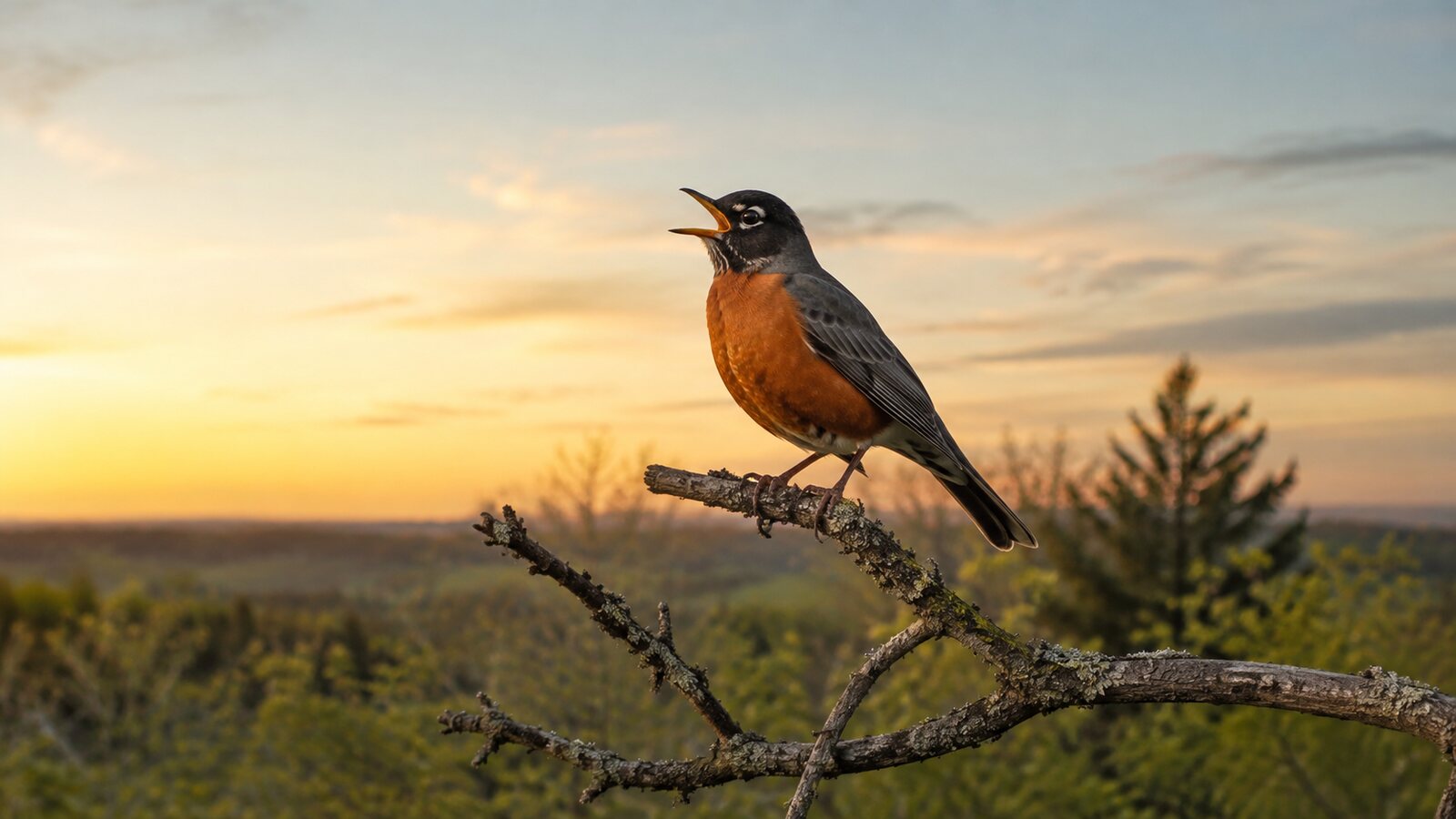
What is the dawn chorus?
The dawn chorus is the wave of bird song that builds around first light. It can begin before sunrise, with one or two species calling from the darkness, then grow into a wall of whistles, trills, chips, buzzes, and repeated phrases.
It is usually most noticeable during the breeding season. In much of Canada and the United States, spring and early summer mornings can be dramatically louder than winter mornings.
Birds sing to defend territory
A song can tell nearby birds, “This space is occupied.” That message may reduce the need for constant chasing and fighting. A male that sings from regular perches around its territory is broadcasting its presence to rivals.
This is one reason the same individual may return to a favourite exposed branch, roofline, fence post, or treetop and repeat the same song again and again. The perch is not random; it can be a good broadcasting point.
The broader guide to why birds sing separates territory, courtship, and other song functions from the special timing of the dawn chorus.
Birds also sing during courtship and breeding
Song can advertise a singer to potential mates. In many temperate North American songbirds, males do much of the most obvious territorial singing, but females also sing in many bird species. Bird song is more varied than the old idea that only males sing.
Because breeding drives so much of this behaviour, the timing of the dawn chorus changes through the year. A bird that sings constantly in April may become much quieter later in summer.
Why sing at dawn instead of later?
There probably isn’t one explanation that fits every species. Cornell Lab and other researchers have discussed several ideas, and some can operate at the same time.
One is that very low light makes feeding less efficient. Singing does not require a bird to see a caterpillar, seed, or tiny insect clearly, so the minutes before good feeding light arrives can be spent on communication.
Another idea is that early-morning air and lower background noise can help maintain a clear signal. The old claim that every song simply travels farther at dawn is too neat; research has found the story is more complicated. Clarity and consistency may matter as much as raw distance.
Singing first thing in the morning may also provide information about the singer’s condition. A bird that made it through the night and can spend energy on repeated song is sending a strong signal to neighbours.
Different species join the chorus at different times
The dawn chorus does not begin with every species at once. Some birds start in very dim light, while others wait until the sky is noticeably brighter.
Cornell has reported research linking the timing of first song with factors such as eye size and the height at which a species forages. A bird that can function in dimmer light may begin its dawn routine earlier.
For a backyard birder, this creates a fun clue: the first voice you hear each morning may be more predictable than you think.
An Eastern Phoebe can be one of the earliest spring voices around farms and wooded neighborhoods. In wetlands, a Red-winged Blackbird may deliver its territorial song from an exposed cattail.
Why are birds louder in spring?
Spring brings territories, courtship, nest building, and breeding. Birds that were quiet or loosely social in winter become much more focused on defending space and communicating with mates.
That doesn’t mean every sound is a song. Birds also give alarm calls, contact calls, begging calls, flight calls, and other vocalizations. Song is only one part of a much larger sound system.
Bird hearing is easy to overlook because the ears are hidden. If you’ve wondered how they hear all that singing, see do birds have ears?
Why do birds sing at 4 or 5 in the morning?
The clock time depends on sunrise, latitude, season, local light, and the species. In late spring at northern latitudes, dawn comes very early. A bird beginning before sunrise can easily be singing while people still think of it as the middle of the night.
Artificial light may also affect timing in towns and cities. Streetlights and other night lighting can shift daily behaviour in some species. Human noise can change when and how loudly urban birds sing as well.
Do birds sing all year?
Some vocalize throughout the year, but the loud dawn chorus is often strongly seasonal. Many species sing most during the breeding period and become quieter once territories and nesting demands change.
Calls can remain common even when full song drops off. Chickadees, nuthatches, crows, jays, and many other birds stay quite vocal in winter, but what they are saying and how they sound may be different.
Do female birds sing?
Yes. Female song is widespread, even though bird books and older studies often focused more heavily on male song in northern temperate species. In some species both sexes sing, and in others females have their own vocal roles.
If you hear a bird singing, sex can sometimes be inferred from the species and context, but it should not be assumed for every bird.
See how female song varies among birds, including the familiar Northern Cardinal.
Can morning songs help you identify birds?
Absolutely. Dawn can be the best time to learn the regular voices around your home because several birds are singing repeatedly from established locations.
Instead of trying to memorize the whole chorus, pick one sound. Listen for rhythm, repetition, pitch, and tone. Then connect that sound with a bird you can see. Cornell uses the same basic approach in its bird-song teaching.
Our bird identification by sound page gives a step-by-step way to break songs apart. You can also practise with chickadees, nuthatches, and titmice.
Why did the morning singing suddenly stop?
A quieter yard can reflect season, weather, time of day, nesting stage, a predator nearby, or birds moving out of the area. Many species become much less vocal after the breeding season.
Migration also changes the soundscape. The singer that woke you in May may be hundreds or thousands of kilometres away by winter. Our page on why birds migrate explains that seasonal movement.
Frequently asked questions
Why are birds so loud in the morning?
Dawn is a peak period for territorial and breeding communication, especially during spring. Many species are singing at once, which makes the whole neighbourhood sound louder.
What is the dawn chorus?
It’s the concentrated burst of bird song around first light, often beginning before sunrise and building as more species join in.
Why do birds start before sunrise?
Some species can begin communicating in very low light before feeding becomes efficient. The exact timing differs among species.
Do birds sing because they are happy?
It’s better not to translate bird song directly into a human emotion. Song has clear biological jobs such as territorial and breeding communication, even though people may find it cheerful to hear.
Do birds sing at night?
Some do. Nocturnal species are active after dark, and a few daytime species also sing at night under certain conditions. Most of the familiar spring chorus, though, is concentrated around dawn. See why birds chirp at night for nocturnal singers, migration calls, alarms, and artificial light.