
What is a thermal?
A thermal is a rising pocket or column of warmer air.
The sun heats the ground unevenly. A dark field, rocky slope, road, or bare patch can warm faster than nearby water or forest. Air touching the warmer surface heats, becomes less dense, and starts rising.
To us, that moving air is invisible. To a soaring bird, it can be a free elevator.
Why does a bird circle instead of flying straight up?
Because the strongest rising air is usually limited to a certain area.
If a hawk simply flew straight through a thermal, it would leave the lift behind. Circling keeps the bird inside the rising column for longer. Each turn can carry it a little higher.
Then the bird straightens out and glides away. Watch long enough and you may see the whole pattern: circle, climb, glide, repeat.
Which birds are most likely to circle on thermals?
Broad-winged soaring birds are the obvious ones.
Turkey Vultures, Black Vultures, Red-tailed Hawks, Broad-winged Hawks, eagles, storks, pelicans, and some cranes regularly use rising air. Their wing shapes let them stay aloft efficiently at relatively low speeds.
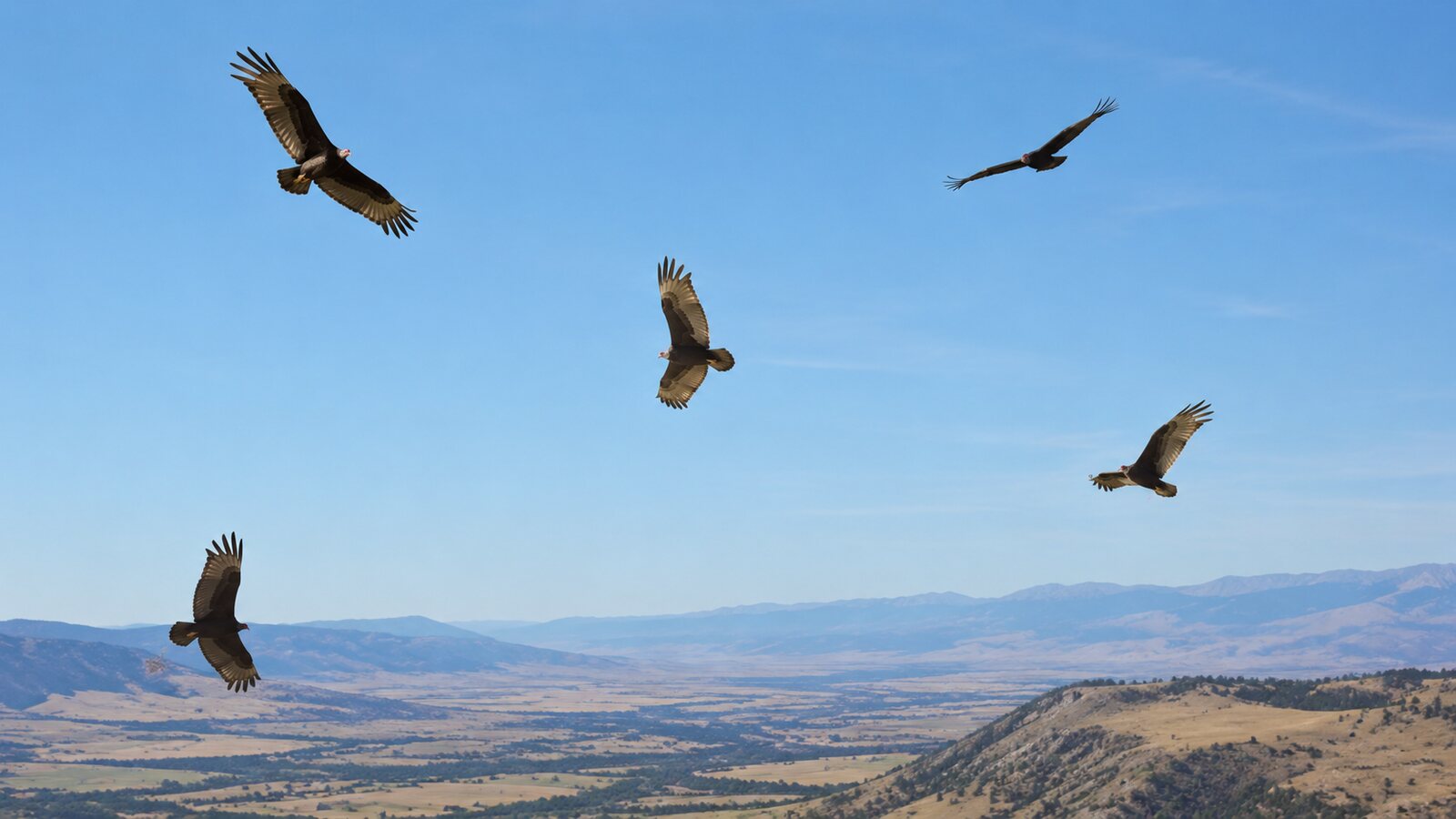
Turkey Vultures are especially easy to recognize. They often hold their wings in a shallow V and teeter slightly while circling.
Why do vultures circle so much?
Flapping big wings costs energy.
Vultures spend long periods searching huge areas for food. Thermals let them get high, scan farther, and travel with fewer wingbeats. Cornell describes Turkey Vultures as frequent thermal riders, and Audubon notes that obligate soaring birds depend heavily on these rising currents.
For a bird that may cover a lot of ground before finding a meal, saving energy is a big advantage.
What is a kettle of birds?
A kettle is a group of soaring birds circling together in rising air.
During raptor migration, dozens, hundreds, or even thousands of hawks and vultures can gather where thermals are strong. From below, the flock can look as if the sky itself is slowly boiling. That image is where the name comes from.
Birds can also watch one another to find good lift. One bird starts climbing, others notice, and the thermal suddenly becomes busy.
Do circling birds all turn the same way?
Often they do inside a busy thermal, but there is no permanent clockwise or counter-clockwise rule for all birds.
When many birds share the same rising air, matching the general direction reduces the chance of head-on conflicts. Wind, the shape of the thermal, and what other birds are already doing can affect the pattern.
Are birds flying in circles looking for food?
Sometimes, but the circle itself does not mean they found food.
A Turkey Vulture may be using the thermal to gain height while also scanning and smelling for carrion. A hawk may be travelling. An eagle may be moving between hunting areas. During migration, the birds might be hundreds of kilometres from where they will stop for the night.
The rising air explains the shape. The reason for the trip can be completely different.
Do vultures circle because something is dead below?
Not necessarily.
This is one of those ideas that sounds convincing because we see vultures around carcasses. But a group circling high overhead may simply be sharing a thermal. There does not have to be a dead animal underneath them.
If the birds begin descending toward one spot, then food becomes a more reasonable possibility.
Why are there more circling birds on warm sunny days?
Thermals usually become stronger after the sun has had time to heat the ground.
That is why raptors and vultures can seem quiet early in the morning, then suddenly appear overhead later. On cool, cloudy days the rising air may be weak or scattered, so birds have to flap more or wait for better conditions.
Do birds use thermals during migration?
Absolutely.
Many daytime-migrating raptors travel from one thermal to the next. They spiral upward, glide forward while slowly losing height, then find another rising column and climb again.
Cornell notes that hawks and vultures can cover very long distances this way with relatively few wingbeats. It is one reason major raptor migration routes concentrate where geography and weather produce dependable lift.
Do small birds fly in circles too?
They can, but not every circle is thermal soaring.
Swallows may loop while catching insects. Flocking birds can turn repeatedly while reorganizing. A territorial bird may circle an intruder. Birds approaching a roost or feeding area can also make several passes before landing.
Context matters. A big hawk slowly climbing with wings outstretched is a very different sight from a flock of swallows chasing insects.
Why do birds sometimes circle before landing?
They may be checking the landing area, losing height gradually, waiting for space, or lining up with the wind.
Waterfowl and gulls often make approach passes that look circular from below. The reason is control, not thermal lift.
Frequently asked questions
Why are hawks flying in circles?
Hawks commonly circle in thermals to gain altitude while using less energy than continuous flapping would require.
Why do vultures circle in groups?
Several vultures may use the same strong thermal. The circling group is called a kettle.
Does circling mean a storm is coming?
No reliable rule says it does. Bird soaring responds to local air movement and weather, but circling birds are not a dependable storm forecast.
How high can a thermal carry birds?
It varies with weather and location. Strong thermals can carry soaring birds thousands of feet upward. See how high birds can fly for a broader look at bird altitude.
Look for the climb
If you see a hawk or vulture making wide circles, pick a landmark in the sky and watch for a minute. The bird may look as if it is going around the same spot, but its altitude keeps changing. That is the giveaway.
Continue with how birds fly, why birds migrate, or return to Bird Facts.