
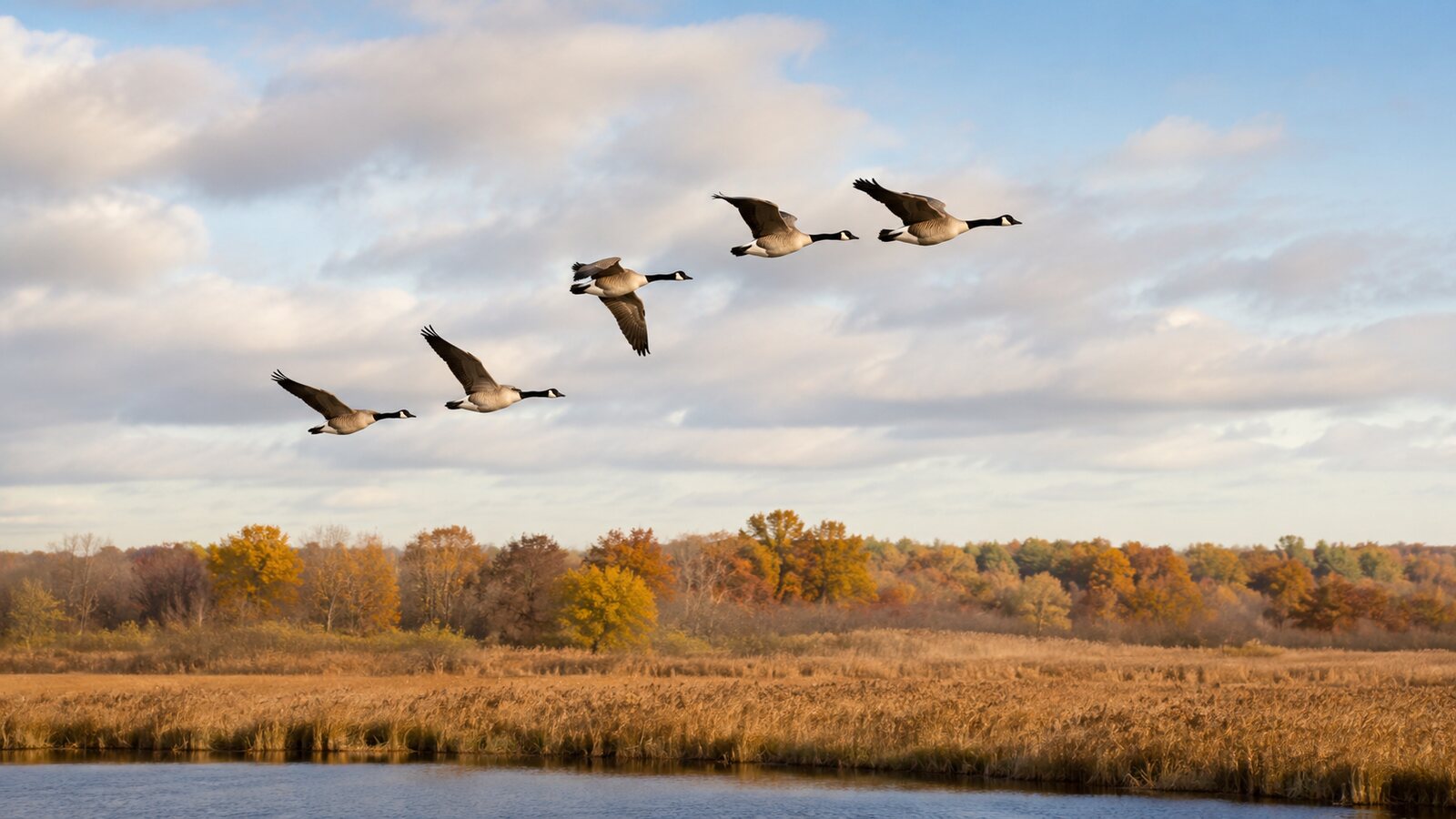
Food is one of the biggest reasons birds migrate
Imagine an insect-eating bird breeding in Canada or the northern United States. Summer can provide more insects than it could ever use. By late autumn, that food supply may collapse. The bird can stay and struggle, switch foods if its body and behaviour allow it, or move.
Many species evolved to move. Cornell Lab migration guidance describes seasonal access to food as a major driver, along with breeding sites and the long daylight available at northern latitudes in summer.
This also explains why two birds living side by side in July may behave very differently in January. A chickadee can find dormant insects, eggs, seeds, and other foods through winter. A bird that depends heavily on flying insects may have little reason to stay.
Birds also migrate to reach good breeding areas
Migration isn’t only a trip away from winter. Spring migration is a race back toward breeding habitat. Northern forests, grasslands, wetlands, tundra, and shorelines can produce an enormous seasonal burst of food and nesting space.
Long summer days give parents more hours to feed growing young. In some northern regions, daylight lasts well into the evening. That extra feeding time is part of the seasonal advantage migrants are travelling toward.
Do birds migrate because they are cold?
Not mainly. Feathers are excellent insulation, and many birds can handle freezing temperatures if they have enough food and a safe place to roost. Think of chickadees, nuthatches, woodpeckers, finches, and other small birds that remain through cold northern winters.
Cold matters indirectly because it changes the landscape. Insects disappear, water freezes, snow covers food, and plants stop producing. A bird may be physically able to survive the temperature but unable to find enough calories.
Not every bird migrates
Bird migration is a spectrum, not an on-off switch. Some species remain in roughly the same area all year. Others travel thousands of kilometres between breeding and wintering grounds. See why some birds stay through winter for the resident side of this seasonal choice.
Not every migrant crosses a continent. Some move only a few hundred kilometres. Others move downhill for winter, and in some populations only part of the group migrates.
Even one species can behave differently in different parts of its range. A population in Canada may migrate while birds of the same species farther south remain year-round.
Why do some migrating birds travel in flocks?
Travelling with other birds can add safety and social information. For species that use formation flight, it can also save energy. But migration flocks vary enormously. A loose stream of songbirds is not organized like a V of geese.
See why birds fly in a V for the aerodynamics, or why birds flock together for the bigger social question.
How do birds know when to migrate?
Birds don’t wait for the first snowstorm and suddenly decide winter has arrived. Seasonal changes in daylight help set internal biological changes in motion. Hormones, fat storage, restlessness, and other changes prepare migrants for travel. Our guide to how birds time migration explains these cues in more detail.
Weather then affects the exact timing. A favourable tailwind may produce a huge night of migration, while strong headwinds or storms can keep birds grounded. Food conditions also influence how long birds remain at a stopover.
How high do migrating birds fly?
Often higher than we realize. Much of migration happens within the first few thousand feet above the ground, but altitude changes with species, geography, weather, and especially wind. Some exceptional flights go far higher.
See how high birds can fly for migration ranges and the extreme altitude records.
How do birds know where to go?
Navigation is one of the remarkable parts of migration. Different species use a mix of inherited information and learned experience. Birds can use the sun, stars, Earth’s magnetic field, landmarks, and in some species smell and other cues.
A young bird making its first migration may have an inherited direction and distance built into its behaviour. Older birds can become more experienced with routes, stopover sites, and local geography. Learn how these tools combine in the bird migration navigation guide.
Why do many birds migrate at night?
Most small songbird migration happens at night. Night air is often cooler and calmer, which can make long flights easier. Darkness also reduces exposure to some daytime predators, and travelling at night leaves daylight available for feeding and rebuilding fat stores.
But plenty of birds migrate in daylight. Hawks and other soaring raptors use rising warm air. Swallows and some other aerial feeders can move while feeding. Waterfowl may migrate by day or night depending on species and conditions. Compare these patterns on the night migration guide.
How far do birds migrate?
The range is enormous. Some birds shift only from a mountain slope to a nearby valley. Others cross countries, oceans, and hemispheres. Cornell notes that more than 300 North American bird species are long-distance migrants.
Distance alone doesn’t tell you how hard the trip is. A small bird may need to cross the Gulf of Mexico without landing, while another migrates in shorter stages through a chain of rich feeding areas. See how migration distances compare.
Why stopover habitat matters
Migration is not one endless flight for most birds. They need places to rest and refuel. A patch of woodland, wetland, shoreline, grassland, or urban green space can become a temporary home for birds that will be hundreds or thousands of kilometres away a week later.
That is why migration can suddenly fill a familiar park with unfamiliar birds. The birds haven’t necessarily moved in. They may be stopping for a day or two before continuing.
Why birds seem to disappear from the yard
A seasonal drop in feeder activity doesn’t always mean something is wrong. Migration, natural food crops, breeding behaviour, weather, and dispersal can all change which birds you see.
If feeder traffic changes suddenly, our page on why birds stopped visiting your feeder walks through the most common possibilities. The birds by region section can also help you think about location and season together.
Migration changes bird identification too
Season is one of the strongest identification clues you have. A bird that is common in May may be impossible in January, while a winter visitor may disappear before spring is fully underway.
Range maps work best when you read the seasonal colours rather than treating a species as simply present or absent. Combine location and date with size, shape, behaviour, field marks, and sound. Our bird identification guide brings those clues together.
Long migration also raises a simple question: do birds get tired of flying? Most do, and stopover habitat is part of how they manage the trip.
Frequently asked questions
Why do birds migrate south?
In North America, south often means moving toward more dependable winter food and habitat. But not every migration runs north to south. Some birds move east or west, down mountains, along coasts, or between inland and coastal regions.
Do all birds migrate?
No. Some species are year-round residents, some are partial migrants, and others make short or very long seasonal journeys.
How do birds know when to migrate?
Changing daylight helps drive the seasonal cycle, while weather and food conditions can influence the exact departure time.
Why do birds migrate at night?
Night can provide cooler, calmer conditions and fewer daytime predators, while letting birds use daylight for feeding. Many species still migrate during the day.
Do birds return to the same place every year?
Many do show strong site fidelity to breeding, wintering, or stopover areas, but the pattern varies by species and individual. Habitat change can also force birds to adjust.