
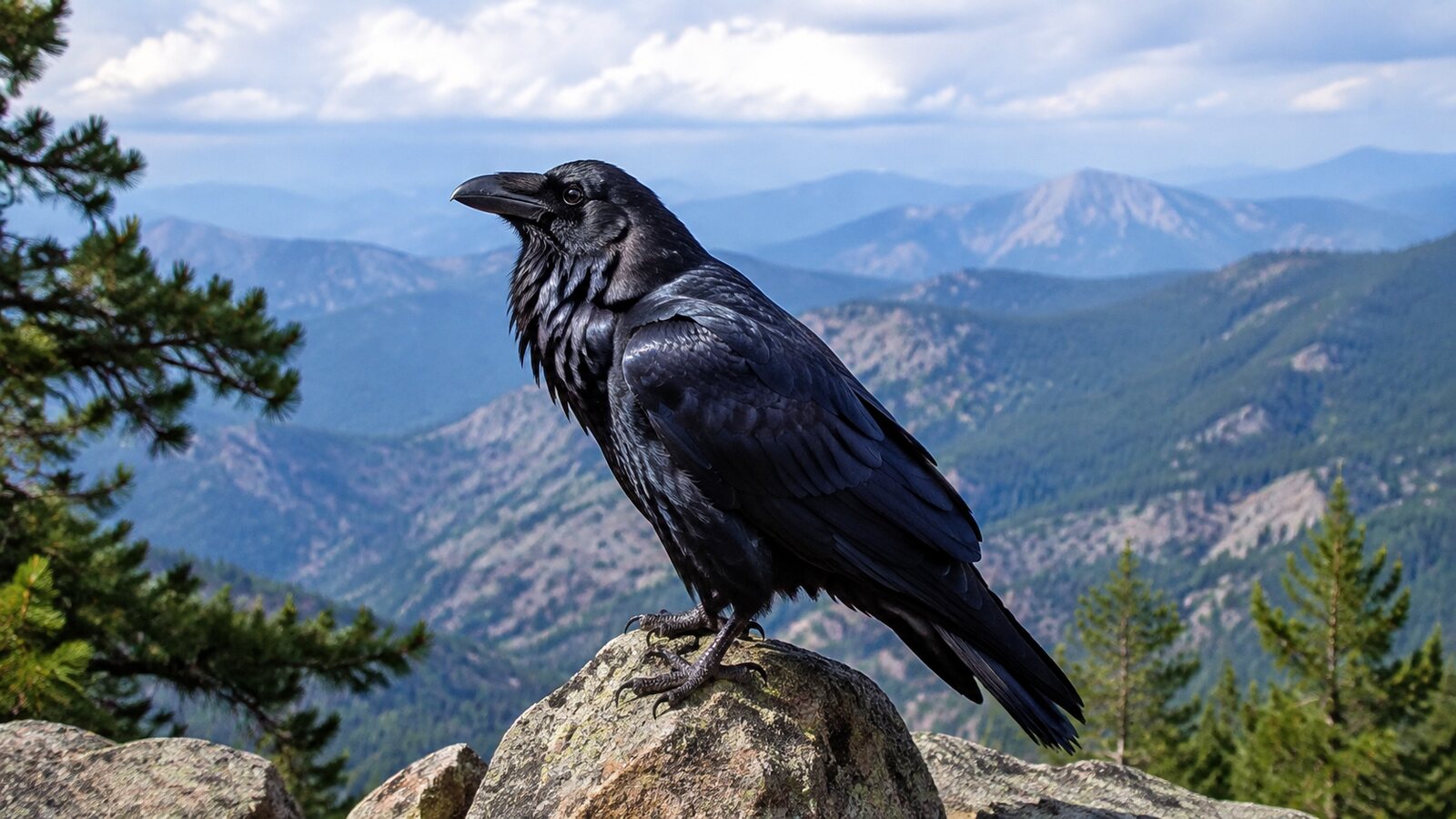
How to identify a Common Raven
A raven can look enormous when it passes close by. Cornell lists Common Ravens at roughly 22 to 27 inches long, with a wingspan around 46 inches. That puts them in a very different size class from most songbirds, even though ravens are technically songbirds too.
The plumage is entirely black. So are the bill, legs, and eyes.
The best shape clues are the big head, thick neck, heavy bill, shaggy throat, long wings, and long tail. In flight, that tail often narrows into a wedge.
Do not rely on black colour alone. Plenty of birds are dark. The raven's proportions are what make it look so powerful.
Listen for the croak
The classic raven call is deep and resonant. Croak is the word most people use, although a real raven has far more sounds than one word can capture.
Common Ravens produce a wide range of calls, from low gurgles to harsh grating sounds and sharp alarm notes. Cornell notes that researchers have divided raven vocalizations into dozens of categories.
The common croak can carry a long way. If a black bird overhead sounds low, throaty, and almost hollow, raven should be high on your list.
Ravens can be graceful in flight
This is where the bird stops looking heavy.
Common Ravens often mix slow wingbeats with gliding and soaring. They can ride rising air, bank sharply, roll, dive, and play in wind in ways that look closer to a raptor than a crow.
American Crows can glide too, but their normal travel flight often has steadier flapping. A raven is more likely to show long, easy stretches of soaring.
Where Common Ravens live
Common Ravens have an enormous range across the Northern Hemisphere. In North America, they are especially widespread across western and northern regions, with populations also returning to parts of the Northeast.
Habitat can be almost anything: mountain forest, coast, tundra, grassland, sagebrush, high desert, farmland, rural settlement, or even a city in the right region.
They are particularly comfortable in open country with cliffs, tall structures, trees, or other good nesting and lookout sites.
What Common Ravens eat
Ravens are opportunistic omnivores and excellent scavengers.
They eat carrion, insects, eggs, small mammals, birds, fish, grains, fruit, pet food, garbage, and human food. A raven that finds a large food source may hide some for later.
They also watch other animals. A raven may follow predators, people, or other birds when doing so creates a chance to find food.
That flexibility helps explain why ravens can live in habitats that seem completely different from one another.
Where do ravens nest?
Common Ravens build large stick nests on cliffs, in trees, and on human structures such as towers, bridges, poles, and billboards.
The female does most of the detailed nest construction. The finished structure can be huge, with a deep inner cup lined with softer material such as grass, bark, wool, fur, or mud.
Cornell lists typical clutches at three to seven eggs, with incubation around 20 to 25 days. Young ravens remain in the nest for several more weeks.
Some nest structures are reused from year to year, though not always by the same pair.
Raven pairs and social life
Common Ravens are usually less social than American Crows. Adults are often seen alone or in pairs, and established pairs may remain together through the year.
Large gatherings still happen. Food can bring ravens together at carcasses, landfills, or other rich feeding sites. Groups of younger, unpaired birds may also gather.
They are curious, playful, and capable problem solvers. Young ravens investigate unfamiliar objects, and adults cache food for later.
Our pages on bird intelligence, bird problem-solving, and bird play look at those behaviours more broadly.
Common Raven vs American Crow
If you only remember four clues, use these: size, voice, bill, and tail.
Ravens are bigger. Their bills are heavier. Their common calls are deeper. Their tails are wedge-shaped.
American Crows are smaller, with more moderate bills, familiar caws, and rounded or squarer tails.
There are more clues, of course. See Crow vs Raven: What's the Difference? for the full comparison.
How long do Common Ravens live?
Wild ravens face high mortality when young, but survivors can live for many years. Banding records show that some Common Ravens reach well beyond a decade in the wild.
As with other birds, the oldest recorded individual is not the same thing as a normal lifespan. It shows what is possible under good circumstances.
Frequently asked questions
Is a raven just a large crow?
No. Common Ravens and American Crows are separate species in the same family and genus. Size is one clue, but voice, bill, throat feathers, tail shape, and flight are different too.
Do ravens live in cities?
They can. Ravens often do well around people, especially in western and northern North America. In many larger towns and cities, American Crows are more common, but ravens occur in some urban areas.
Are ravens intelligent?
Yes. Ravens have performed impressively in studies of problem solving, social behaviour, memory, caching, and other cognitive tasks. Intelligence is complicated, but ravens are clearly flexible learners.
Do ravens mate for life?
Ravens can form long-term pair bonds, and pairs may remain together throughout the year. As with other birds, a long pair bond does not mean every detail of mating behaviour is identical across every individual or population.
More crow and raven pages
Continue with American Crow, Crow vs Raven, Do Birds Play?, Do Birds Grieve?, or browse all Common Birds.