
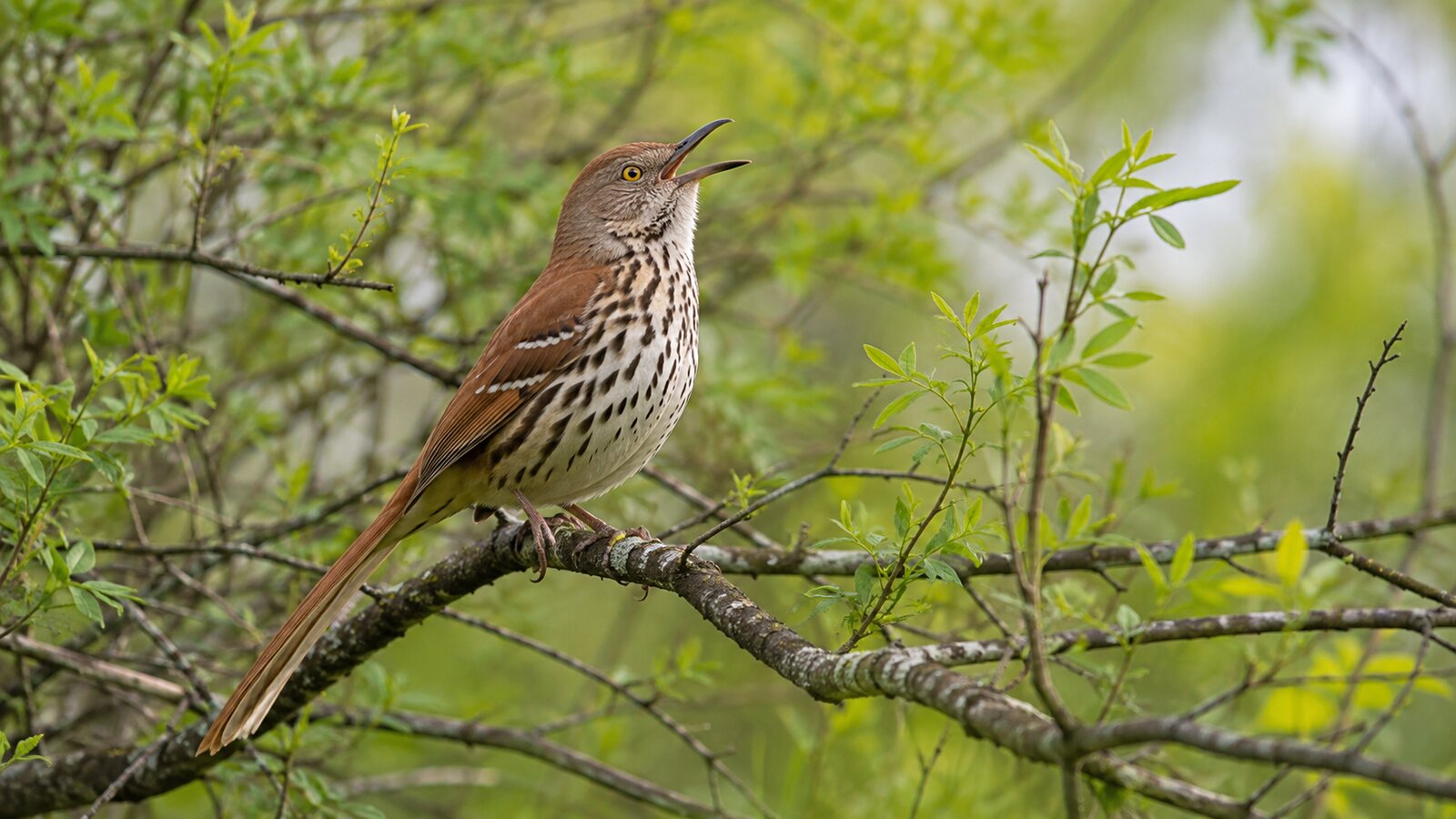
How to identify a Brown Thrasher
Brown Thrashers have foxy brown backs, two pale wing bars, a pale belly covered in heavy dark streaks, and a long reddish tail. The bright yellow eye and long, gently downcurved bill help separate adults from similar birds.
Males and females look alike. Young birds are duller, with grayish eyes and softer markings. On the ground, a thrasher often sweeps its bill through dead leaves in quick side-to-side strokes.
Brown Thrasher size and wingspan
Adults are about 23 to 30 cm long, weigh roughly 61 to 89 g, and have a wingspan near 29 to 32 cm. They are larger and more strongly streaked than most thrushes.
The long tail can make the bird look even bigger. It may hold the tail slightly raised while moving through brush or running across an opening.
What does a Brown Thrasher sound like?
A male Brown Thrasher sings a long stream of whistles, trills, squeaks, and rough notes. Most phrases are repeated twice before the bird switches to a new sound, a useful pattern for separating it from the Northern Mockingbird, which often repeats phrases three or more times.
Calls include a sharp, harsh smack that can resemble an exaggerated kissing sound, along with chirrups, rattles, and hisses. Listen from shrub edges in spring, then use the guide to identifying birds by sound to compare pace, repetition, and tone.
Habitat, range, and migration
Brown Thrashers use dense shrubs, woodland edges, overgrown fields, hedgerows, and brushy yards across eastern and central North America. They can be hard to see even when singing nearby.
Northern populations usually migrate south for winter, while many birds in the southeastern United States remain year-round. Migration distance varies across the range.
What do Brown Thrashers eat?
Brown Thrashers eat insects, beetles, caterpillars, spiders, snails, berries, acorns, and other plant foods. Much of their food is found by turning and sweeping leaf litter.
They are not regular feeder birds, though they may visit yards with dense cover, fallen leaves, berry shrubs, or ground-level food. Leaving some natural leaf litter gives them a place to forage.
Nesting, eggs, and young
Both adults help build a bulky cup nest in a dense shrub, small tree, vine tangle, or occasionally on the ground. Twigs form the outer structure, with a finer inner lining.
A clutch often contains two to six pale bluish or greenish eggs with reddish-brown marks. Incubation lasts about 11 to 14 days, and young usually leave the nest roughly 9 to 13 days after hatching.
Similar birds and lifespan
The Gray Catbird is plain slate gray and gives a cat-like call. The Northern Mockingbird is pale gray with bold white wing patches. Brown Thrashers are rustier, more heavily streaked, and usually stay closer to dense cover.
The oldest recorded Brown Thrasher was at least 10 years and 11 months old. That record does not describe the usual lifespan of a wild bird.
Why the Brown Thrasher sings
The male’s varied spring song advertises a territory and helps attract a mate. It is a strong example of why birds sing, while the paired phrases make it useful practice for learning repetition by ear.
Frequently asked questions
Do Brown Thrashers mimic other birds?
Yes. They can copy sounds, but their paired phrases and rich mix of original notes often make the overall pattern recognizable.
Do male and female Brown Thrashers look different?
They look alike. Singing behavior is usually more useful than plumage for identifying a male.
Will Brown Thrashers visit a bird feeder?
They are uncommon at raised seed feeders. They are more likely to use brushy yards with leaf litter, berries, and food near the ground.
More familiar birds
Use the thrasher, catbird, and mockingbird comparison, or browse more common birds.