
How to identify a Gray Catbird
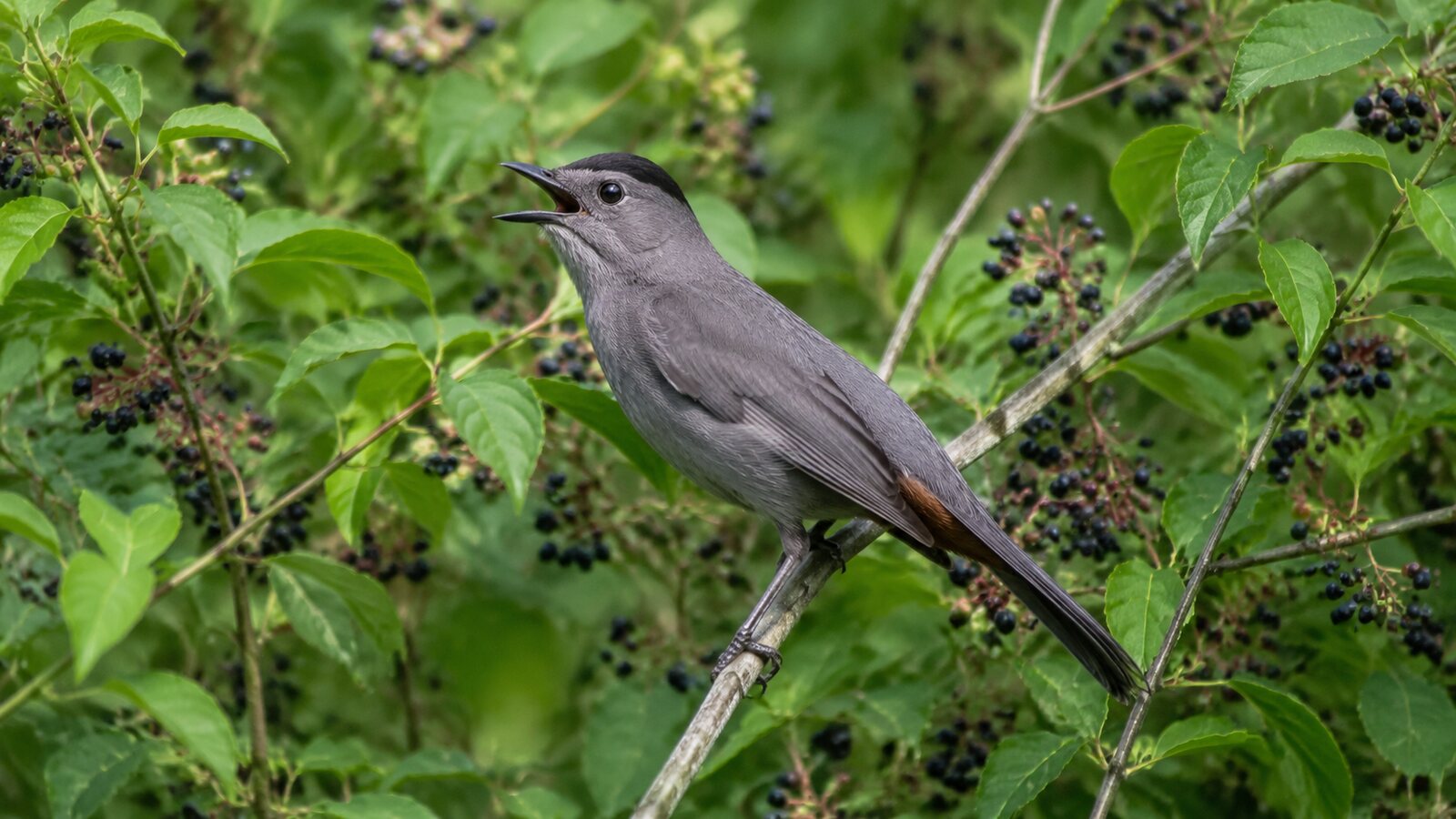
Gray Catbirds are nearly uniform slate gray, with a small black cap and dark tail. The rusty patch beneath the tail is easy to miss unless the bird turns, raises its tail, or flies.
The bill is slim and dark. Males and females look alike. Juveniles are duller, with a less distinct cap and softer-looking plumage. Catbirds often stay inside cover, hopping through branches or dropping to the ground beneath shrubs.
Gray Catbird size and wingspan
Adults are about 21 to 24 cm long with a wingspan around 22 to 30 cm. They are close to a Northern Cardinal in body length but slimmer, grayer, and longer-tailed.
The smooth gray body separates them from most streaked or spotted thrush-like birds. A Northern Mockingbird is paler, often shows white in the wings, and spends more time in open areas.
What does a Gray Catbird sound like?
The best-known call is a rough, nasal mew that can sound surprisingly cat-like. It may come from deep inside a shrub where the bird is difficult to see.
The male song is a long, varied series of whistles, squeaks, chatters, and imitations. Unlike a Northern Mockingbird, which often repeats a phrase several times, a catbird tends to move quickly from one sound to the next. A female may give a quieter song near her mate or nest.
Use the practical guide to identify birds by sound, and remember that “chirping” can include many short calls with different jobs.
Habitat, range, and migration
Gray Catbirds breed across much of southern Canada and the United States. Dense shrubs, woodland edges, regenerating forest, gardens, streamside tangles, and overgrown fields are good places to look.
Most northern birds migrate to the southeastern United States, Caribbean, Mexico, or Central America. Some remain year-round along parts of the Atlantic and Gulf coasts.
What do Gray Catbirds eat?
Catbirds eat beetles, ants, caterpillars, grasshoppers, spiders, and other invertebrates. Fruit becomes especially important later in summer and during migration.
Native dogwoods, serviceberries, elderberries, and other fruiting shrubs can attract them. They may visit fruit or jelly offerings, but dense natural cover is usually more important than a feeder.
Nesting, eggs, and behavior
The female builds a bulky cup nest in dense shrubs, small trees, or vines. A clutch commonly contains one to six turquoise-green eggs. Incubation lasts about 12 to 15 days, followed by roughly 10 to 11 days in the nest.
Catbirds forage on the ground and in low vegetation, often turning leaves with the bill. They can be curious and may approach a quiet observer while staying partly hidden.
Similar birds and lifespan
Northern Mockingbirds are lighter gray with obvious white wing and tail patches. Townsend’s Solitaires are slimmer, have pale eye rings, and are associated more with western mountain habitats.
The oldest recorded Gray Catbird was at least 17 years and 11 months old. Most wild birds live much shorter lives.
Why catbirds copy other sounds
Gray Catbirds belong to the same family as mockingbirds and thrashers. Their songs can include sounds learned from other birds. The syrinx gives songbirds fine control over complex notes, as explained in how birds make sounds.
Frequently asked questions
Why is it called a Gray Catbird?
Its common call is a nasal mew that sounds much like a cat.
Do Gray Catbirds visit feeders?
They rarely use seed feeders, but may come for fruit or jelly. Native fruiting shrubs and dense cover are better attractions.
Do female Gray Catbirds sing?
Females can give a quieter song, especially near a mate or nest, although males produce most of the loud territorial song.
More familiar birds
Use the thrasher, catbird, and mockingbird comparison, hear the Common Yellowthroat, or browse Bird Guides.