
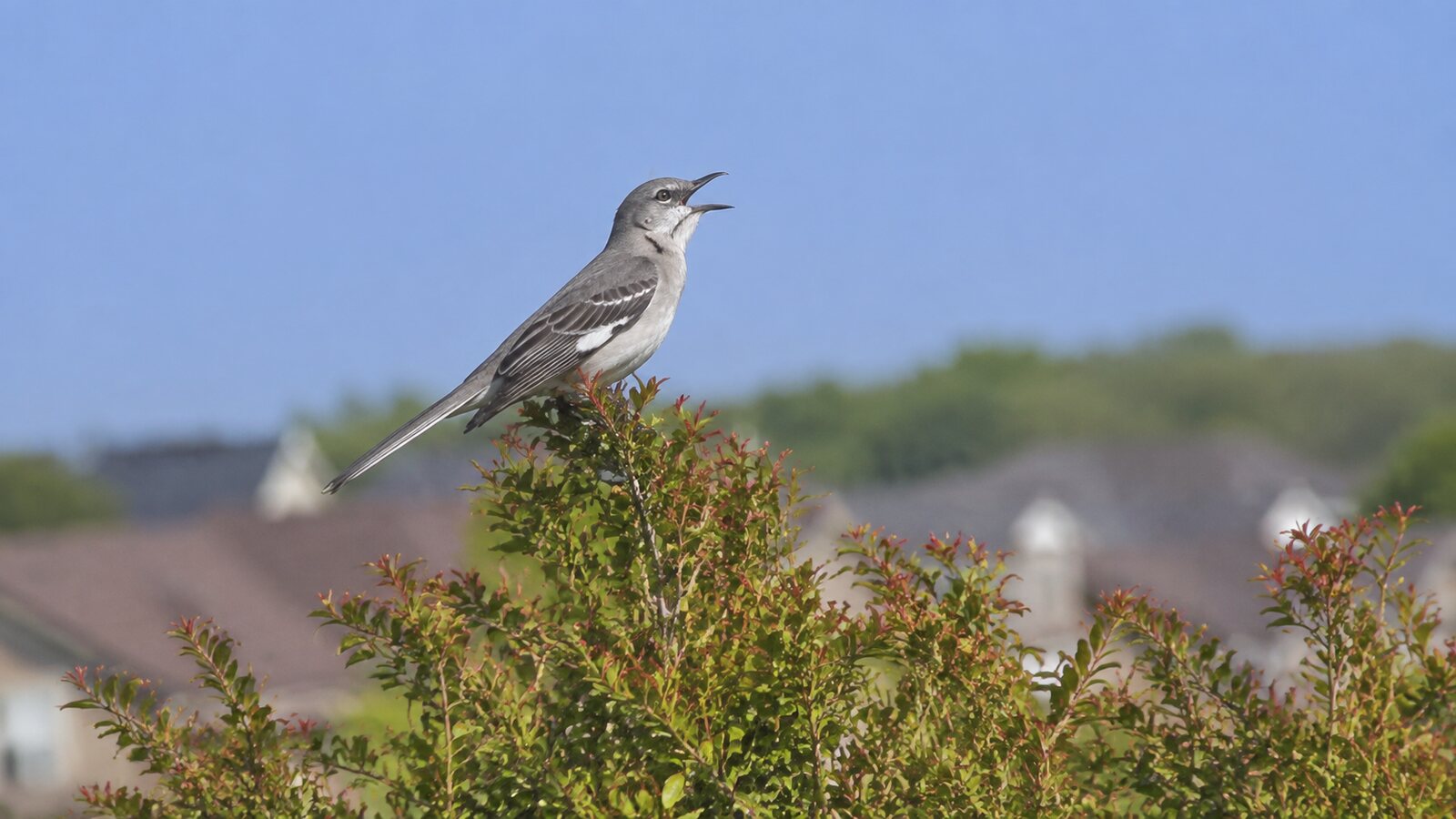
How to identify a Northern Mockingbird
Northern Mockingbirds have gray upperparts, whitish underparts, long tails, slim dark bills, and pale eyes. Broad white patches show in the wings, especially when the bird flies or raises them. White outer tail feathers are also noticeable in flight.
Males and females look alike. Juveniles have a spotted chest and can look less sleek than adults. On the ground, mockingbirds run, hop, stop sharply, and may lift or flash the wings.
Northern Mockingbird size and wingspan
Adults are about 21 to 26 cm long with a wingspan around 31 to 35 cm. They are close to an American Robin in length but slimmer, longer-tailed, and much grayer.
A Gray Catbird is darker and lacks the bold white wing patches. Shrikes have stronger hooked bills and black masks.
What does a Northern Mockingbird sound like?
A mockingbird strings together clear whistles, rasps, trills, calls, and imitations of other birds. One of the best clues is repetition: a phrase is often given two to six times before the singer changes to another sound.
Males sing from exposed perches through much of spring and summer, and some unmated males sing at night. Females sing too, usually more quietly and especially during fall. The page on female bird song explains why singing should not automatically be assigned to a male.
When many different birds seem to be calling from one spot, pause and check whether a single mockingbird is performing the whole sequence. Use pitch, rhythm, repetition, and habitat to confirm it.
Habitat, range, and year-round status
Northern Mockingbirds are common across much of the United States, southern Canada in smaller numbers, Mexico, and the Caribbean. They favor open ground mixed with shrubs, trees, hedges, and human structures.
Most stay in the same broad area year-round. Parks, suburbs, farms, cemeteries, roadsides, and brushy open country can all support them.
What do Northern Mockingbirds eat?
Insects and other invertebrates are important in spring and summer. Fruit becomes a major food in fall and winter. Mockingbirds may defend a fruiting tree or shrub from other birds.
They rarely use ordinary seed feeders. Native fruit-bearing shrubs, open foraging ground, and dense nesting cover are better ways to make a yard attractive.
Nesting, eggs, and territorial behavior
The male usually starts an open cup nest in a dense shrub or tree, and the female completes the lining. A clutch often has two to six pale blue or greenish eggs marked with reddish-brown spots. Incubation is about 12 to 13 days, and young remain in the nest around 12 to 13 days.
Mockingbirds defend nests, feeding areas, and territories boldly. They chase crows, hawks, cats, and people that come too close. Their wing-flashing display may help startle insects from the ground. See how breeding and feeding territories differ.
Song learning, people, and lifespan
A male can learn around 200 song types over his life and may keep adding new sounds. The result is a changing repertoire rather than one fixed song. This connects directly with territory and mate attraction.
Wild Northern Mockingbirds in a controlled study quickly learned to distinguish people who repeatedly approached their nests. The broader guide to how birds recognize people explains what that result shows and what it does not.
The oldest recorded Northern Mockingbird was at least 14 years and 10 months old.
Frequently asked questions
Why do mockingbirds copy other birds?
Imitation becomes part of a large learned song repertoire used in territorial and breeding communication.
Why does a mockingbird sing at night?
Unmated males are frequent nighttime singers, especially during the breeding season. Bright moonlight and artificial light may also affect timing.
Do Northern Mockingbirds visit feeders?
They seldom use seed feeders. Fruiting native plants and open ground are more likely to attract them.
More familiar birds
Use the thrasher, catbird, and mockingbird comparison, listen for the Eastern Phoebe, or continue with bird identification by sound.