
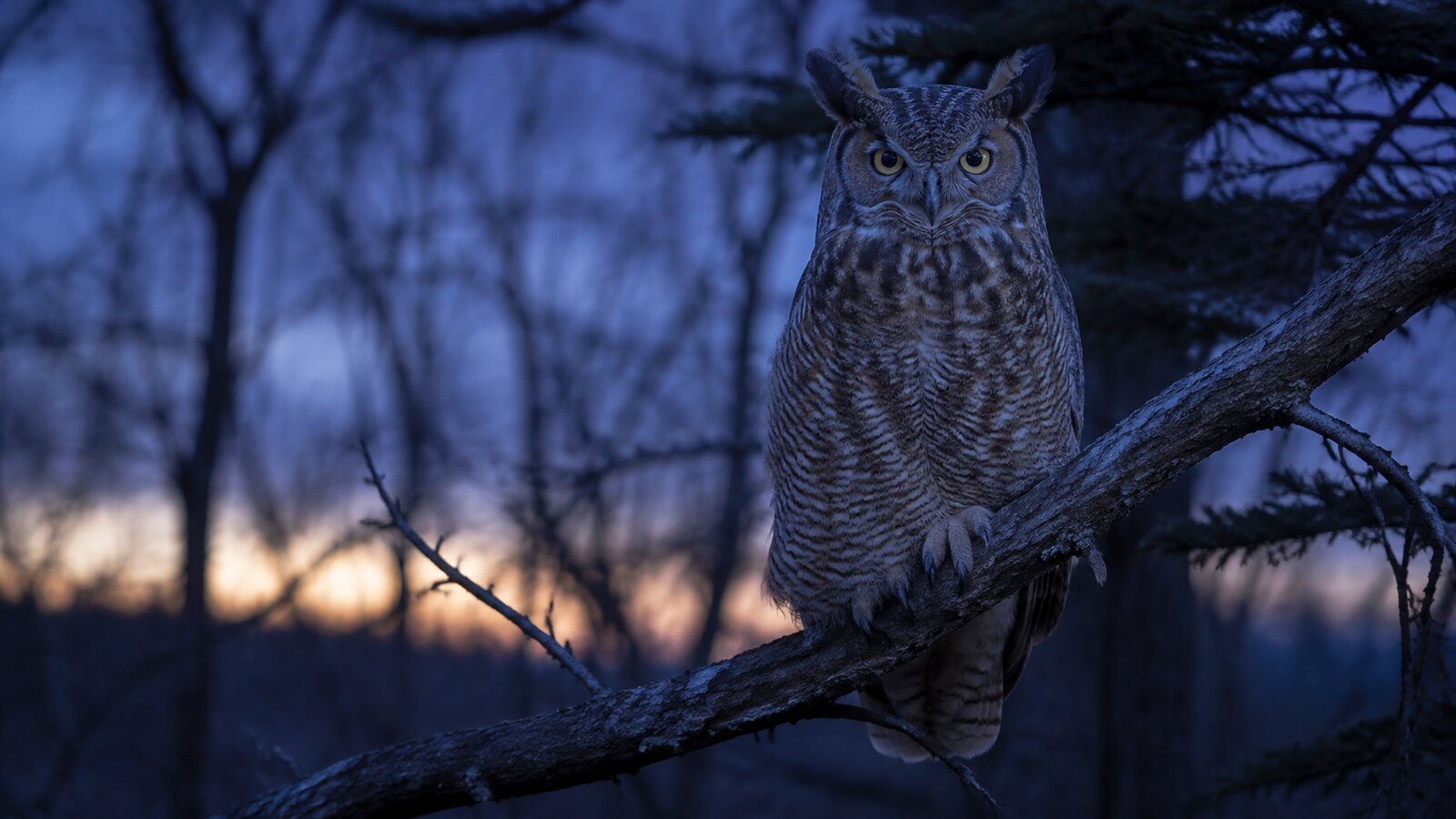
Can owls really see in the dark?
They can see in very dim light.
That is a better way to say it.
Owls have eyes designed for low-light conditions, so a scene that looks nearly black to us may still contain enough light for an owl to detect movement and shape.
But complete darkness contains no visual information. If there is truly no light reaching the eye, vision cannot do the job.
What makes owl eyes good at night?
Size is part of it. Large eyes gather more light.
Owls also have pupils that can open widely and retinas with many rod cells. Rods are photoreceptors that are especially sensitive in low light.
The tradeoff is that an eye optimized for faint light is not necessarily optimized for the same colour detail and sharp daylight vision that some diurnal birds have.
Different birds are built around different visual problems.
Can owls hunt in complete darkness?
Some can still catch prey when vision is unavailable, but hearing deserves the credit.
Barn Owls are famous for locating small mammals by sound. Their facial feathers help direct sound toward the ears, and the auditory system can pinpoint prey with astonishing precision.
Laboratory work has shown that Barn Owls can strike prey in total darkness.
That is not super-powered eyesight. It is extraordinary hearing.
Can regular backyard birds see at night?
Yes, but most are much better in daylight.
A chickadee, robin, sparrow, or finch can still respond to movement and light after sunset. That does not mean it sees the nighttime world like an owl.
Most familiar feeder birds settle into sheltered roosts when light levels fall.
That is one reason where do birds sleep at night? has so many different answers.
What birds are active at night?
Owls are the best-known group, but they are not alone.
Nightjars such as Common Nighthawks and whip-poor-wills are active in low light. Some herons feed after dark. Shorebirds can forage at night. Seabirds may travel or return to colonies under darkness.
Then there are migrating songbirds, many of which travel at night even though they spend their normal waking hours in daylight.
How do migrating birds fly at night?
Vision is only part of the navigation system.
Night migrants can use stars, landscape cues, the Earth’s magnetic field, wind, and inherited directional information. The exact mix varies among species.
They also do not need to see every branch and leaf the way a bird moving through a forest canopy does. Much of migration happens in open air high above the ground.
Read why do birds migrate? for the bigger seasonal picture.
Do birds see better than humans at night?
Some do. Some do not.
An owl has a clear advantage over us in dim conditions. A strongly daytime-adapted bird may not.
It is tempting to say birds have better eyesight than humans, full stop. Bird vision is too diverse for that.
Eagles excel at fine detail in daylight. Owls excel in low light. Some birds see ultraviolet. Each visual system has its own strengths.
Can birds see colour at night?
Colour vision becomes harder as light fades because rod cells dominate low-light vision and are not the main system for colour discrimination.
That means even a bird capable of excellent colour vision during the day may rely more on brightness, contrast, shape, and movement after dark.
The answer also varies by species and light level.
For daytime colour vision, see can birds see colour?.
Why do owl eyes look so large?
Large eyes collect more light and create a larger retinal image.
In many owls, the eyes are elongated rather than shaped like neat little balls. They fit tightly in the skull and do not rotate freely in their sockets.
That helps explain the famous owl head turn. If the eyes cannot swing around the way ours do, the head has to do more of the aiming.
Why are owl eyes facing forward?
Forward-facing eyes create a large area of binocular vision, where both eyes view the same part of the scene.
That helps with judging distance when striking prey.
Many prey species have eyes set farther to the sides, gaining a wider field of view instead. Again, different visual problems produce different designs.
Can artificial light affect birds at night?
Yes.
Bright artificial lighting can change bird behaviour and interfere with natural nighttime conditions. Migrating birds may be attracted to or disoriented by intense lights, especially around buildings and during poor weather.
Artificial light can also influence singing, feeding, and sleep timing in some species.
This is one reason nighttime bird activity can feel different in a city than in a dark rural area.
Why do birds sometimes chirp at night?
Night vision is only one part of that question.
Nocturnal birds are naturally active. Migrants call while moving overhead. Young birds beg. Territorial birds may sing around dawn or under artificial light.
If a bird wakes you up at 2 a.m., our why do birds chirp at night? page is the better next stop.
Frequently asked questions
Can birds see in complete darkness?
No eye can see without light. Some birds can still function in total darkness by relying heavily on hearing and other senses.
Which birds have the best night vision?
Owls are among the strongest low-light specialists, although many other nocturnal birds also have large, light-sensitive eyes.
Can robins see at night?
They can see under some low-light conditions, but robins are mainly daytime birds and are not specialized for owl-like night vision.
Can birds see through darkness better than cats?
It depends on the bird. Comparing entire groups with one ranking is misleading because low-light ability varies widely among bird species.
Keep following the question
Compare this low-light specialty with the broader guide to bird eyesight, then see why many songbirds migrate at night and where birds sleep after dark.
Read do birds have eyelids?, can birds see colour?, or return to the Bird Facts hub.