
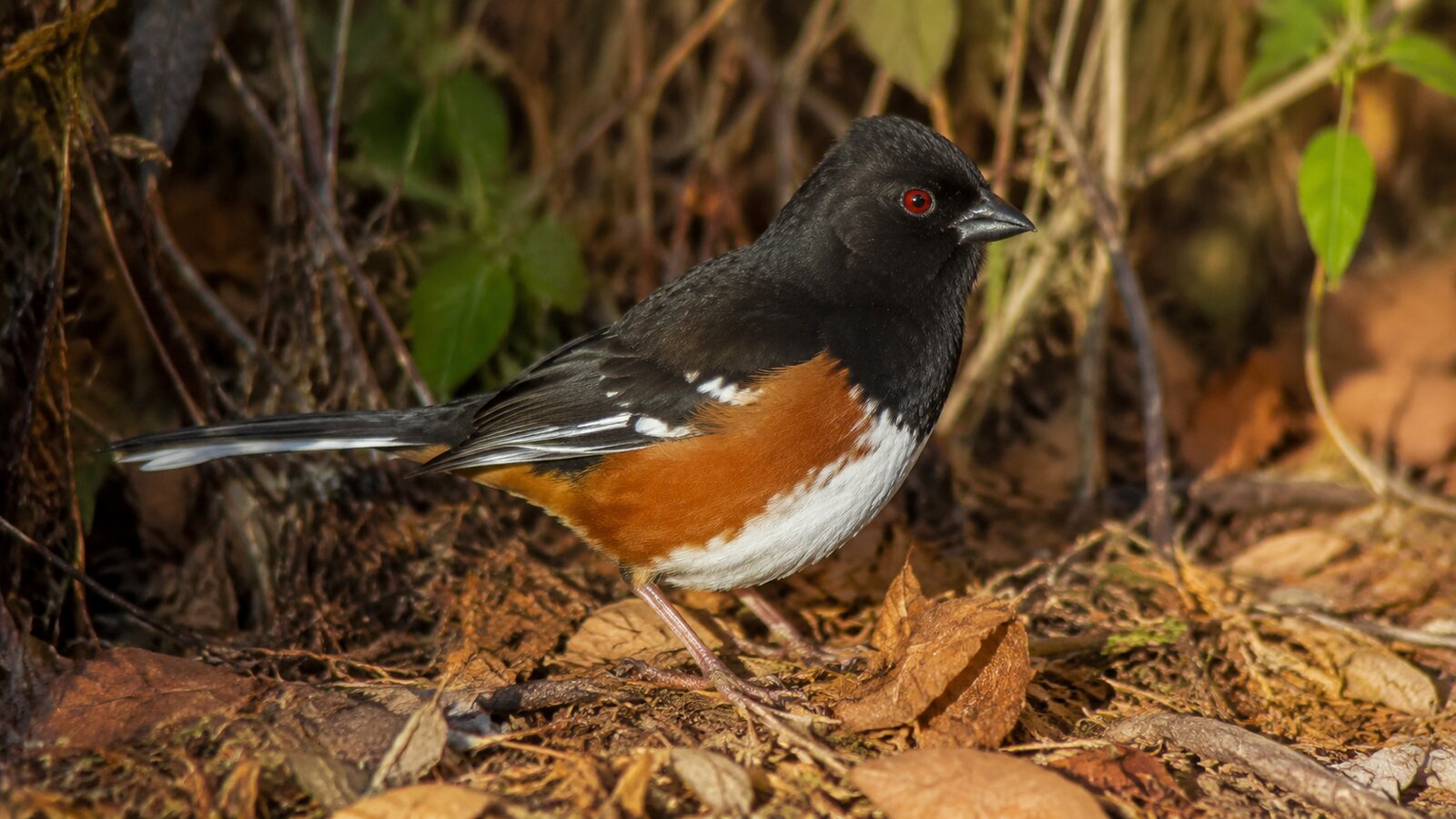
How to identify an Eastern Towhee
Adult males have a black head, throat, back, wings, and tail. The sides are rich rusty orange and the belly is white. White patches show in the wings and tail. In most of the range, the eyes are red.
Females replace the male’s black with warm brown but keep the rusty sides and white belly. Juveniles are brown and heavily streaked, so shape, habitat, and behavior become more important.
Eastern Towhee size and wingspan
Adults are about 17 to 23 cm long with a wingspan around 20 to 30 cm. They are much larger and heavier than a Song Sparrow, with a thick bill and long rounded tail.
At first glance, a male can suggest an oriole or robin because of its orange sides. The white belly, dark hood, leaf-scratching behavior, and thick sparrow bill point to a towhee.
What does an Eastern Towhee sound like?
The familiar call is a sharp, rising note often written as chewink or tow-hee. It can sound rougher and more forceful than a simple sparrow chip.
The male song starts with a clear phrase and ends in a musical trill. Many people remember it with “drink your tea,” but rhythm and tone are safer clues than the exact words. Males repeat the song from exposed branches during breeding season.
Listen from the edge of dense cover, then watch for movement low down. The guide to identifying birds by sound helps separate the opening whistle from the final trill.
Habitat, range, and migration
Eastern Towhees live in brush, woodland edges, overgrown fields, young forest, power-line cuts, and shrubby yards across eastern North America. Dense low cover with leaf litter is the key habitat feature.
Northern populations migrate south. Birds in much of the Southeast remain year-round, while wintering towhees also appear farther south than their breeding range.
What do Eastern Towhees eat?
Towhees eat insects, spiders, snails, seeds, berries, and other plant foods. They use both feet together to jump backward and toss leaves aside, then inspect the exposed ground.
They may feed beneath a bird feeder on fallen millet, sunflower pieces, or cracked corn. Keeping the ground clean matters whenever birds gather there.
Nesting, eggs, and young
The female builds a cup nest on the ground or very low in shrubs, usually hidden beneath leaves, vines, or low branches. A clutch often contains two to six creamy white or gray eggs with brown or reddish spots.
Incubation lasts about 12 to 13 days. Young usually leave after another 10 to 12 days, often before they fly strongly. Adults may continue caring for them in dense cover.
Similar birds and lifespan
The Spotted Towhee replaces Eastern Towhee across much of the West and shows white spots across the back and wings. Their ranges meet in the Great Plains, where hybrids can occur.
The oldest recorded Eastern Towhee was at least 12 years and 3 months old.
Why towhees sing from higher perches
A towhee spends much of its feeding time hidden near the ground, but a singing male often climbs to a more exposed perch so the territorial message carries. Read more about why birds sing and the concentrated dawn chorus.
Frequently asked questions
Do Eastern Towhees visit bird feeders?
Sometimes. They are most likely to scratch for millet, cracked corn, or sunflower pieces on the ground below a feeder.
Do male and female Eastern Towhees look different?
Yes. Males are black above, while females show the same basic pattern in brown.
What bird says drink your tea?
The Eastern Towhee song is often remembered that way, with a short opening phrase followed by a trill.
More familiar birds
Compare the Song Sparrow, listen for the Common Yellowthroat, or explore Common Birds.