
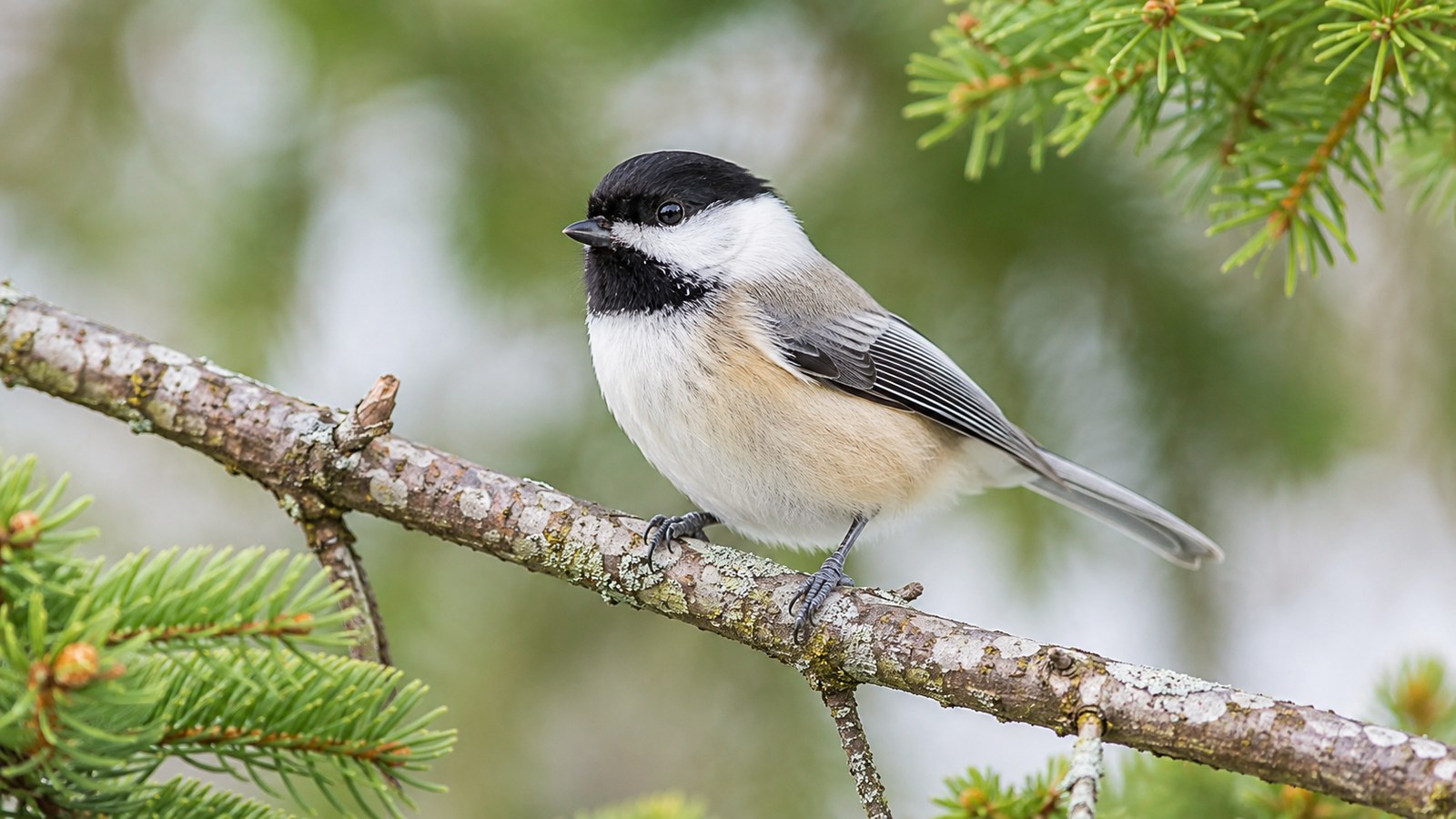
Why chickadees are good birds for beginners
Chickadees are small, active birds with oversized-looking heads, short bills, rounded bodies, and long narrow tails. They often move through branches in quick hops, hang upside down while searching leaves and bark, and travel in loose flocks outside the nesting season. Several species also visit feeders, making them easier to study from a window or favourite chair.
The family resemblance is strong, but the group isn’t impossible. Most North American chickadees can be separated by one or two major features, especially head pattern, back colour, habitat, or region. The difficult pair is Black-capped and Carolina Chickadee. Those two require a more careful combination of range, sound, wing edging, and flank colour.
Six North American chickadees to know
| Bird | Strong starting clues | Where to expect it |
|---|---|---|
| Black-capped Chickadee | Black cap and bib, broad white cheeks, gray back, visible pale wing edging, buff wash along the sides | Much of Canada, Alaska, the northern United States, wooded neighbourhoods, parks, forest edges, and mixed or deciduous woods |
| Carolina Chickadee | Black cap and bib, white cheeks, plainer gray wings, usually less warm colour on the sides, often a four-note whistle | Southeastern and south-central United States in woods, parks, swamps, neighbourhoods, and mixed habitats |
| Mountain Chickadee | Bold white eyebrow breaking through the black cap, gray back, black bib, pale cheeks | Mountainous conifer forests of western Canada and the western United States, with some movement to lower elevations |
| Chestnut-backed Chickadee | Rich chestnut back, dark cap, white cheeks, often chestnut sides, small and compact appearance | Pacific coastal coniferous and mixed forests from Alaska and British Columbia through the western United States |
| Boreal Chickadee | Brown cap, gray collar, small white cheek patch, small black bib, warm buff or cinnamon sides | Northern spruce and fir forests across Canada, Alaska, and parts of the northern United States |
| Mexican Chickadee | Extensive black bib, dark gray body, gray flanks, no warm buff wash, solid black cap without an eyebrow | Mountain forests of Mexico, barely reaching southeastern Arizona and southwestern New Mexico |
Continue with focused chickadee comparisons
The Black-capped Chickadee vs Carolina Chickadee guide begins with range and song, then checks white wing edging, flank colour, photographs, habitat, and the hybrid contact zone.
The Mountain Chickadee vs Black-capped Chickadee guide centres on the white eyebrow, western conifers, elevation, seasonal movement, wings, sides, and sound. The Boreal Chickadee vs Black-capped Chickadee guide compares cap, nape, cheek, bib, warm sides, wings, spruce habitat, lighting, and call quality. The Chestnut-backed Chickadee vs Black-capped Chickadee guide uses back colour, sides, wings, Pacific habitat, voice, and regional variation. The chickadee sound guide compares all six species by whistles, call pace, tone, habitat, and range.
Confirm that the bird is a chickadee
A chickadee usually looks round-headed and compact, with a short pointed bill and a tail that seems long for the body. The bird may cling sideways to a twig, hang below a cone, or grab one seed and carry it away rather than remain at the feeder. The familiar black cap, white cheek, and dark throat pattern is common across the group, although Boreal Chickadees replace the black cap with brown.
Nuthatches can occur in the same flock and at the same feeders. A nuthatch has a longer bill, shorter tail, and a habit of moving headfirst down trunks or working along heavy branches. Chickadees more often search leaves, twigs, cones, and small branches.
Look for the clearest head feature
The head can solve several identifications immediately. Mountain Chickadees have a white eyebrow stripe that cuts through the black cap. Boreal Chickadees have a rich brown cap and a gray collar. Mexican Chickadees have a very large black bib and a dark gray body. Chestnut-backed Chickadees have a blackish cap, but their brown back is usually more obvious than the head itself.
Black-capped and Carolina Chickadees both have black caps, black bibs, and bright white cheeks. Don’t force that pair from the head alone. Turn next to region, sound, and the folded wing.
Compare the back, wings, and sides
Black-capped Chickadees usually show more white edging on the wing feathers, creating a brighter patterned wing. Carolina Chickadees tend to look plainer gray in the wing. The difference can be subtle in poor light, worn feathers, or a blurred photograph, but a clean side view may show it well.
Chestnut-backed Chickadees have rich brown across the back. Most also show strong chestnut along the sides, although birds along part of the central California coast can have grayer sides. Mountain Chickadees remain gray-backed, and Boreal Chickadees combine a browner overall impression with warm sides.
Use habitat before chasing small plumage details
Habitat often separates chickadees that look broadly similar. Black-capped Chickadees use deciduous woods, mixed forests, shrubby edges, parks, and residential areas. Carolina Chickadees also use deciduous and mixed habitats, but in the southeastern and south-central United States.
Mountain Chickadees are strongly associated with western mountain conifers. Chestnut-backed Chickadees favour moist Pacific coastal coniferous and mixed forests. Boreal Chickadees belong to northern spruce and fir country. Mexican Chickadees live in mountain forests far to the south, with only a very small United States range.
Region can be one of the strongest clues
Location isn’t a minor detail for this group. A chickadee in most of Canada is far more likely to be Black-capped, Mountain, Chestnut-backed, or Boreal than Carolina. A bird in the southeastern United States is much more likely to be Carolina. A coastal conifer forest in British Columbia or Washington points strongly toward Chestnut-backed, while a high-elevation western pine forest may favour Mountain.
Range maps should still be checked rather than memorized as hard borders. Birds move, mountain species change elevation, and Black-capped and Carolina Chickadees meet in a narrow contact area. Habitat and sound should support the map.
Use sound as part of the identification
| Bird | Starting sound impression | Caution |
|---|---|---|
| Black-capped | Often a clear two- or three-note whistled song; familiar chick-a-dee call | Song varies in the Pacific Northwest and a few other regions |
| Carolina | Often a longer four-note whistle; chick-a-dee call can sound faster | Carolina Chickadees have many song patterns, not just one |
| Mountain | Sweet whistled song and chickadee calls, sometimes with more notes | Can sound similar to Black-capped where both occur |
| Chestnut-backed | Fast, high, buzzy chickadee calls and clicking gargles | Usually lacks the clear whistled song familiar from other chickadees |
| Boreal | Slower, huskier, buzzier chickadee call | Distant calls may be difficult to separate in wind or dense spruce |
| Mexican | Complex songs and harsh, raspy chickadee calls | Range normally removes other chickadees from consideration |
Record several phrases when possible. A single alarm note may be less reliable than a full song or repeated call. Note pitch, pace, number of notes, habitat, and whether more than one bird was calling.
Watch how the bird uses a feeder
Chickadees often approach one at a time, take a sunflower seed or small piece of food, and fly to cover to open or cache it. They may return repeatedly from the same direction. Their quick visits can make them seem nervous, but the pattern is normal and may allow careful observation of the same perch or flight path.
Black-capped, Carolina, Mountain, and Chestnut-backed Chickadees commonly use feeders within their ranges. Boreal Chickadees may visit where homes meet northern forest, but many bird watchers encounter them away from yards. Feeder use supports the identification only when paired with region, habitat, and appearance.
Look for mixed winter flocks
Outside the breeding season, chickadees often move with nuthatches, kinglets, creepers, woodpeckers, and other small birds. Robin and I sometimes notice a chickadee first because its calls seem to announce that a whole group is passing through.
Mixed flocks give you a built-in comparison. A nuthatch may travel down a trunk, a kinglet may look even smaller and more nervous, and a chickadee may work twigs or carry a seed away. Behaviour can be as valuable as colour when the birds never sit still.
Don’t rely on exact size
All six species are small. Chestnut-backed Chickadee is especially compact, while Boreal can look slightly larger and softer, but perspective changes quickly among branches. Exact size is rarely the best first clue unless two species are together.
Use body proportions instead. Chickadees have large-looking heads, tiny bills, rounded bellies, and fairly long tails. A clear photograph may show bill length, tail length, and wing edging more reliably than a field estimate of total length.
Allow for wear, light, and regional variation
Black can look brown in warm light. Chestnut can look nearly black in shade. Pale wing edging can disappear in blur or worn plumage. A bird facing the camera may hide the wing pattern completely. Use photographs from more than one angle when possible.
Regional variation also matters. Black-capped songs differ in the Pacific Northwest. Mountain Chickadees vary in bill shape across the West. Chestnut-backed birds along part of coastal California can have much grayer flanks than birds farther north. A field guide illustration should be treated as one example, not a promise that every bird will look identical.
What to check on a chickadee
- Write down the location and habitat.
- Confirm the round head, short bill, long tail, and active twig-foraging behaviour.
- Check whether the cap is black or brown.
- Look for a white eyebrow.
- Compare the back and sides for chestnut, buff, or plain gray.
- Study the folded wing for pale edging.
- Record the song or call pattern.
- Check the range and leave the identification broad when the evidence conflicts.
When an exact identification isn’t possible
A distant black-capped chickadee in the contact zone may remain uncertain. Record it as Black-capped/Carolina Chickadee when range, song, and wing pattern don’t agree. This is a good observation, not a failure.
For other birds, a broader note such as “brown-capped chickadee” or “small chickadee with white eyebrow” preserves what was actually seen. A later photograph, sound recording, or return visit may provide the missing clue.
Frequently asked questions
Which chickadee has a white eyebrow?
The Mountain Chickadee has a white eyebrow stripe through the black cap. Worn birds may show it less clearly, so region and mountain-conifer habitat can support the identification.
Which chickadee has a brown cap?
The Boreal Chickadee has a brown cap, gray collar, small white cheek patch, small black bib, and warm sides. Gray-headed Chickadee also has a brownish cap but is exceptionally rare and restricted in North America.
Which chickadee has a brown back?
The Chestnut-backed Chickadee has a rich chestnut back. Most birds also have chestnut sides, though some central California coastal birds are grayer along the flanks.
Can sound identify every chickadee?
Sound can be very handy, especially for Black-capped and Carolina Chickadees, but songs vary and calls can overlap. Use sound with range, habitat, and visible marks.
Sources and further reading
- Cornell Lab: Black-capped Chickadee similar species
- Cornell Lab: Carolina Chickadee similar species
- Cornell Lab: Mountain Chickadee identification
- Cornell Lab: Chestnut-backed Chickadee identification
- Cornell Lab: Boreal Chickadee identification
- Cornell Lab: Mexican Chickadee identification
- Birds Canada: common winter bird identification
If the bird has a black cap, black bib, and bright white cheeks, continue with our full Black-capped Chickadee guide.