
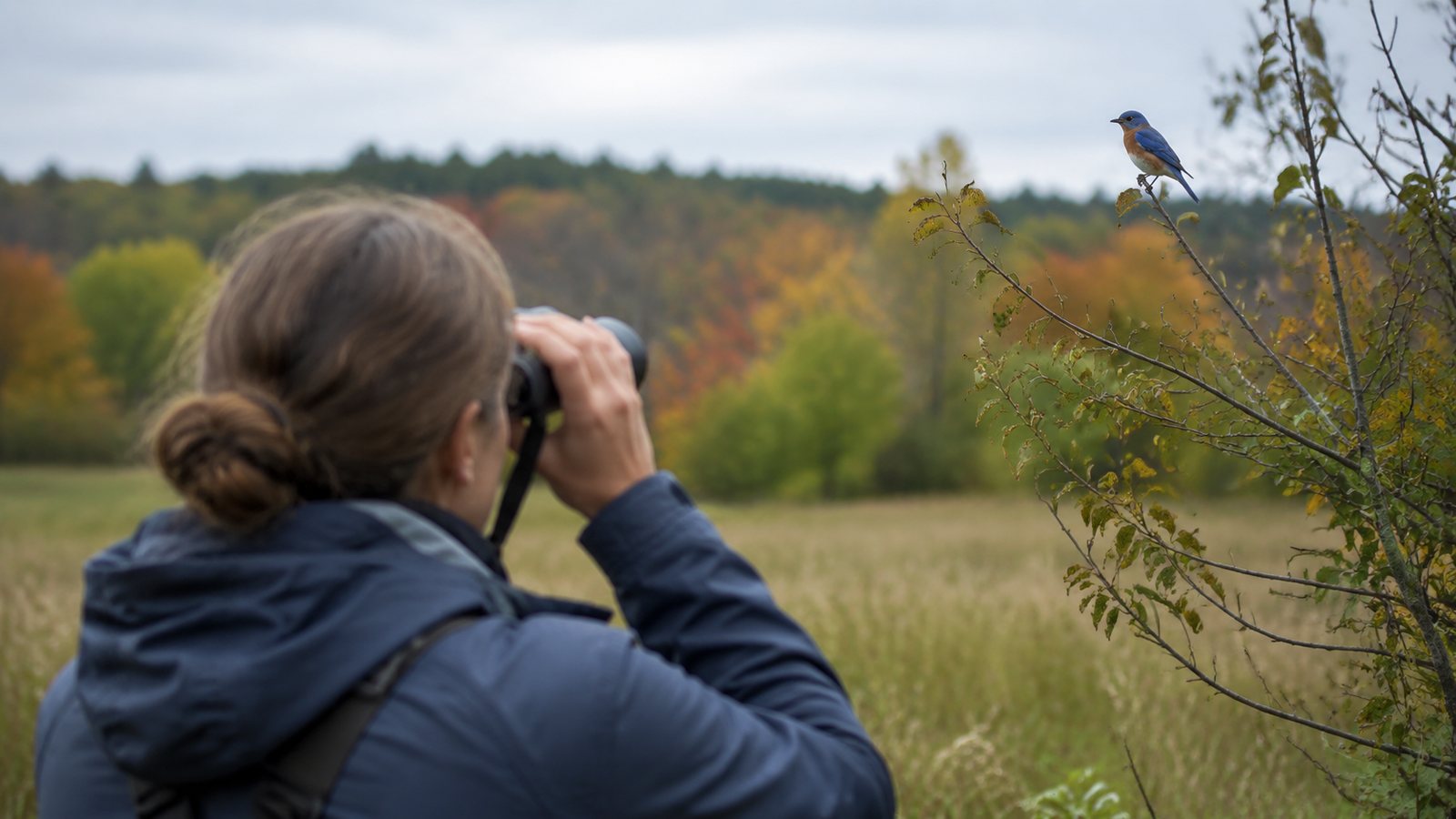
Don’t begin with every tiny marking
An unfamiliar bird can disappear before you have time to study every feather. The most best first observations are broad and easy to remember: size, shape, colour pattern, behaviour, habitat, location, season, and sound.
Cornell calls size and shape, colour pattern, behaviour, and habitat the four keys to visual identification. Birds Canada teaches a closely related five-part approach using shape, size, context, colour, and sound. Both methods encourage beginners to narrow the bird to a likely group before searching for one tiny field mark.
Record the location and date
Write down the town, province or state, and the type of place where the bird appeared. A bird beside a saltwater shore belongs to a different shortlist than a bird in a dry prairie, city park, mountain forest, or suburban feeder.
The date matters because migration and seasonal movements change which species are likely. A bird common during a May migration stop may be unusual at the same location in January.
Compare its size with a familiar bird
Exact measurements are difficult in the field. Use familiar reference birds instead. Was it smaller than a sparrow, about robin-sized, similar to a crow, duck-sized, or closer to a goose?
Make the comparison while the bird is visible. Memory can stretch or shrink a bird after the sighting, especially when the distance was uncertain.
Study the silhouette and posture
Ask whether the bird looked compact, long-bodied, round, slim, upright, horizontal, long-necked, or short-tailed. Shape still helps when the bird is backlit and colour is difficult to see.
A woodpecker clinging upright to a trunk, a swallow with pointed wings, a heron with long legs and neck, and a small round chickadee have very different outlines even from far away.
Look at the bill before fine plumage
The bill can suggest how a bird feeds. A short thick bill often belongs to a seed-eating bird. A thin pointed bill can suit insect feeding. A long probing bill may belong to a shorebird, while a hooked bill is associated with birds of prey.
Compare the bill with the bird's own head. Is it shorter than the head, about the same length, much longer, narrow, deep, straight, curved, or flattened?
Notice the tail and wings
Tail length and shape can quickly narrow the choices. Look for a forked, notched, square, rounded, pointed, or fan-shaped tail. Notice whether the tail is constantly flicked, cocked upward, spread in flight, or held still.
When the bird flies, note whether the wings look broad and rounded or long and pointed. Watch the rhythm too: rapid buzzing, steady flapping, flap-and-glide, soaring, hovering, or bounding flight.
Use broad colour pattern, not a list of colours
Lighting can make grey look blue, brown look black, and pale yellow disappear. Instead of trying to name every colour, remember the arrangement of light and dark areas.
Was the head darker than the body? Did the bird have pale wing bars, a bright rump, a streaked breast, a dark hood, white outer tail feathers, or a strong eye line? Overall pattern is often more dependable than an exact shade.
Watch what the bird does
Behaviour can separate similar-looking birds. Note whether it hops or walks, climbs a trunk, scratches leaves, catches insects in the air, probes mud, dives, swims, hovers, pumps its tail, or sits still on an exposed perch.
Also record where it feeds. A bird taking seed beneath a feeder provides a different clue from one searching bark, picking berries, diving under water, or circling high overhead.
Use habitat as a filter
Habitat doesn’t prove an identification, but it can remove many unlikely choices. Look at the broader setting and the exact microhabitat: open water, reeds, treetop, tree trunk, forest floor, lawn, shoreline, fence line, flowering garden, or building ledge.
Ask whether the bird's behaviour fits that habitat. A species may occur in the region but be unlikely in the particular place where you saw it.
Listen for calls and songs
A sound may be more distinctive than the view. Try to describe it with rhythm and quality rather than forcing it into words. Was it one clear whistle, a repeated two-note call, a harsh scold, a trill, a rattle, or a rising series?
Record the sound on your phone when you can do so without disturbing the bird. Merlin Sound ID can suggest possibilities, but compare the recording with reference sounds and visual clues before deciding.
Notice whether it was alone or in a flock
Some birds often feed alone, while others gather in family groups, mixed flocks, or large seasonal gatherings. Flock size and the species accompanying the bird can be good clues.
Don’t assume every bird in a flock is the same species. Mixed flocks are common, especially during migration and outside the breeding season.
Take a photograph, even a poor one
A distant or blurry photograph can preserve proportions, posture, wing pattern, tail shape, habitat, and relative size. It doesn’t need to be a perfect wildlife photograph to help with identification.
Photograph first, then zoom later. Repeatedly moving closer can disturb the bird and may cause you to lose the observation entirely.
Make a quick sketch
A rough outline can preserve what stood out. Draw the bill, body, tail, and any bold light or dark patches. Add arrows and short notes rather than trying to create finished artwork.
Robin and I find that a ten-second note often remembers more than a confident guess made an hour later. Write what you actually saw, including uncertainty.
Use a field-note template
| Clue | What to record |
|---|---|
| Place and date | Town, province or state, habitat, date, and time |
| Size | Smaller than a sparrow, robin-sized, crow-sized, duck-sized, or another comparison |
| Shape | Body posture, head size, neck, legs, bill, wings, and tail |
| Colour pattern | Broad light and dark areas, wing bars, streaks, patches, or contrasting marks |
| Behaviour | Hopping, walking, climbing, swimming, hovering, feeding method, or flight style |
| Social clues | Alone, pair, family, flock, or mixed with other species |
| Sound | Rhythm, pitch, repeated notes, and a recording when possible |
Compare only realistic possibilities
Use a regional field guide, Birds Canada resources, All About Birds, Audubon, or Merlin to create a shortlist. Filter by location and date before comparing plumage details.
A rare species is possible, but a common local species seen in unusual light is usually more likely. Don’t choose a rare bird only because one colour seems to match.
Use Merlin as a starting assistant
Merlin Bird ID can suggest birds from a short observation questionnaire, a photograph, or a sound recording. It can be especially handy for creating a manageable list of species expected nearby.
Check the suggested bird's range, season, size, shape, behaviour, habitat, and sound. A tool suggestion becomes more convincing when several independent clues agree.
Best clues and weaker clues
| More reliable | Use carefully |
|---|---|
| Overall proportions and posture | Estimated exact length at an unknown distance |
| Bill and tail shape | One colour seen in difficult light |
| Broad colour pattern | A single tiny field mark remembered later |
| Behaviour and feeding method | Assuming every bird at a feeder eats the same food |
| Location, habitat, and season | Choosing a rare species before common local options |
| A few clues that agree | One app suggestion without comparison |
Make sure the clues agree
A strong identification should make sense as a whole. The size, shape, bill, pattern, behaviour, habitat, range, season, and sound shouldn’t contradict one another.
It’s fine to leave a bird unidentified. Recording an honest “sparrow-sized bird with a thin bill and two wing bars” is better than forcing a species name that the evidence doesn’t support.
Practise these clues with backyard woodpeckers
The common backyard woodpecker guide compares eight birds using size, bill, pattern, behaviour, sound, range, and season. If you have narrowed it to a similar pair, use the matching comparison: Downy vs Hairy, Yellow-shafted vs Red-shafted Flicker, the three sapsuckers, Red-bellied vs Red-headed, or Northern Flicker vs Pileated.
Frequently asked questions
What should I notice first when identifying a bird?
Start with location, date, approximate size, overall shape, bill, tail, broad colour pattern, behaviour, habitat, and any sound you heard.
Can I identify a bird from colour alone?
Colour can help, but lighting, distance, age, sex, season, and feather wear can change how a bird looks. Combine colour pattern with size, shape, behaviour, habitat, location, and season.
Is Merlin Bird ID accurate?
Merlin can suggest birds from your notes, photos, or sounds. Treat that as a starting point. Compare several clues and check whether the species should be in your area at that time of year.
What should I write down after seeing an unfamiliar bird?
Write down the date, place, habitat, size, shape, bill, tail, main colours, behaviour, flock size, feeding style, and sound. Even the direction the bird flew can help.
Practise these clues with backyard finches
The common backyard finch guide applies size, bill, colour pattern, behaviour, range, and season to eight birds. Focused practice includes House Finch vs Purple Finch, Evening vs Pine Grosbeak, and Redpoll vs Pine Siskin.