
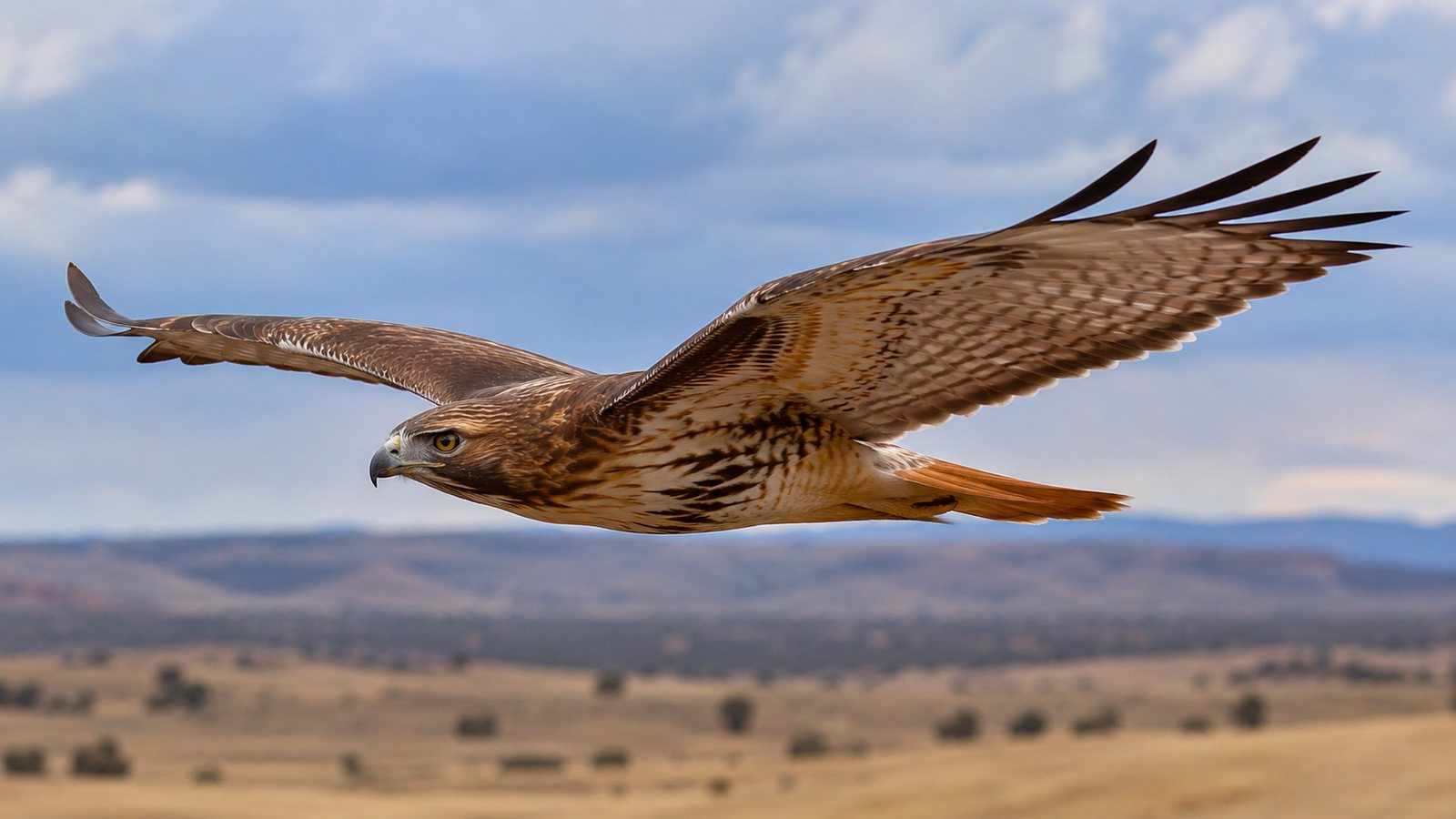
What forces keep a bird in the air?
Four basic forces are involved: lift, weight, thrust, and drag.
Weight is gravity pulling the bird toward the ground. Drag is the resistance of moving through air. Lift pushes upward, and thrust moves the bird forward.
That is the same basic set of forces an airplane deals with. A bird handles them with a living, flexible wing instead of a fixed wing and engine.
How do bird wings create lift?
A wing changes the flow of air around it.
The curved shape, angle, and movement of the wing create pressure differences and push air downward. The reaction helps push the bird upward. Scientists can describe that process in several connected ways, but the simple part is easy to picture: a wing has to move through air and redirect it.
No air, no lift. That is why a bird could not flap its way through a vacuum.
For a closer look at primaries, secondaries, coverts, flapping, and gliding, read how bird wings work.
What does flapping actually do?
Flapping gives the bird both lift and forward push.
On the downstroke, the wing meets the air with a broad working surface. The bird pushes air down and back. On the upstroke, many birds partly fold, rotate, or angle the wing so it creates less resistance on the way back up.
Watch a slow-motion clip of a small bird taking off and the movement looks much more complicated than simply moving two wings up and down.
Why are feathers so important for flight?
Feathers turn the arm and hand bones of a bird into a smooth aerodynamic surface.
The long primary feathers near the wingtip play a major role in thrust and fine control. Secondary feathers along the inner wing contribute strongly to lift. Smaller coverts smooth the surface so air can flow over it more cleanly.
Those feathers are not locked in place. A bird can spread, overlap, twist, and angle them as conditions change.
That is one reason preening matters so much. Flight feathers need to stay aligned and in good condition.
Where does all that flapping power come from?
Mostly from the chest.
The large pectoral muscles power the strong downstroke. Another muscle, the supracoracoideus, helps lift the wing again through an unusual tendon arrangement that acts a bit like a pulley.
In strong fliers, those muscles make up a large share of the bird's body mass. They have to. Flight is expensive.
How does a bird take off?
Takeoff depends on the bird.
A chickadee can spring from a twig and start flapping almost instantly. A duck may run across the water while beating its wings. A large vulture prefers to use height or rising air because getting a heavy body moving takes more effort.
The common goal is speed. The wings need moving air before they can produce enough lift to support the bird.
How do birds turn in the air?
They change the forces on one side of the body.
A bird can bank, alter the angle of one wing, change its wing shape, fan the tail, or use several of those movements together. The tail works like part rudder, part brake, and part balancing surface.
Small birds can make these changes incredibly fast. One second they are flying straight. The next, gone behind the hedge.
See how birds steer, bank, brake, and land for the full control sequence.
How do birds slow down and land?
Landing is controlled falling with excellent timing.
A bird raises its body angle, spreads wings and tail, and increases drag. That sheds speed. Just before touching down, many birds flare by angling the wings sharply and bringing the feet forward.
A tiny perch gives almost no room for error, yet songbirds hit branches all day long.
Do birds have to flap all the time?
No.
Once a bird has enough speed and height, it can glide. Hawks, eagles, vultures, pelicans, and many other large birds also use rising air to soar with surprisingly few wingbeats.
That is the answer behind another common sight: birds flying in circles on a warm day.
Why do different birds have different shaped wings?
Because birds do different jobs in the air.
Long narrow wings suit efficient gliding over oceans. Broad wings can work well for soaring on thermals. Short rounded wings can give woodland birds quick acceleration and tight turns. Pointed wings are common in fast, long-distance fliers.
There are trade-offs. A wing that is excellent for one style of flight may be awkward for another.
Can all birds fly?
No. Ostriches, emus, cassowaries, rheas, kiwis, and penguins are among the living birds that do not fly through the air.
Penguins are a fun exception in another sense. Their wings evolved into stiff flippers, and underwater they almost look as if they are flying through the sea.
Why can hummingbirds fly so differently?
Hummingbirds can generate lift through much more of the wingbeat than most birds. Their shoulder joints allow the wings to rotate through an unusual range, producing the familiar figure-eight-like motion.
That lets them hover with extraordinary control. It also explains how hummingbirds can fly backwards.
Frequently asked questions
How do birds stay up in the air?
Their wings generate lift, while forward movement and flapping keep air moving around the wings. Birds continually adjust wing angle, speed, and shape to maintain height.
Do birds fly because their bones are hollow?
Lightweight skeletons can reduce mass, but hollow bones are only one part of the story. Wing shape, muscles, feathers, breathing, balance, and body design all contribute to flight.
Can birds fly without feathers?
A normally feathered bird that lost its major flight feathers would have serious trouble flying. The wing bones and muscles alone do not create the broad, controlled surface needed for normal bird flight.
Is bird flight the same as airplane flight?
The same four forces apply, but bird wings are flexible and active. They can flap, twist, fold, spread individual feathers, and change shape from one second to the next.
Watch the wings, not just the bird
The next time a bird leaves a fence or feeder, watch the first two or three wingbeats. Takeoff, acceleration, and steering happen almost at once. Then compare that with a hawk barely moving its wings overhead. Same sky. Very different solution.
Continue with how bird wings work, why birds have tails, bird bone structure, bird breathing, or return to Bird Facts.