
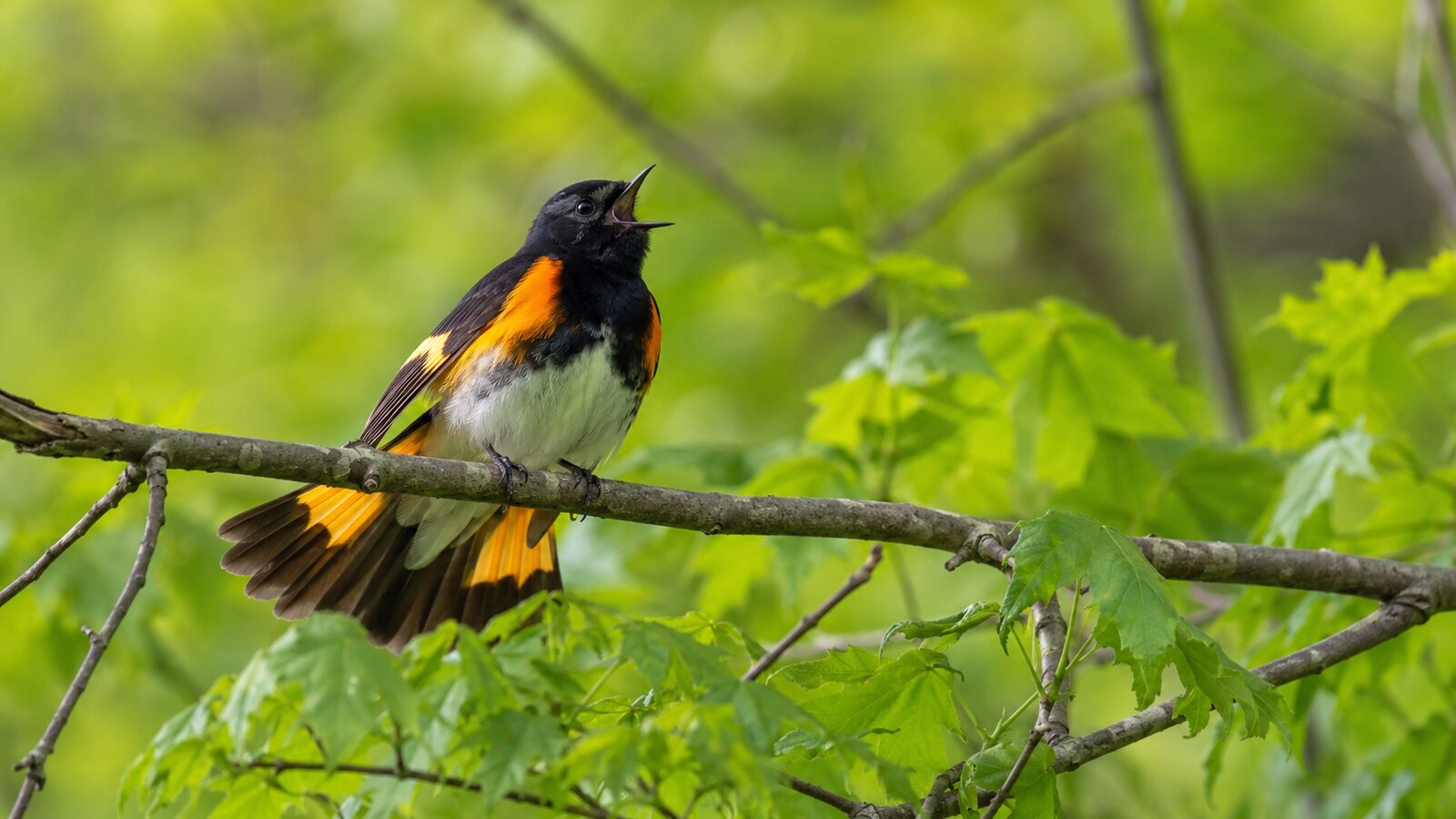
How to identify an American Redstart
Adult males have black heads, backs, and upper breasts, white lower underparts, and bold orange patches in the wings and tail. Females are gray-olive above and pale below with yellow wing and tail patches.
Immature males resemble females during their first year and do not gain full black-and-orange adult plumage until later. All ages move constantly, spreading the tail and drooping the wings as they forage.
American Redstart size and wingspan
Adults are about 11 to 13 cm long, weigh roughly 6 to 9 g, and have a wingspan around 16 to 19 cm. They are small, slim warblers with thin insect-catching bills.
Their movement can make them look larger than they are. Follow the colored flashes rather than trying to study one still pose.
What does an American Redstart sound like?
The male sings a quick series of thin, high notes, often repeated in sets. Some songs end with a sharply accented note that can sound a little like a sneeze, while others finish more evenly.
Both sexes use short chip or tsip calls, including sharper alarm notes. Song varies enough that it is best to compare pace, pitch, ending, habitat, and visible tail flashes. The guide to identifying birds by sound explains that combined approach.
Habitat, range, and migration
American Redstarts breed in deciduous and mixed woods across much of Canada and the eastern and northern United States. They often use second-growth forest, woodland edges, and shrubby openings.
They migrate long distances to Mexico, Central America, the Caribbean, and northern South America. During migration they may appear in parks, yards, and other leafy places outside their breeding habitat.
What do American Redstarts eat?
Small insects, flies, moths, beetles, leafhoppers, and caterpillars make up most of the diet. Redstarts pick prey from foliage or catch it in the air.
The fanned tail and bright patches may startle insects into moving, making the prey easier to see. Redstarts sometimes eat small fruits, especially during migration, but they are not seed-feeder birds.
Nesting, eggs, and young
The female builds a compact cup in the fork of a small tree or shrub. Bark strips, grass, plant fibers, and spiderweb form the nest, which is often decorated with bark or lichen.
A clutch usually contains one to five creamy eggs marked with brown or gray. Incubation lasts about 10 to 13 days, and young generally leave the nest about 7 to 13 days after hatching.
Similar birds and lifespan
A male’s black-and-orange pattern is distinctive. Female and young American Redstarts can be confused with other yellow-marked warblers, but their gray body, yellow tail panels, active fanning, and restless foraging are useful clues.
The oldest recorded American Redstart was at least 10 years and 1 month old. That longevity record is not a typical lifespan.
How display and song work together
Males sing to advertise breeding areas, while the bright tail and wing patches are easy to notice during movement and display. This connects the species with bird song, courtship, and territorial behavior.
Frequently asked questions
Is an American Redstart a warbler?
Yes. It is a small New World warbler, despite the “start” in its name.
Do female American Redstarts have orange patches?
Females usually have yellow patches. Young males can also look female-like before gaining black-and-orange adult plumage.
Do American Redstarts visit feeders?
They rarely use seed feeders. They may visit insect-rich trees, shrubs, and yards during migration.
More familiar birds
Compare the Common Yellowthroat and Yellow Warbler, or browse more common birds.