
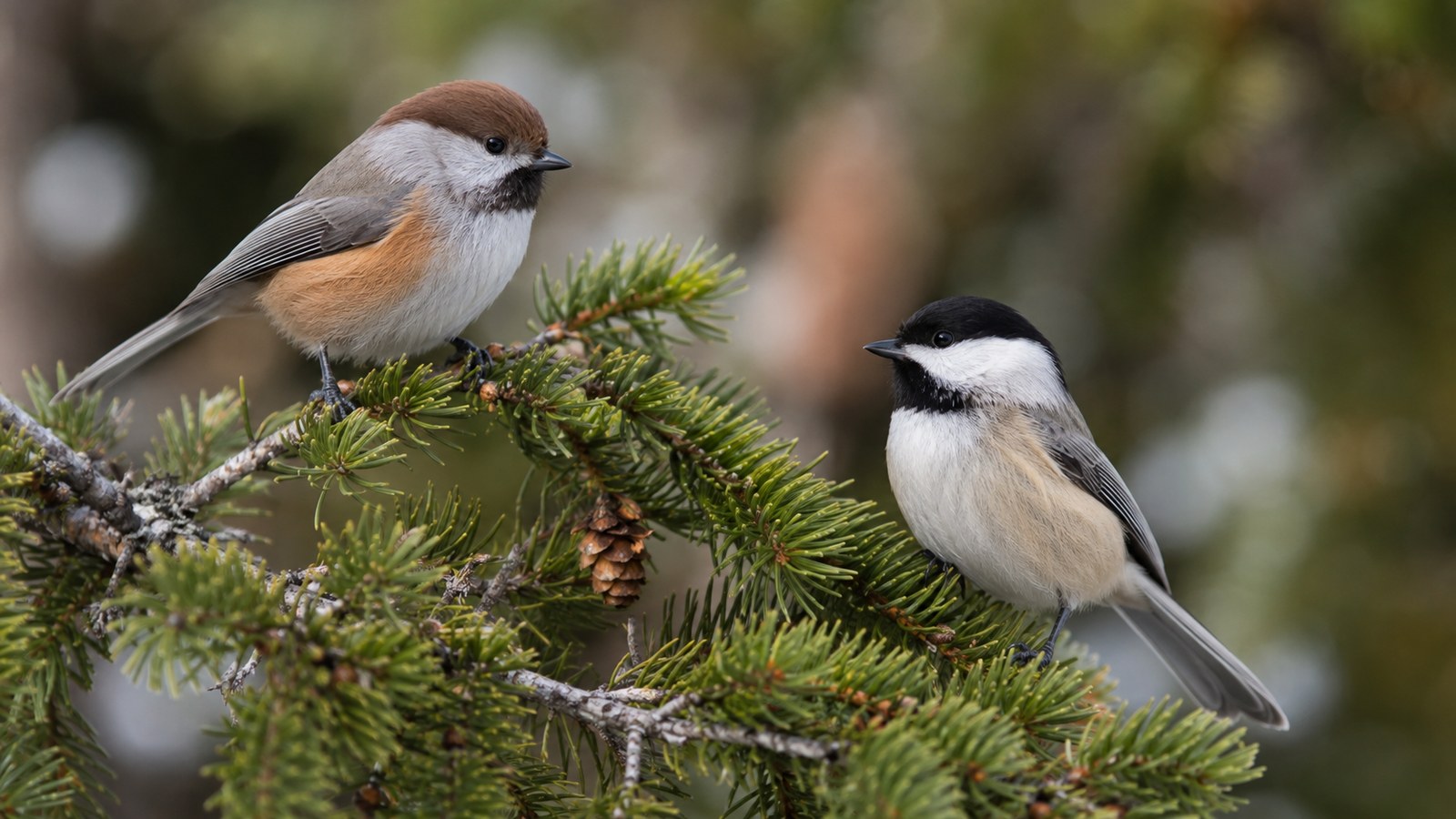
Why these two chickadees can be confused
Both birds are tiny, active, round-headed chickadees with short bills, black caps, black throat patches, white cheeks, pale underparts, and quick feeder visits. Both can hang below twigs, carry a sunflower seed into cover, join mixed winter flocks, and disappear into a dense tree before a clear photograph is taken.
The head is so similar that beginners sometimes concentrate on it and miss the strongest clue. The chestnut-brown back of a Chestnut-backed Chickadee is far better than a small difference in head shape or body size. A good identification begins with the back, then checks the sides, wings, habitat, location, and voice.
Chestnut-backed and Black-capped Chickadee comparison
| Feature | Chestnut-backed Chickadee | Black-capped Chickadee |
|---|---|---|
| Back | Rich chestnut brown | Gray, sometimes with a slight olive cast |
| Sides | Usually chestnut or rusty; central California birds can be much grayer | Pale buff, usually strongest toward the rear flanks |
| Head | Black cap and bib with white cheeks | Black cap and bib with white cheeks |
| Wings | Dark and often relatively plain | Usually shows more pale edging on the folded wing |
| Tail | Often looks compact and slightly shorter | Can look a little longer, but perspective makes this subtle |
| Habitat | Pacific evergreen and mixed evergreen forest, parks, and wooded suburbs | Deciduous, mixed, streamside, park, neighbourhood, and open woodland |
| Range | Pacific Coast from Alaska and British Columbia south through the western United States | Most of Canada, Alaska, and much of the northern United States |
| Sound | Thin, scratchy, high chickadee calls and gargling notes; no familiar clear whistle | Clear chickadee call and, across much of the range, a pure whistled song |
The chestnut back is the strongest visual clue
Cornell’s comparison centres on the back: Chestnut-backed Chickadees have rich brown across the mantle and upper back, while Black-capped Chickadees are gray-backed. This difference can remain visible even when the flanks are hidden by a branch or the bird is facing away.
Wait for a side or rear view. A bird facing the observer may show only a black cap, white cheeks, and pale breast, which can fit either species. The instant it turns, the colour between the wings often settles the identification.
Don’t rely on flank colour alone
Most Chestnut-backed Chickadees have rich chestnut along the sides, creating a warm brown-and-white body. Black-capped Chickadees usually have a softer buff wash that’s much paler than the back of a Chestnut-backed bird.
There’s an important regional exception. Chestnut-backed Chickadees along part of the central California coast may have gray sides with chestnut limited near the rear. A visitor who expects every bird to have rusty flanks could overlook one. The brown back and Pacific range remain more dependable.
Compare the folded wings
Black-capped Chickadees often show obvious pale edging on the wing feathers, creating a brighter, more patterned folded wing. Chestnut-backed Chickadees tend to have darker and plainer-looking wings beside the brown back. Feather wear, shadow, and motion can reduce this difference.
Use a photograph taken from the side in even light. A front view hides the wing, while strong backlighting can remove the pale edges from both species. Wing pattern should confirm the back colour rather than replace it.
Body size and tail length are supporting clues
Chestnut-backed Chickadees can look especially compact, with a short-bodied, quick-moving appearance. Black-capped Chickadees may look slightly longer through the body and tail. These impressions are difficult to judge when birds are on different branches or at different distances.
Exact size should remain low on the checklist. A familiar feeder, the same perch, or two birds together provides a sense of scale. Without that comparison, the back and habitat are much stronger evidence.
Pacific evergreen habitat supports Chestnut-backed
Chestnut-backed Chickadees are strongly associated with dense evergreen and mixed evergreen forests along the Pacific Coast. They also use wooded parks and suburbs where large conifers remain nearby. In coastal British Columbia, Washington, Oregon, southeast Alaska, and northern California, conifer habitat can put this species high on the list.
Black-capped Chickadees use a broader selection of deciduous, mixed, shrubby, streamside, park, and residential habitats. They can enter conifers, so one evergreen tree isn’t proof. Look at the wider setting and the complete plumage.
Range narrows the shortlist
Chestnut-backed Chickadees are Pacific birds. Their range follows western coastal forests from Alaska and British Columbia south through the Pacific Northwest and California. Black-capped Chickadees extend across most of Canada and the northern United States, including parts of the West where both can occur within the same broader region.
Location should guide the search, not decide it automatically. A bird in coastal forest still needs the brown back, and a gray-backed bird in the same area may be Black-capped or another chickadee.
Mixed flocks can contain several similar birds
Chestnut-backed Chickadees often move with other small forest birds, including Mountain Chickadees, nuthatches, kinglets, creepers, and woodpeckers. Black-capped Chickadees also lead or join mixed flocks. A burst of calls may reveal several species moving through one stand of trees.
Don’t assume every small black-capped bird in the flock is the same species. Check each bird’s back. Robin and I often find that the second or third bird provides a much clearer view than the first one that caught our attention.
Listen for a thinner, scratchier voice
Chestnut-backed Chickadees usually give high, thin, scratchy chickadee calls. Cornell notes that the number of dee notes varies but is often lower than in the Black-capped call. Chestnut-backed birds also make clicking or gargling notes.
Black-capped Chickadees have the familiar chick-a-dee call and, across much of North America, a clear two- or three-note whistled song. Pacific Northwest Black-capped songs can differ from the familiar eastern pattern, so local recordings and visible field marks still matter.
The missing whistle can help
Chestnut-backed Chickadees don’t have the clear whistled fee-bee style song used by most other chickadees. A small chickadee giving only rapid scratchy calls in dense Pacific evergreens may therefore be Chestnut-backed, especially when the brown back is seen.
Silence proves nothing. A Black-capped Chickadee may be calling rather than singing, and a Chestnut-backed bird may remain quiet. The dedicated chickadee sound guide compares all six species using pitch, pace, tone, phrase shape, habitat, and region.
Juveniles still show the basic back difference
Young chickadees can look softer, fluffier, and less sharply marked than adults. Their caps and bibs may seem less clean, while newly grown feathers can change the contrast of the wings and sides. The broad back colour still helps.
A juvenile Chestnut-backed Chickadee should still show warm brown across the back. A young Black-capped Chickadee remains gray-backed. Check more than one view because fresh plumage and shaded forest light can make colours appear deeper.
Photography can change brown and gray
Automatic camera white balance may warm a gray-backed Black-capped Chickadee until it looks brown. Deep evergreen shade can make a Chestnut-backed Chickadee look almost black. Reflected green light can also give pale feathers an unusual cast.
Keep the original files and compare several frames. Check whether bark, sky, snow, or feeder parts also look too warm or too cool. A true Chestnut-backed Chickadee should show brown concentrated on the bird rather than across the whole image.
A seven-clue field routine
- Record the location, date, and surrounding forest type.
- Wait for a side or rear view of the back.
- Decide whether the back is chestnut brown or gray.
- Check the sides, allowing for gray-sided central California birds.
- Study the folded wing for pale edging.
- Record calls and listen for a thin scratchy voice or clear whistle.
- Leave the bird as Chestnut-backed/Black-capped Chickadee when the back is never visible enough.
Frequently asked questions
What is the easiest way to tell these chickadees apart?
Check the back. Chestnut-backed Chickadees have a rich chestnut-brown back, while Black-capped Chickadees have a gray back.
Can a Chestnut-backed Chickadee have gray sides?
Yes. Many central California coastal birds have gray sides with chestnut concentrated toward the rear. The brown back is still the stronger feature.
Do both species visit feeders?
Yes. Feeder use depends on range, nearby habitat, season, food, and cover. The bird’s back, wings, sides, voice, and location are better than feeder behaviour alone.
Do Chestnut-backed and Black-capped Chickadees sound different?
Chestnut-backed Chickadees usually sound thinner, faster, and scratchier and lack the familiar clear whistled song. Black-capped Chickadees usually have clearer calls and a whistled song, although that song varies regionally.
Sources and further reading
- Cornell Lab: Chestnut-backed Chickadee similar species
- Cornell Lab: Black-capped Chickadee similar species
- Cornell Lab: Chestnut-backed Chickadee sounds
- Cornell Lab: Black-capped Chickadee sounds
For a full species profile, see our Black-capped Chickadee guide.