
Why female song was often overlooked
Much early bird-song research focused on familiar species in Europe and temperate North America, where male breeding song is often conspicuous. Researchers also sometimes assumed that a singing bird was male without confirming its sex.
Broader work across the bird family tree shows that female song is widespread and likely has deep evolutionary roots. It is especially common in many tropical and year-round territorial species.
Why do female birds sing?
There is no single reason. Depending on the species, a female may use song to defend food or nesting space, maintain a pair bond, answer a mate, coordinate breeding, or compete with other females. Some pairs sing duets in which their parts alternate closely.
These functions overlap with the main reasons covered in why birds sing.
Female Northern Cardinals sing
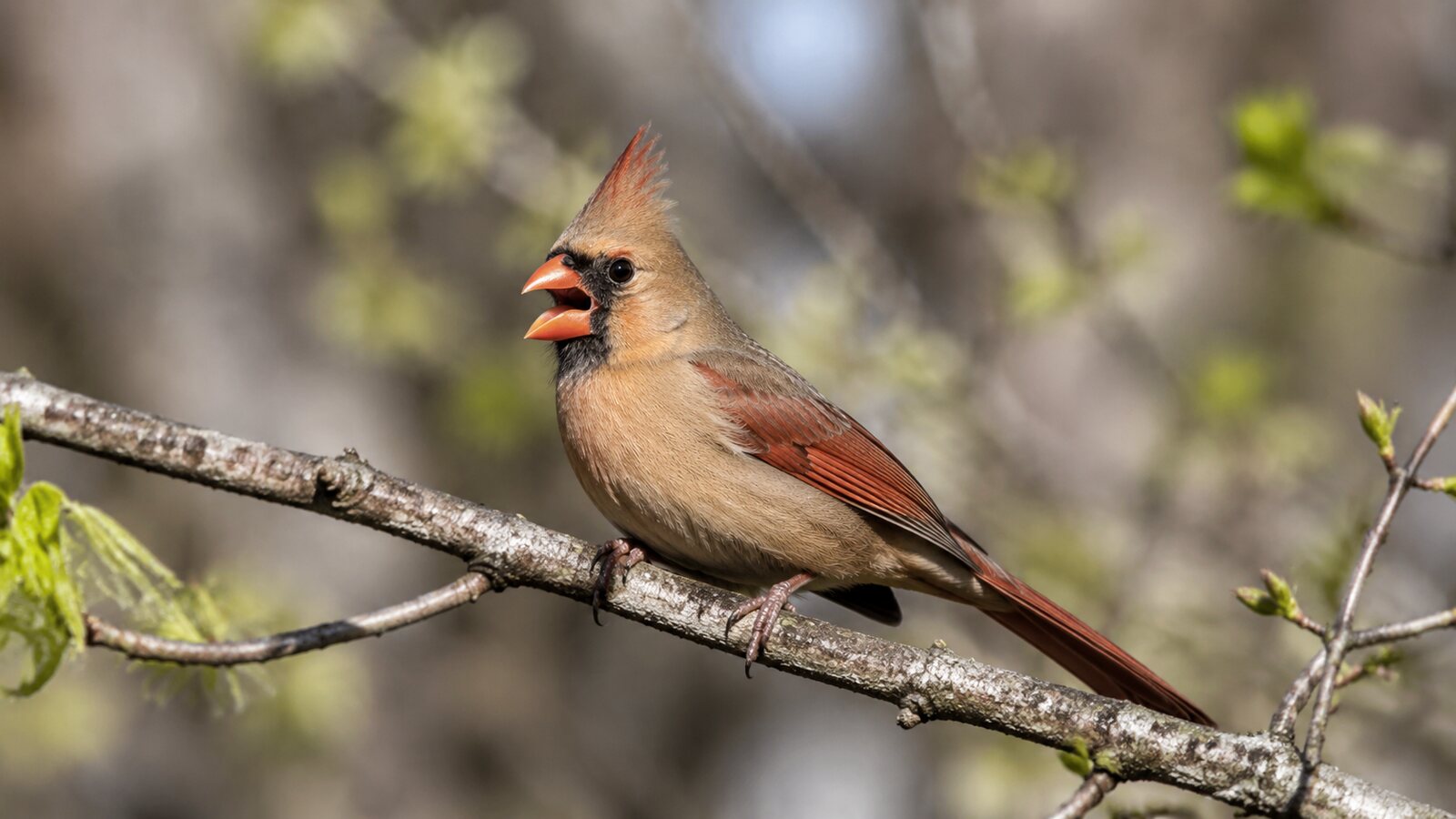
Both sexes of Northern Cardinal sing. A female may sing from the nest or nearby, and mates can exchange song. Females are brownish with red in the wings, crest, and tail, so a singing cardinal is not always the bright red male people expect.
Female Northern Mockingbirds also sing, especially in fall, though usually more quietly than males. A female Gray Catbird may answer her mate with a quieter song near the nest.
Song roles differ among species
In some species both sexes sing often. In others, females use shorter songs, sing only in certain settings, or mostly use calls. Region matters too. A pattern common in one part of the world may not describe the same bird group elsewhere.
The safe rule is simple: do not decide a bird is male only because it sang. Use plumage, season, behaviour, pair interactions, and species knowledge together.
Can female and male songs sound different?
Sometimes they differ in pitch, length, phrase type, or how often they are given. In other species the songs are similar enough that sound alone may not identify sex. Individual birds can also have more than one song type.
How to listen without making assumptions
Watch the singer if you can do so without moving close to a nest. Record its plumage, companion, perch, behaviour, date, and habitat. Then compare several trusted recordings labeled by sex. Our guide to identifying birds by sound explains how to compare pitch, rhythm, repetition, and tone.
Frequently asked questions
Can female songbirds sing?
Yes. Female song is found in many songbird species, but its frequency and purpose vary.
Do female Northern Cardinals sing?
Yes. Females sing and may exchange songs with their mates.
Can you tell a bird is male because it is singing?
Not reliably for every species. Confirm sex with other clues when it matters.