
How to identify a House Wren
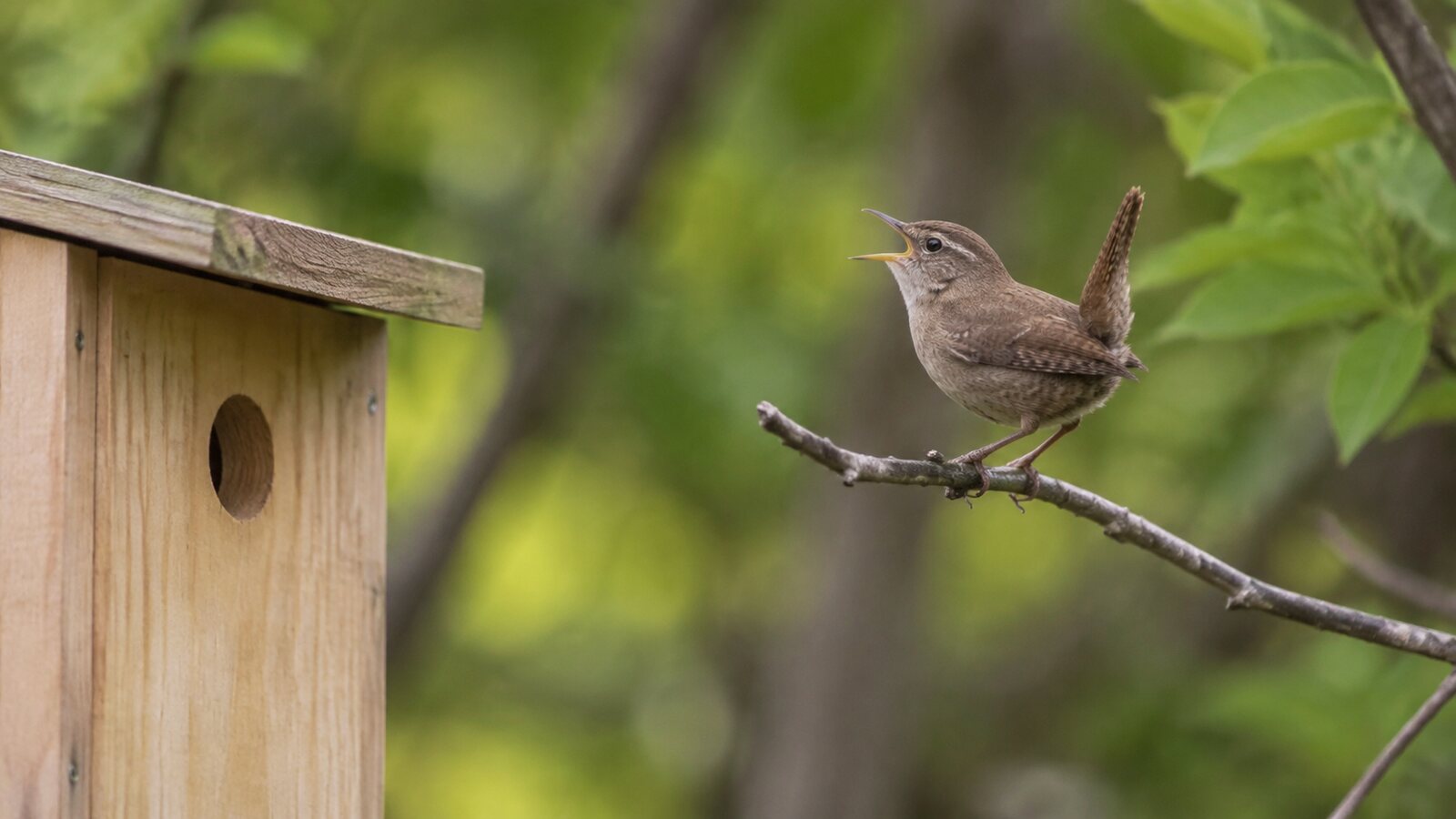
House Wrens are subdued brown above and paler gray-brown below. Fine dark bars cross the wings and tail, the eyebrow is faint, and the slender bill curves slightly downward.
Males and females look alike. Juveniles are similar but may show softer markings and a slightly scaly look below. Behavior and voice are often more useful than a quick view of the plumage.
House Wren size and wingspan
Adults are about 11 to 13 cm long, weigh roughly 10 to 12 g, and have a wingspan near 15 cm. They are compact and much smaller than an American Robin.
A Carolina Wren is larger and warmer reddish brown, with a bold white eyebrow and richer buff underparts.
What does a House Wren sound like?
The song is a long, lively jumble of abrupt churrs, whistles, bubbling trills, and rattling notes. A male may sing over and over near a nest cavity, and females also sing in this species.
Calls include harsh churrs, chatter, scolds, and dry rattles. Listen for the fast, busy delivery low in an edge habitat, then use sound, setting, and behavior together before choosing a wren.
Habitat, range, and migration
House Wrens use open woods, woodland edges, farms, city parks, gardens, and backyards with shrubs or cavities. They readily use nest boxes when the entrance and surrounding habitat suit them.
They breed across much of southern Canada and the United States. Most northern birds migrate south for winter, while some populations in warmer areas remain closer to their breeding range.
What do House Wrens eat?
House Wrens eat spiders, caterpillars, beetles, flies, grasshoppers, and other small invertebrates. They search bark, twigs, leaves, and low tangles.
They do not usually visit seed feeders. Native plants, leaf litter, and low pesticide use support the insects they need.
Nesting, eggs, and young
House Wrens nest in tree holes, old woodpecker cavities, crevices, and birdhouses. The male may place sticks in several cavities, while the female finishes the chosen nest with softer material.
A clutch may contain three to ten white or pinkish eggs with reddish-brown spots. Incubation lasts about 9 to 16 days, and the nestlings usually leave after roughly 15 to 17 days.
Similar birds and lifespan
Carolina Wrens are bigger, brighter, and boldly marked. Winter Wrens and Pacific Wrens are darker, shorter-tailed forest birds with especially tiny tails. Range, habitat, face pattern, and song help separate them.
The oldest recorded House Wren was at least 9 years old. Most wild wrens have much shorter lives.
A note about the name
The broad House Wren species was split in 2024. Many authorities now use Northern House Wren for the North American bird, Troglodytes aedon. House Wren remains a familiar name, so this page keeps it while noting the change.
A small bird with a large voice
The strong song helps a male advertise a cavity and defend the nearby area. Because females also sing, the species is a helpful example for the guide to female bird song as well as why birds sing.
Frequently asked questions
Will House Wrens use a birdhouse?
Yes. They often use a suitable nest box near shrubs, edges, or open woodland. Keep boxes clean and follow safe placement guidance.
How can I tell a House Wren from a Carolina Wren?
House Wrens are smaller, grayer brown, and lack a bold white eyebrow. Carolina Wrens are warmer reddish brown and sing different clear repeated phrases.
Do female House Wrens sing?
Yes. Both sexes can sing, though singing frequency and context differ.
More familiar birds
Use the full House Wren vs Carolina Wren comparison, listen for the Eastern Phoebe, or explore more common birds.