
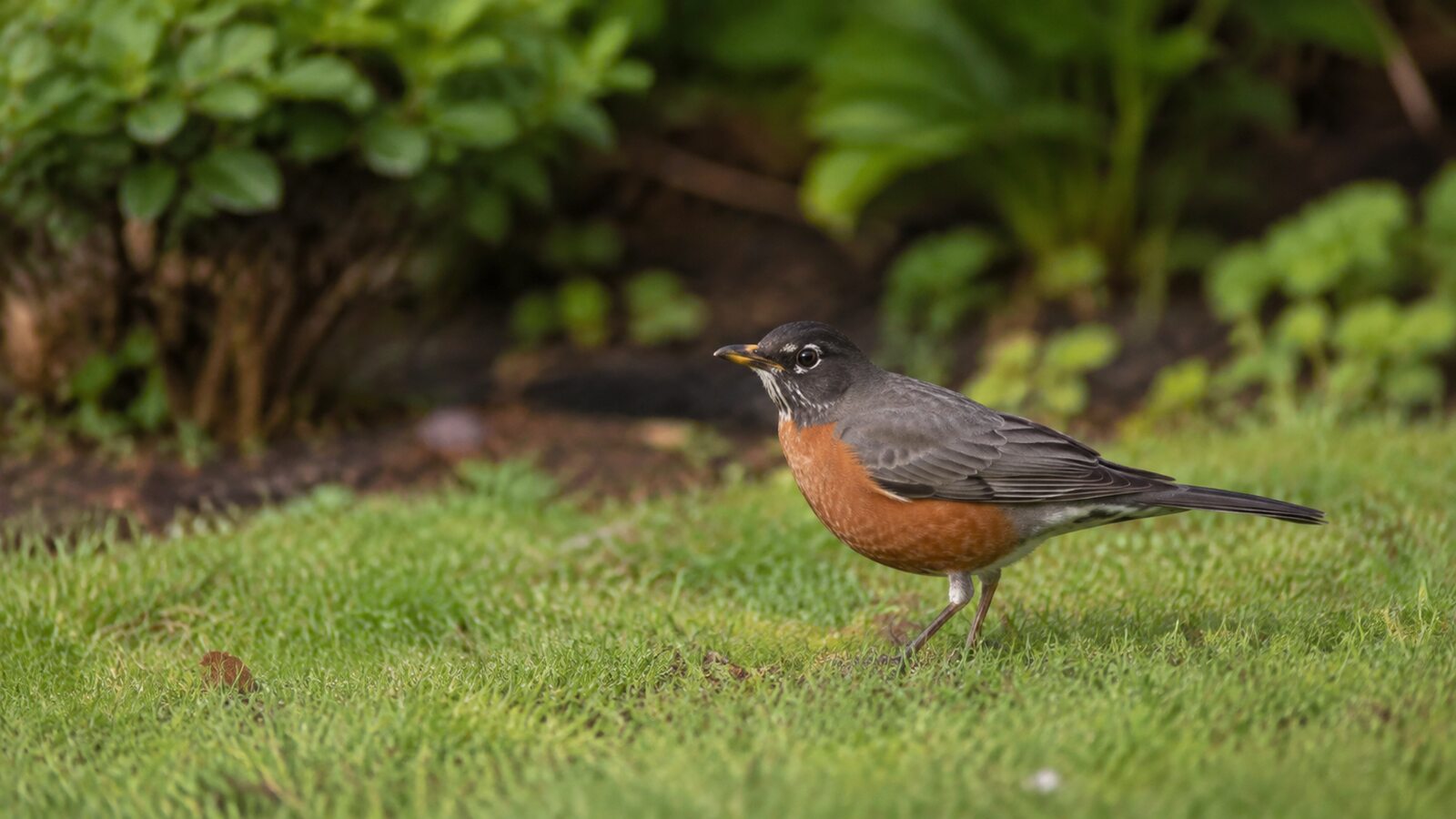
How to identify an American Robin
American Robins have a shape that becomes familiar quickly. They are larger and heavier than most sparrows, with a round body, long legs, a fairly long tail, and a straight yellow bill.
The breast and belly are warm orange to rusty red. The back is gray-brown. Adult males usually have a darker head and stronger contrast, while females often look a little paler and browner.
Look for the broken white eye ring too. It can stand out nicely when the bird is close.
Juveniles are different. Young robins have spotted breasts, which can make them look more like other thrushes until you notice the body shape and family resemblance.
American Robin song
The song is one of those sounds many people know before they know the bird.
American Robins sing a series of clear, rich whistles with a steady rhythm. Birders often turn the pattern into words such as cheerily, cheer up, but you do not need a mnemonic. Listen for a smooth phrase, a short pause, then another phrase.
At dawn, robins can sing faster and more persistently. That makes them part of the morning chorus covered in Why Do Birds Sing in the Morning?.
Robins also give short calls and sharper alarm notes. A bird's song is only one part of its voice.
Why robins run across lawns
Watch one for a minute and you will see a pattern: run, stop, look, grab.
Robins hunt earthworms, insects, and other invertebrates on or near the ground. They often cock their heads while searching, then make a quick move when they locate food. They combine visual, movement, sound, and habitat clues rather than relying on a single sense. See how birds find food.
The old idea that a robin is simply listening for a worm is too narrow. Vision plays an important role as the bird searches the surface and soil.
What American Robins eat
The menu changes with the season.
In spring and summer, robins eat large numbers of earthworms, insects, and other invertebrates. Fruit becomes especially important later in the year, including berries from many trees and shrubs.
That seasonal shift helps explain why robins can seem to disappear from lawns in winter and then turn up in flocks around fruiting trees.
They are not classic seed-feeder birds, although they may visit yards for fruit, water, and natural foods.
Where American Robins live
Robins are found across most of North America.
Lawns and city parks are familiar settings, but they are not just suburban birds. American Robins also use fields, woodlands, forests, mountains, recently burned areas, tundra, and many other habitats.
Some robins remain in the same broad region all year. Northern breeders are more likely to move south in fall. Cornell describes the species as resident or a short-distance migrant rather than one bird following one fixed migration rule.
Where do American Robins nest?
Female robins choose nest sites in trees, shrubs, and many human structures, including ledges, eaves, gutters, and light fixtures.
The nest is a sturdy cup. Grass and twigs form the structure, and mud helps bind it together. The female then lines the inside with finer dry grass.
A typical clutch contains three to five eggs. The famous robin's-egg blue is real: the eggs are usually sky blue or blue-green and unmarked.
Incubation lasts about two weeks, and the young leave the nest roughly two weeks after hatching. That is fast.
For the broader cycle, see How Long Do Bird Eggs Take to Hatch?, How Long Do Baby Birds Stay in the Nest?, and What Do Baby Birds Eat?.
Do robins really mean spring is here?
Sometimes they feel that way. The song gets louder, birds return to lawns, and nesting activity begins.
But plenty of American Robins spend winter within parts of their breeding range. They may simply become less visible because they leave lawns and gather around woodland fruit.
So seeing the first robin of spring does not always mean the species just arrived from far away. It may mean the local robins changed where they were spending their time.
American Robin look-alikes
The Varied Thrush is one of the main western look-alikes. It also has orange and dark plumage, but the male Varied Thrush shows a bold dark breast band and stronger orange wing pattern.
Spotted and Eastern Towhees can cause a quick mix-up from a poor angle. Their black-and-rufous pattern, thick sparrow-like bills, and body shape are different once you get a better look.
A juvenile robin may resemble a spotted thrush. Look at size, shape, behaviour, location, and whether adult robins are nearby.
How long do American Robins live?
Many robins die young, especially during their first year. Birds that survive those early risks can live much longer.
Cornell reports an oldest recorded wild American Robin of nearly 14 years. That is an exceptional bird, not a typical lifespan.
Frequently asked questions
Do male and female robins look different?
They are similar, but males tend to have darker heads and richer orange breasts. Females often look browner and less strongly contrasted. Individual variation and lighting can make the difference subtle.
Why do robins tilt their heads?
They are positioning their eyes while searching the ground for prey. The behaviour often happens just before a robin grabs a worm or insect.
Do robins eat birdseed?
Seed is not their main food. American Robins are much more interested in invertebrates and fruit. Water, berry-producing plants, and healthy soil can be more attractive to robins than a standard seed feeder.
Do robins stay for winter?
Many do, depending on location and food. Winter robins may form flocks and spend more time in trees and fruiting habitat, making them much less obvious than the lawn birds people notice in spring.
More familiar birds
Continue with American Crow, Common Raven, or browse all Common Birds. If you saw a bird but do not have a name yet, start with How to Identify a Bird You Saw.