
What is a normal flying speed for a bird?
There isn't one.
A small songbird moving between shrubs is doing a very different job from a goose crossing a province or a falcon chasing prey. Even the same bird can fly slowly one minute and much faster the next.
Smithsonian's migration information says about 90 percent of migrating birds have airspeeds between 15 and 45 mph. It gives typical ranges of about 10 to 30 mph for songbirds, 20 to 40 mph for shorebirds, 30 to 50 mph for waterfowl, and 20 to 45 mph for raptors.
Those numbers are a good starting point. Wind can make the speed over the ground look very different.
What is the fastest bird in the world?
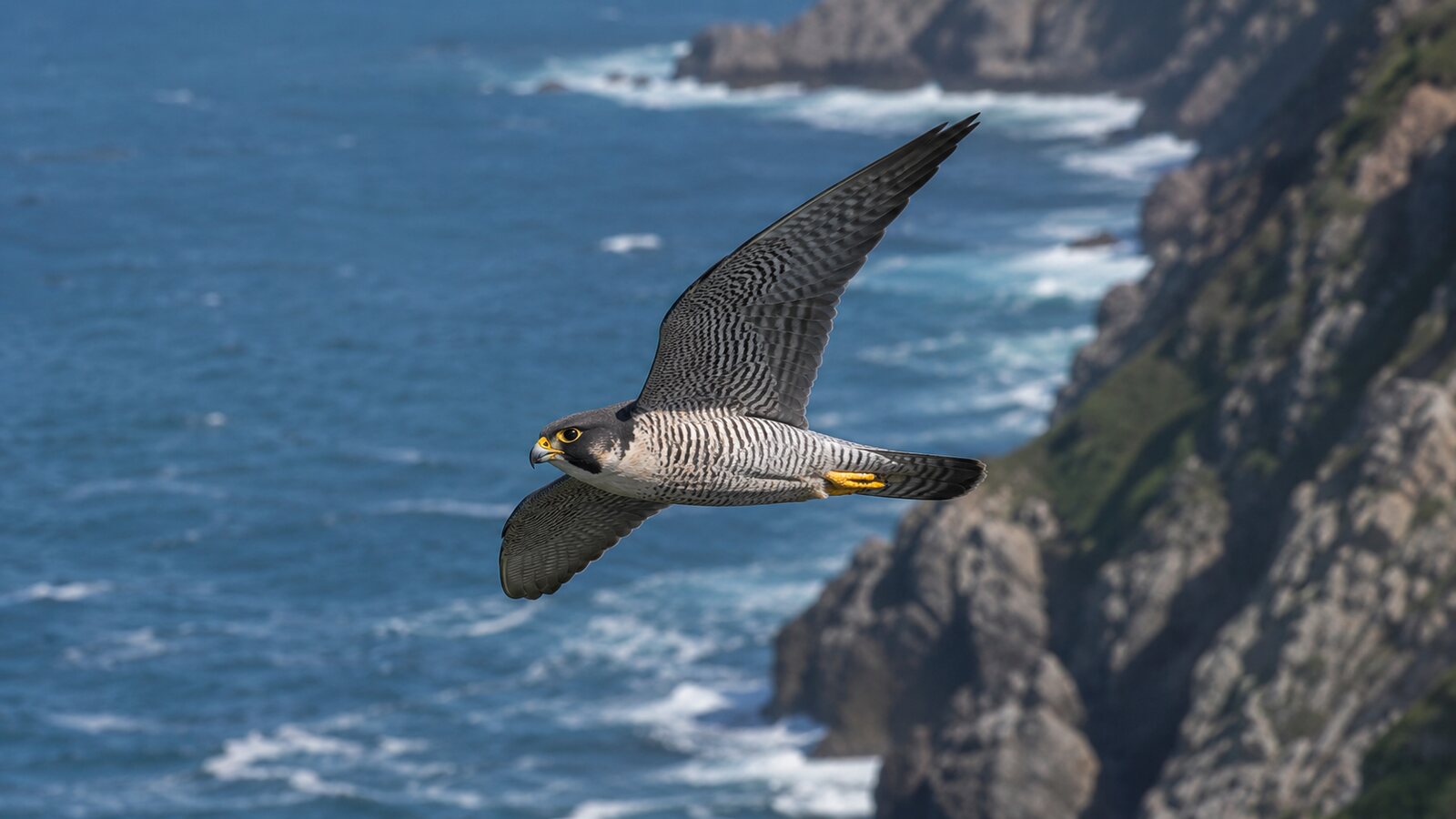
The Peregrine Falcon gets the headline.
During a hunting dive called a stoop, a peregrine folds its wings and drops at extraordinary speed. Cornell reports calculated dive speeds as high as 238 mph in research on trained falcons. More conservative field references commonly describe peregrines exceeding 200 mph.
That makes the Peregrine Falcon the bird most often called the fastest animal on Earth.
But there is a catch. It is falling as well as flying.
How fast does a Peregrine Falcon fly normally?
Much slower than 200 mph.
Cornell lists average peregrine cruising speed around 24 to 33 mph and about 67 mph when actively pursuing prey. The spectacular triple-digit numbers happen in the steep stoop.
So if someone says, “Peregrines fly at 200 mph,” the better answer is, “They can reach that kind of speed in a dive.”
How fast do birds migrate?
For a lot of migrants, think tens of miles per hour rather than hundreds.
A small bird might have an airspeed around 20 mph, yet cover the ground much faster with a strong tailwind. Put the same bird into a headwind and its ground speed drops.
This is one reason migration timing can change so quickly. Birds often wait for winds that improve the trip.
See why birds migrate for the bigger seasonal picture.
How fast do geese fly?
Geese fit within the faster end of ordinary migration flight.
Smithsonian's range for waterfowl is about 30 to 50 mph through the air. A tailwind can push their speed over the ground higher than that. A headwind can make a flock seem to crawl.
If they are flying in formation, there is another piece to the story. Read why birds fly in a V.
How fast do hummingbirds fly?
Tiny doesn't mean slow.
Smithsonian reports hummingbirds close to 30 mph in direct flight and more than 45 mph during courtship dives. They can also stop almost instantly, hover, move sideways, and reverse direction.
That control may be even more impressive than the top speed. Our page on whether birds can fly backwards explains how hummingbirds do it.
Are bigger birds always faster?
No.
Body size influences flight, but wing shape, muscle power, aerodynamic design, and behaviour matter too. A large soaring bird may be built to stay aloft efficiently rather than sprint. A compact falcon is built for speed and control.
Small swifts and shorebirds can be remarkably fast. Large herons may look almost leisurely.
What is the difference between airspeed and ground speed?
This makes bird speed much easier to understand.
Airspeed is how fast the bird moves through the surrounding air. Ground speed is how fast it moves across the landscape below.
Imagine a bird flying through the air at 30 mph with a 20 mph tailwind. Its speed over the ground could be close to 50 mph. Turn the wind around and the same bird may make only about 10 mph of progress over the ground.
The bird's effort did not suddenly change by five times. The air did.
Can birds use wind to fly faster?
Absolutely.
Migrating birds often choose favourable winds and may even change altitude to find them. Soaring birds use rising air to gain height without constant flapping. Seabirds exploit wind over waves and open water.
Flight is always a conversation with the air around the bird.
Why do birds sometimes look slower than they are?
Distance fools us.
An airplane at 30,000 feet can look like it is barely moving. A small bird passing three metres away looks impossibly fast. The same visual effect applies to birds at different distances.
A goose high overhead may be covering ground quickly even though its wingbeats look calm.
How do scientists measure bird speed?
Radar is one major tool, especially during migration. GPS tags and other tracking devices can follow individual birds over long journeys. High-speed video can measure wingbeats and dives. Aircraft observations and controlled studies have also contributed to flight records.
Each method measures a slightly different part of the story, which is why it helps to know whether a number refers to airspeed, ground speed, level flight, pursuit, or a dive.
Do birds get faster when frightened?
They often accelerate sharply.
A bird escaping a hawk, defending a territory, or racing to cover can fly much faster than it does during relaxed movement. But short bursts are not the same as a sustainable migration speed.
Think of a person sprinting across a parking lot. That's real speed. It just isn't the pace they can hold all afternoon.
Speed is only part of the effort. See whether birds get tired of flying and how migrants manage their fuel.
Frequently asked questions
How fast can birds fly?
Many migrating birds have airspeeds around 15 to 45 mph. Individual species can be slower or faster, and dives can produce much higher speeds.
What is the fastest bird?
The Peregrine Falcon is the famous record holder, exceeding 200 mph in a steep hunting dive.
How fast do geese fly?
Waterfowl commonly travel around 30 to 50 mph through the air during migration, with wind changing their ground speed.
Can a bird fly 100 mph?
Some birds can exceed 100 mph in dives or exceptional conditions. Ordinary sustained level flight for most birds is much slower.
The speed depends on what the bird is doing
A bird crossing the yard, a goose migrating with a tailwind, and a peregrine dropping on prey should not be compared with one number. Continue with how wings create lift and thrust, how birds control speed and direction, whether birds can fly backwards, or return to Bird Facts.