
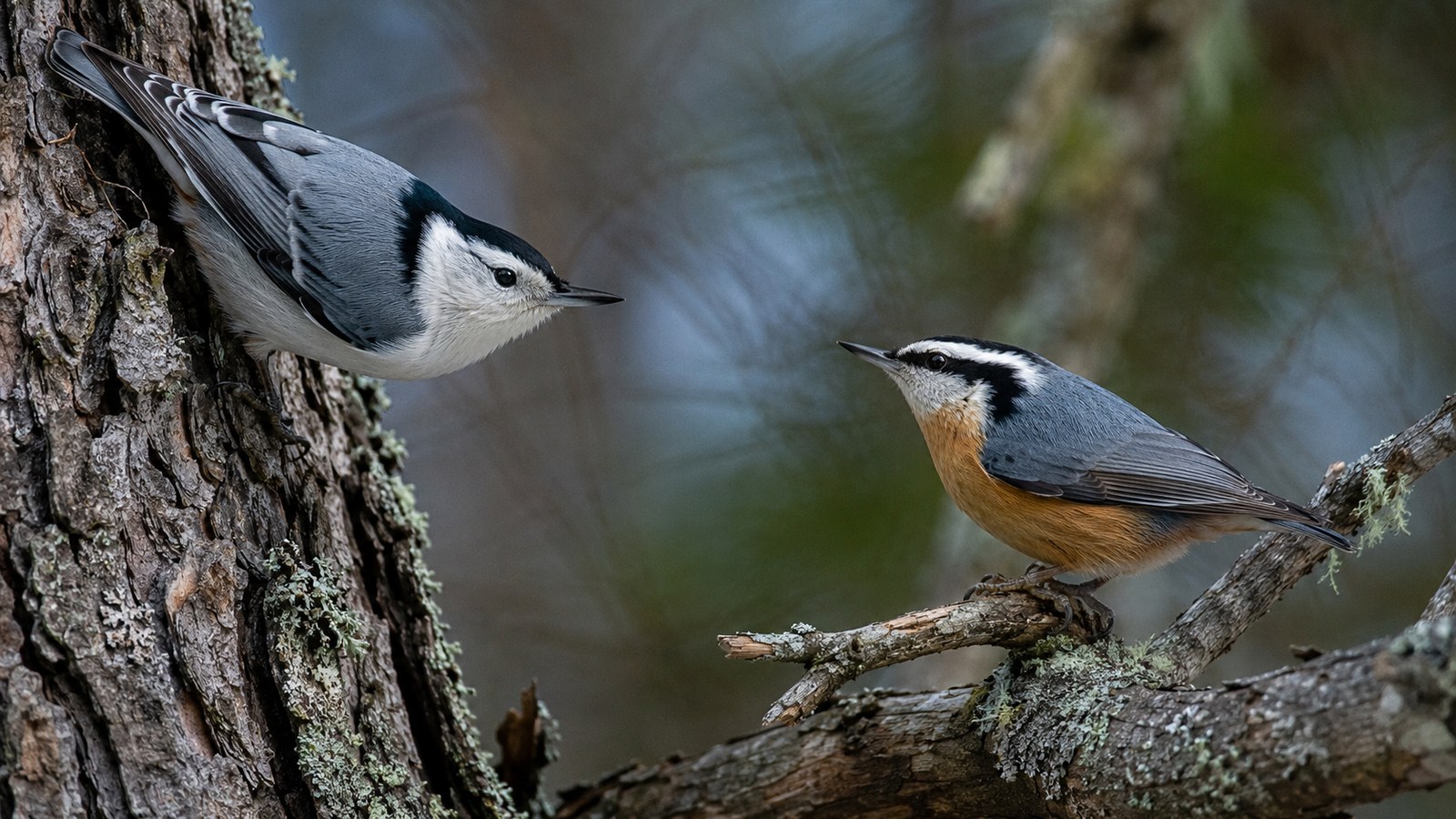
Side-by-side comparison
| Clue | White-breasted Nuthatch | Brown-headed Nuthatch |
|---|---|---|
| Size | Large for a nuthatch | Very small and compact |
| Crown | Black on many males, often grayer on females | Warm brown cap |
| Face | Broad white face and cheek | Pale face below the brown cap |
| Bill | Longer and heavier | Shorter and finer |
| Underparts | Mostly white with rusty colour near the rear | Mostly whitish to pale buff |
| Habitat | Mature deciduous and mixed woods, parks, wooded suburbs, and yards | Mature open pine forests of the Southeast |
| Range | Widespread across much of Canada and the United States | Southeastern United States |
| Voice | Loud nasal yank notes and repeated nasal song phrases | Tiny wheezy squeaks and high jumbled notes |
Look at the difference in body size first
White-breasted Nuthatch is the largest of the four regular North American nuthatches. It looks sturdy and long-billed, especially when it lands on a feeder beside a chickadee or a smaller nuthatch. Brown-headed Nuthatch is tiny, with a short tail, compact body, and much finer overall proportions.
Size is works best when there’s something familiar in the scene. A feeder port, suet cage, branch, pine cone, or second bird can provide scale. A lone bird high in a tree can fool the eye, so don’t let size carry the identification by itself.
The crown gives you a second clear clue
Brown-headed Nuthatch is well named. Its cap is brown, with a pale face and blue-gray back below it. The brown cap may look darker in shade, but it still lacks the clean dark hood and broad white cheek of a White-breasted Nuthatch.
Male White-breasted Nuthatches usually show a dark black crown and nape. Females often have a grayer crown, which can reduce the contrast. Even then, the white face, larger body, long bill, and mostly white belly keep the bird from looking like the tiny brown-capped species.
Look at the face, not just the top of the head
White-breasted Nuthatch has a strikingly open white face. The white surrounds the cheek and reaches around the eye, creating a strong dark-cap-over-white-face pattern. Brown-headed Nuthatch has a smaller pale face tucked below the brown cap.
That difference can survive poor light better than exact colour. If warm sunlight makes a crown look brownish, check whether the bird still has the broad white face and large build of White-breasted. Shape and pattern are safer than one colour impression.
Bill length helps on close feeder views
White-breasted Nuthatch has a long, sharply pointed bill that looks substantial for a songbird. Brown-headed also has the straight pointed bill expected on a nuthatch, but it’s shorter and finer on the much smaller head.
Photographs can distort bill length when the bird faces toward or away from the camera. A side view is best. If you’ve got several photos, keep the one showing the bill, crown, cheek, body length, and tail in the same frame.
The underparts are different, but not dramatically so
White-breasted Nuthatches are mostly white below, with rusty or chestnut colour concentrated toward the lower belly and undertail area. Brown-headed Nuthatches are also pale below, usually whitish to light buff.
Because both can look pale underneath, belly colour isn’t the fastest separator. Use it after size, crown, face, and bill. If the bird has rich rusty colour across much of the breast and belly, check the White-breasted vs Red-breasted Nuthatch guide instead.
Habitat can narrow a southeastern sighting
Brown-headed Nuthatches are closely tied to mature open pine forests in the southeastern United States. Longleaf and other pine systems with mature trees and an open understory are especially important. A tiny brown-capped nuthatch working pine trunks and branches in that setting fits Brown-headed well.
White-breasted Nuthatches use a broader range of wooded habitats. They’re common in mature deciduous woods, mixed forests, parks, wooded suburbs, and yards with large trees. In the Southeast, both species can occur within the same wider area, so habitat should support the visual clues rather than replace them.
Range matters, but this pair can overlap
Brown-headed Nuthatch is a southeastern species. White-breasted is widespread across much of North America and also occurs through the Southeast. That means range alone can’t finish this comparison the way it often can for Brown-headed vs Pygmy Nuthatch.
If you’re in Brown-headed range, keep both birds on the list until you see size and head pattern. A large white-faced bird is White-breasted. A tiny brown-capped bird in pine habitat is Brown-headed.
Listen for a loud yank or a tiny squeak
White-breasted Nuthatches often give a loud nasal yank call. Cornell also describes the male song as a rapid series of nasal notes in late winter and spring. The voice can carry surprisingly well for a small woodland bird.
Brown-headed Nuthatches commonly give tiny wheezy two-part squeaks, often repeated several times. Groups can answer one another from the treetops, making the sound easier to notice. One distant note can be misleading, so listen for a sequence and note which habitat it came from.
Watch flock behaviour for supporting evidence
Brown-headed Nuthatches can move in small social groups, and several birds may call while feeding through the same pines. White-breasted Nuthatches are often seen alone or in pairs, though they can join mixed-species flocks with chickadees, titmice, woodpeckers, and other woodland birds.
Flock size is only supporting evidence. A lone Brown-headed Nuthatch is still possible, and a White-breasted may be surrounded by other species. The crown and body size remain stronger clues.
Both move like nuthatches
Either species can climb up, down, and around trunks and branches. Both probe bark, investigate crevices, and move headfirst down a trunk. That behaviour confirms you’re probably looking at a nuthatch, but it doesn’t separate this pair very well.
Use movement to rule out longer-tailed chickadees, titmice, and creepers, then return to the head. The common backyard nuthatch guide compares all four regular species by shape, pattern, habitat, region, and behaviour.
Feeder visits can give you the easiest comparison
Both species may visit feeders in the right habitat. White-breasted Nuthatches often take sunflower seeds, peanuts, and suet. Brown-headed Nuthatches can also use feeders near suitable southeastern pine woods.
At a feeder, notice how much of the perch or suet cage the bird occupies. Then check the crown and bill. A feeder photograph with a fixed object for scale is much better than a cropped image with no sense of size.
Young birds can look softer than adults
Juveniles may show softer contrast and fluffier body feathers, especially shortly after leaving the nest. A young White-breasted can look less crisp than the adult shown in a field guide, while a young Brown-headed may have a subdued head pattern.
Don’t expect a young bird to match a perfect adult photo. Keep using size, bill length, habitat, location, behaviour, and the general cap-and-face pattern. If the view is poor, recording “nuthatch species” is better than forcing a precise answer.
What if you only saw the bird from behind?
A rear view hides the broad white face that makes White-breasted easy. Note the body size, bill if visible, crown colour, tree type, and call. A very small brown-capped bird in southeastern pine forest strongly favours Brown-headed.
A larger blue-gray nuthatch with a dark or gray crown should keep White-breasted high on the list. Wait for the bird to turn around a trunk. Nuthatches move constantly enough that a second angle often appears within a few seconds.
What if both species are using the same wooded property?
In the Southeast, a property with mature hardwoods beside open pine habitat can support both species in the wider area. Don’t assume every nuthatch on the property is the same bird you saw five minutes earlier. White-breasted may work larger hardwood trunks while Brown-headed moves through nearby pines.
When several nuthatches are active, identify each bird from its own clues. Note the crown, face, bill, body size, tree species, and call before following the next bird. This avoids turning a mixed group of sightings into one mistaken identification.
Keep one uncropped photo for scale
A tight crop helps for seeing the cap and face, but it removes the very scale clues that help separate a large White-breasted from a tiny Brown-headed. Keep at least one wider image showing the branch, feeder, suet cage, or nearby bird.
That wider frame can also preserve habitat. Pine needles, broad leaves, bark texture, and the height of the perch may not prove the species, but they can make the rest of the identification much easier when you review the sighting later.
A six-clue field routine
- Judge whether the bird is large or very small for a nuthatch.
- Check for a dark or gray crown versus a warm brown cap.
- Look for the broad white face of White-breasted.
- Compare the long heavy bill with the shorter finer bill.
- Record deciduous or mixed woods versus mature southeastern pine habitat.
- Listen for a loud nasal yank or a tiny repeated wheezy squeak.
Frequently asked questions
Which clue should I check first?
Use size and crown colour together. White-breasted is much larger and has a dark or gray crown. Brown-headed is tiny with a brown cap.
Can both species occur in the same backyard?
They can occur in the same southeastern region, especially where a yard sits near suitable woods and mature pines. Look at the individual bird rather than assuming the habitat guarantees one species.
Does a gray crown rule out White-breasted Nuthatch?
No. Female White-breasted Nuthatches often have a grayer crown than males. Their larger size, white face, long bill, and mostly white underparts still separate them from Brown-headed.
Which one has the squeakier call?
Brown-headed Nuthatches commonly give tiny wheezy squeaks. White-breasted Nuthatches are better known for louder nasal yank notes. Several notes are better than one isolated sound.