
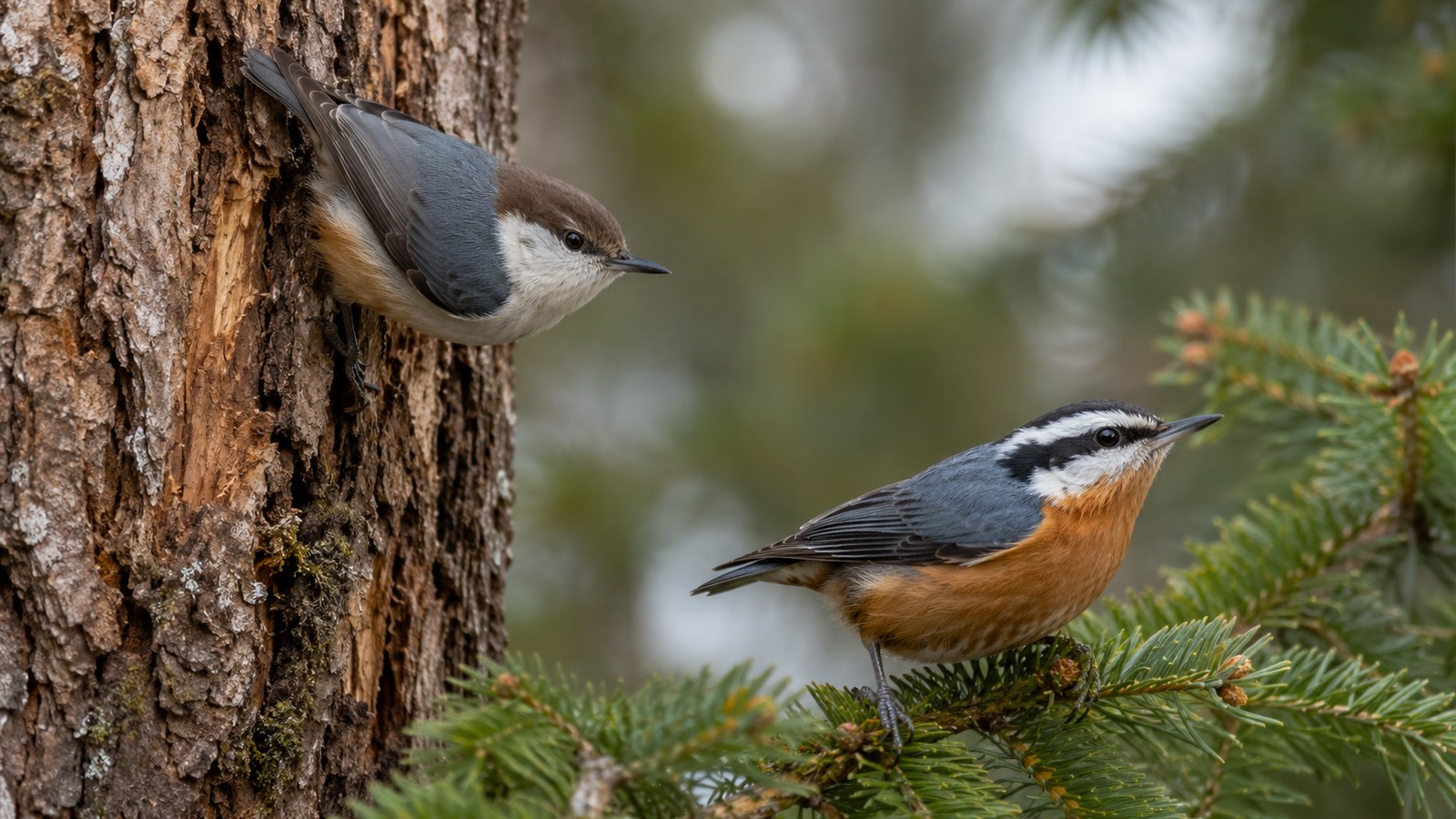
Side-by-side comparison
| Clue | Brown-headed Nuthatch | Pygmy Nuthatch |
|---|---|---|
| Range | Southeastern United States | Western North America, including southern British Columbia and western U.S. mountain and pine regions |
| Cap | Brown | Brown, often sharply defined |
| Back | Blue-gray | Blue-gray |
| Underparts | Whitish | Whitish to pale buff |
| Nape | Pale spot can show at the back of the head | Pale nape spot can also show |
| Size | Tiny and compact | Tiny, averaging slightly smaller |
| Habitat | Mature open pine forests of the Southeast | Western pine forests, especially mature ponderosa pine |
| Voice | Wheezy squeaks, often two-syllabled and repeated | Short staccato piping notes, titters, trills, and flock chatter |
Why this pair looks so confusing
Both birds are tiny, short-tailed nuthatches with blue-gray backs, brown caps, pale underparts, pointed bills, and pale areas near the back of the head. A quick photograph with no location attached can make them look almost interchangeable.
That’s exactly why range matters so much. Cornell lists each as a similar species for the other, while also noting that their ranges don’t overlap. You usually don’t need to split them from a tiny feather detail.
Start with the map, not the cap
If the bird is in Florida, Georgia, the Carolinas, the Gulf Coast, or another part of the southeastern United States within Brown-headed range, Pygmy isn’t the expected answer. Brown-headed belongs to southeastern pine country.
If the bird is in British Columbia, Washington, Oregon, California, the Rocky Mountain region, Arizona, New Mexico, or other western pine country within Pygmy range, Brown-headed isn’t the expected answer. Pygmy is the western bird.
The ranges normally don’t overlap
This is one of those identifications where geography isn’t a weak supporting clue. It’s central to the answer. The species occupy widely separated parts of North America, so a normal backyard or woodland sighting should fit only one of them.
If a photograph appears wildly outside the expected range, check the date, location metadata, and whether the image was shared from somewhere else. For a genuinely unusual sighting, keep the photographs and notes and seek local expert review rather than assuming the range map is wrong.
Brown cap versus brown cap isn’t enough
Both species have brown crowns. Pygmy often shows a sharply defined brown cap that ends around the eye, while Brown-headed also shows a clear brown crown over a pale face. The cap shade can shift with light and camera settings.
Neither species should be identified from "brown cap" alone. Use the cap to confirm that you’re dealing with one of the small brown-capped nuthatches, then let region and pine habitat do the heavier work.
The pale nape spot can occur on both
Pygmy Nuthatches often show a small pale spot at the back of the neck. Brown-headed Nuthatches can show a pale area there too. That makes the nape spot less reliable for splitting this pair than it first appears.
A photograph from behind may show the spot beautifully and still not settle the species. Keep the image, but pair it with location, voice, habitat, and a side view of the head.
Size is a weak separator
Pygmy Nuthatch averages slightly smaller, but both birds are tiny. Without a direct comparison, that difference is far too subtle for most field sightings. Branch thickness, camera zoom, and distance can change the impression immediately.
Size works better for separating either bird from White-breasted Nuthatch, which is much larger, or from Red-breasted Nuthatch, which is larger and has a more strongly striped face.
Both are pine specialists, but in different regions
Brown-headed Nuthatches favour mature open pine forests of the Southeast. They often work trunks, branches, and pine crowns in areas with an open understory. Yards near suitable pine habitat can attract them to feeders and bird-friendly trees.
Pygmy Nuthatches are western pine specialists and are especially associated with mature ponderosa pine. They can also use other pine forests. A flock moving through tall western pines fits Pygmy much better than Brown-headed even before you see the cap.
Both can sound like squeaky toys
Voice is interesting because both species are sometimes compared with a rubber-duck or squeaky-toy sound. Brown-headed Nuthatches commonly give wheezy squeaks that can sound two-syllabled and may be repeated several times.
Pygmy Nuthatches often give shorter, sharper piping notes in a staccato rhythm. Large groups also produce titters, trills, and constant chatter. The difference is easier to hear from several notes than from one isolated squeak.
Social behaviour can help a little
Both species can be social, and both may be found with other birds. Pygmy Nuthatches are especially known for extended family groups and large flocks. A busy western pine stand full of tiny brown-capped birds and nonstop piping fits Pygmy very well.
Brown-headed Nuthatches can also move in groups and join mixed-species flocks, so flocking isn’t a hard dividing line. Use it as context after range and habitat.
Watch how they work the tree
Both birds move like nuthatches. They climb up, down, and around trunks and branches, probe bark, and search pine needles and cones. Their short tails and compact bodies make them look almost neckless as they move.
That behaviour helps confirm the bird family but does little to separate these two species. It is better for ruling out chickadees, kinglets, and other small birds sharing the same trees.
Young Pygmy Nuthatches can look less typical
Juvenile Pygmy Nuthatches can be paler overall, with a grayer crown and a yellowish bill. That can make a young western bird look less like the rich brown-capped adult shown in many field-guide images.
Don’t let a softer summer plumage pattern override location. The bird is still in western Pygmy range, and habitat, flock behaviour, size, and calls can support the identification while the plumage matures.
Feeder sightings still need habitat context
Both species can visit feeders within their ranges. A feeder sighting gives you a close look at cap colour, bill, body size, and behaviour, but the surrounding habitat still matters. A yard beside mature pines is more likely to host these birds than a treeless urban block.
Keep sunflower seeds, peanuts, or suet fresh, clean the feeder regularly, and provide nearby natural cover. Even when a nuthatch uses the feeder, it may spend much of the day foraging naturally on bark and in pine foliage.
What if the location is missing from a photograph?
This is the hardest version of the comparison. Without location, the plumage may not give a confident answer. Look for the exact cap shape, amount of buff below, nape pattern, bill proportions, flock size, and any visible tree clues, but be ready to stop at "Brown-headed/Pygmy Nuthatch."
That broader label is better than pretending one tiny difference is diagnostic when it isn’t. If you can contact the photographer, the state, province, or country may solve the identification in seconds.
Save the location with your bird photos
This pair is a good example of why location belongs in field notes. A photo of a tiny brown-capped nuthatch can be difficult to label years later if the place has been forgotten. The same image may become straightforward as soon as you know it came from a longleaf pine forest in the Southeast or a ponderosa pine stand in the West.
You don’t need to publish an exact nest or private-property location. A park, county, state, province, or general region is often enough for identification. Keep the date too, because season can help with other species that may appear in the same flock.
Don’t confuse either one with Red-breasted
Red-breasted Nuthatch has a bold white eyebrow above a dark eye stripe and usually much warmer cinnamon or rusty underparts. Those marks give the face a striped look missing from Brown-headed and Pygmy.
In western North America, the Pygmy vs Red-breasted Nuthatch guide covers that comparison in detail. In the Southeast, the same white-eyebrow clue helps separate Red-breasted from Brown-headed during seasons when Red-breasted moves south.
A six-clue field routine
- Confirm a tiny compact nuthatch with a brown cap.
- Record the exact state, province, or region.
- Check whether the habitat is southeastern pine or western pine.
- Listen to several calls rather than one squeak.
- Note flock size and whether the birds are moving as a social group.
- Use plumage details as confirmation, not as a substitute for range.
Frequently asked questions
Can Brown-headed and Pygmy Nuthatches occur together?
Not in their normal ranges. Brown-headed is southeastern and Pygmy is western. A claimed overlap sighting deserves careful documentation and review.
Which one has the paler spot at the back of the head?
Both can show a pale nape area, so that mark doesn’t safely separate them. Use location and habitat first.
Which one sounds more like a rubber duck?
Descriptions of both species use squeaky-toy comparisons. Brown-headed often gives wheezy repeated squeaks, while Pygmy commonly gives short staccato piping and flock chatter. Listen to rhythm and several notes.
What should I call a photo when I don’t know where it was taken?
If the plumage isn’t enough, "Brown-headed/Pygmy Nuthatch" is a reasonable temporary label. Adding the location later may solve the identification immediately.