
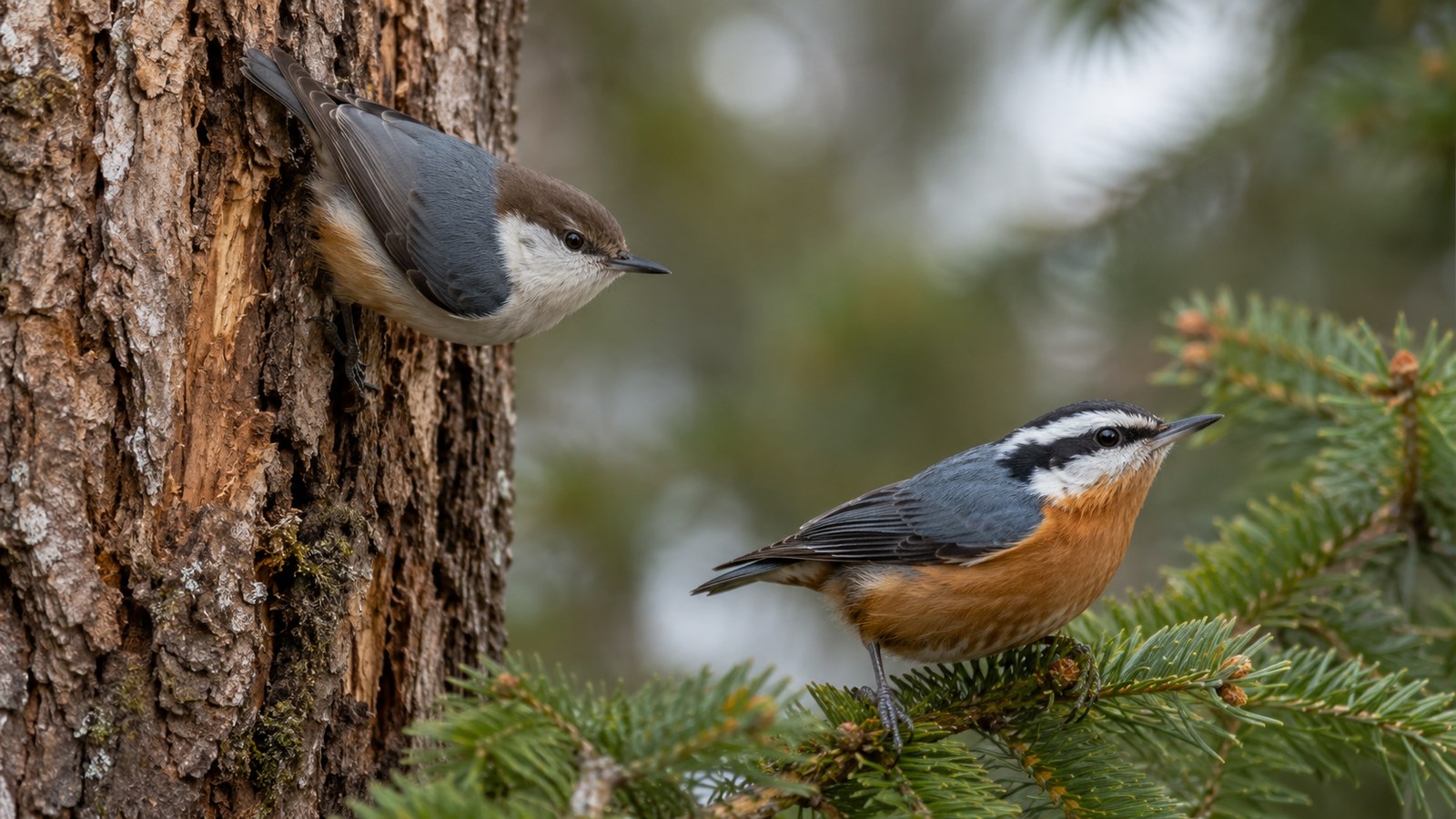
Side-by-side comparison
| Clue | Pygmy Nuthatch | Red-breasted Nuthatch |
|---|---|---|
| Head | Brown crown, pale face, often a pale nape spot | Dark crown, bold white eyebrow, dark eye stripe |
| Underparts | Whitish to pale buff | Rusty, cinnamon, or warm buff-rust |
| Size | Very tiny, the smallest North American nuthatch | Small but larger and more substantial |
| Back | Blue-gray | Blue-gray |
| Habitat | Western pine forests, especially mature ponderosa pine | Conifer forests of spruce, fir, pine, hemlock, larch, and cedar; broader habitats during movement |
| Voice | Short squeaky piping notes, often in busy groups | Repeated nasal yank notes, often hornlike |
| Social behaviour | Often in family groups and larger social flocks | Often alone, in pairs, or with mixed-species flocks |
| Season | Usually resident within its western range | Can move widely in fall and winter, with numbers changing from year to year |
The head pattern is the fastest clue
Pygmy Nuthatches look brown-capped. The crown is rich brown and ends sharply around the eye area. The face below the cap is pale, and a small pale patch can show at the back of the neck. Some birds can show a darker line near the eye, but the head still lacks the bold striped look of Red-breasted.
Red-breasted Nuthatches have a strong white eyebrow above a dark stripe through the eye. Males tend to have darker crowns, while females can look grayer, but both sexes keep the eyebrow-and-eye-stripe pattern. That pattern is usually visible before you can judge the exact shade of the belly.
Underparts give you a second strong clue
Pygmy Nuthatches are pale below, usually whitish to creamy buff. They can pick up warm tones from sunlight, bark, or reflected pine needles, but they don’t normally show the broad rusty wash of a Red-breasted Nuthatch.
Red-breasted Nuthatches are warm below. Males are often richer cinnamon or rusty, while females can be much paler. A pale female may not look obviously "red-breasted," so the face pattern remains more dependable than colour alone.
Size helps most when the birds are together
Pygmy Nuthatch is tiny, with a compact body, short square tail, and small sharp bill. Red-breasted Nuthatch is still a small bird, but it usually looks longer and more substantial beside a Pygmy.
Don’t rely on size when a bird is alone. Distance can reverse the impression. A nearby Pygmy may look larger than a Red-breasted farther up the tree. A feeder port, branch, pine cone, or second bird makes size much easier to judge.
Both can have blue-gray backs
A rear view can be frustrating because both species are blue-gray above and both have short tails. If all you see is the back, record the size, tree type, flock size, and call rather than guessing from shade.
Wait for the bird to circle the trunk or turn sideways. Nuthatches rarely stay in one position for long, and one brief head view can reveal either the brown crown of Pygmy or the striped face of Red-breasted.
Bill and body shape are supporting clues
Both species have the pointed bill and compact, almost neckless shape of a nuthatch. Pygmy usually looks especially tiny and round, with a very short square tail. Red-breasted often looks a little longer through the bill and body, even though it remains much smaller than White-breasted Nuthatch.
Shape is works best when two birds are close together. On a lone bird, angle can make the bill seem longer or the body seem larger. Use shape to support the crown, face pattern, underparts, and habitat rather than letting a single silhouette decide the species.
Habitat can point you in the right direction
Pygmy Nuthatches are strongly tied to western pine country and are especially associated with mature ponderosa pine. They forage along trunks, branches, bark, and needle clusters, often moving through the trees in noisy social groups.
Red-breasted Nuthatches favour conifers too, but their habitat is broader. Spruce, fir, pine, hemlock, larch, and western red cedar can all support them. In eastern North America and during winter movements, they may also turn up in mixed woods, parks, orchards, and neighbourhood trees.
The ranges overlap in the West
This pair is worth learning because both species can occur in parts of western Canada and the western United States. A pine forest may hold both, especially where local elevation and forest structure create several kinds of conifer habitat close together.
Range therefore helps, but it doesn’t finish the identification. In shared areas, use the face, belly, size, voice, and flock behaviour. If the bird has a white eyebrow and rusty belly, Red-breasted should rise quickly on the list. If it has a brown cap and pale belly, think Pygmy.
Listen for piping versus yank notes
Pygmy Nuthatches often sound busy and conversational. Their most familiar calls are short, shrill piping notes that may remind some listeners of a squeaky toy. A group can create a constant stream of small notes as birds move through the pines.
Red-breasted Nuthatches often give repeated nasal yank notes. The notes can sound thin, hornlike, and more drawn out than the short Pygmy piping. Record several calls when possible. One distant note can lose the timing and tone that separate the two.
Flock size can support the identification
Pygmy Nuthatches are unusually social. Family groups can stay together, and larger flocks may forage and move through pine stands as a unit. If several tiny brown-capped nuthatches are chattering together, that social setting fits Pygmy well.
Red-breasted Nuthatches can join chickadees, kinglets, woodpeckers, and other birds in mixed flocks, but a cluster of nearly identical tiny nuthatches moving together is more characteristic of Pygmy. Behaviour should support the plumage, not replace it.
Mixed flocks can contain both kinds of clue
A western mixed flock may include chickadees, kinglets, creepers, woodpeckers, and nuthatches. Listen for which bird is making each call before matching a sound to the bird you’re watching. A Red-breasted Nuthatch may be calling from one trunk while several Pygmy Nuthatches chatter farther back in the pines.
Follow one bird at a time. Note its head pattern, then its call, then its neighbours. This prevents a common field mistake where the plumage of one bird gets paired with the voice of another.
Season matters more for Red-breasted
Pygmy Nuthatches are generally resident within their western range. The same pine woods may hold them through the year. Red-breasted Nuthatches can be much more changeable, with some fall and winter seasons bringing many birds into places where they were scarce the year before.
That makes the date worth recording when a new nuthatch suddenly appears at a feeder or in a city park. A small striped-faced nuthatch in fall or winter may be part of a wider Red-breasted movement.
Feeder visits can give you a close comparison
Red-breasted Nuthatches regularly visit feeders within their range, and Pygmy Nuthatches can also use feeders where yards meet suitable western pine habitat. Sunflower seeds, peanuts, and suet can bring either species into view.
A feeder helps because it gives you a fixed scale. Note the bird’s size against the same port or cage, then look for the eyebrow, eye stripe, crown colour, and belly. Keep the feeder clean and place it where birds have nearby escape cover.
What if the bird is in poor light?
Warm light can make a Pygmy Nuthatch look more buff below, while deep shade can make a Red-breasted Nuthatch lose much of its rusty colour. Camera white balance can make the problem worse.
Head pattern is less vulnerable to those colour shifts. Look for the white eyebrow and dark eye stripe. If those marks are missing and the crown looks brown, use size, habitat, voice, and flocking to test Pygmy.
Juveniles can soften the usual pattern
Young Pygmy Nuthatches can look paler than adults, with a grayer crown and a yellowish bill. That can make the brown-cap clue less obvious for a short time. The tiny size, short tail, pine habitat, social group, and piping calls can still help.
Young Red-breasted Nuthatches can also look duller than bright adults. Don’t expect every bird to match a saturated field-guide illustration. Use several independent clues and keep age in mind during summer.
What to photograph
Try to keep one side view showing the crown, eyebrow area, eye, breast, belly, bill, and tail. A second wider image that includes the tree or feeder can preserve scale and habitat. If several birds are present, include more than one in the frame when you can.
A short phone recording can be just as valuable as a photograph. Pygmy piping and Red-breasted yank notes may be easier to compare later when you can listen to the pace and repetition without trying to follow the bird at the same time.
A seven-clue field routine
- Confirm a compact nuthatch with a short tail and pointed bill.
- Check for a brown crown or a bold white eyebrow.
- Look for a dark stripe through the eye.
- Decide whether the underparts are pale or broadly rusty.
- Note whether the trees are mainly mature pine or a broader conifer mix.
- Listen for short piping notes or repeated nasal yank notes.
- Record flock size, season, and location before deciding.
Frequently asked questions
Which clue should I check first?
Check the head. A brown crown without a strong white eyebrow fits Pygmy. A bold white eyebrow over a dark eye stripe fits Red-breasted.
Can a Pygmy Nuthatch look rusty underneath?
It can look warm buff, especially in golden light, but it normally lacks the broad cinnamon or rusty wash of Red-breasted. Check the head pattern before trusting colour.
Can both species be in the same pine forest?
Yes, in parts of the West. Pygmy is especially tied to mature ponderosa pine, while Red-breasted uses a wider range of conifer forests and may move through seasonally.
Which species is more likely to be in a large group?
Pygmy Nuthatches are especially social and often travel in family groups or larger flocks. Red-breasted Nuthatches can join mixed flocks, but the flock may contain several different species.