
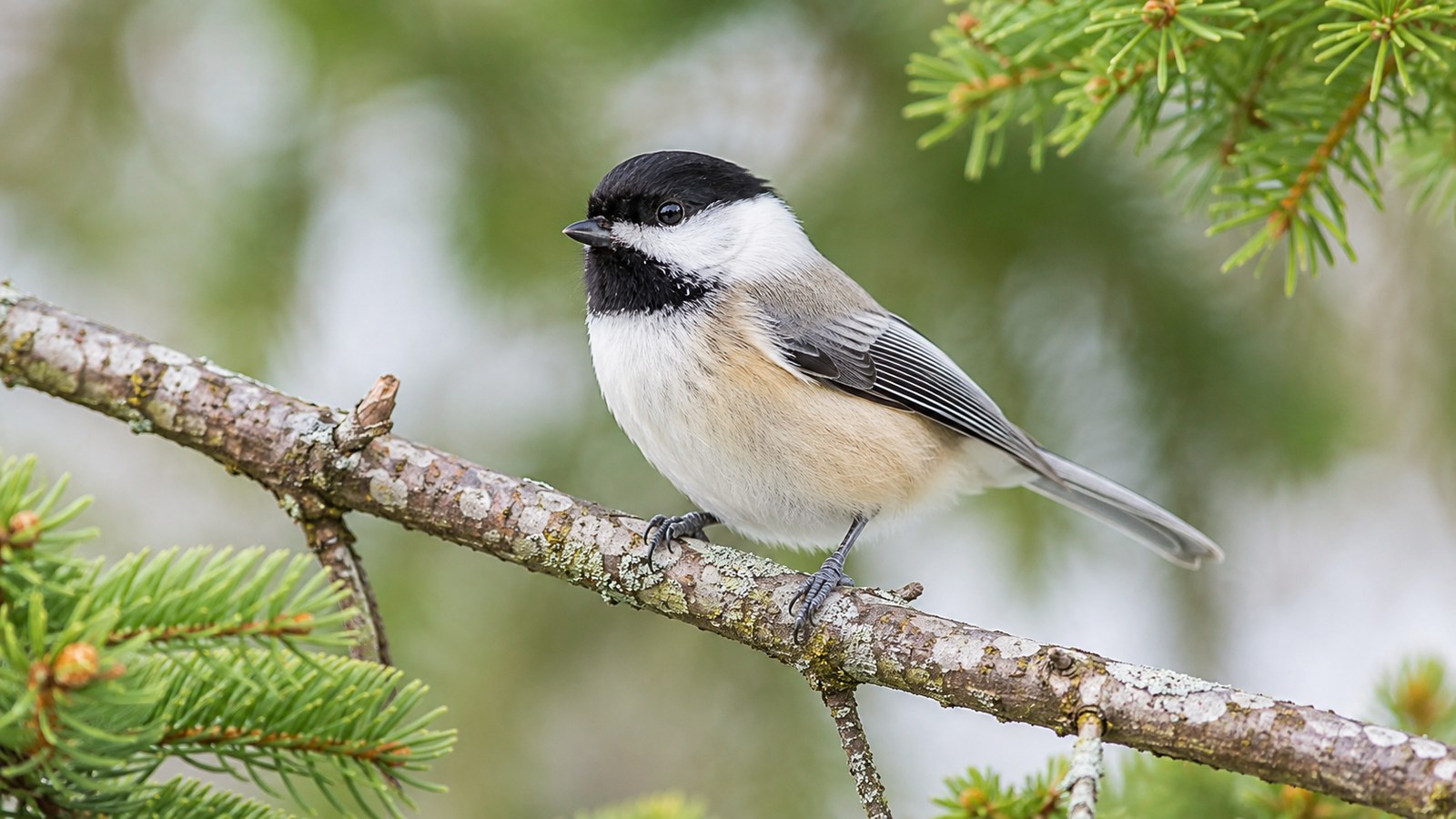
Why chickadee sounds help and difficult
Chickadees are often heard before they’re seen. Their contact calls can lead a bird watcher to a mixed flock moving through trees, while clear spring whistles may carry across a neighbourhood or forest edge. Sound is especially valuable when a bird stays inside dense spruce or high evergreen branches.
The difficulty is that chickadees share related calls. The number of notes changes with context, regional songs can differ, and alarm calls may sound harsher than calm contact calls. A dependable identification uses the whole phrase, including pitch, pace, tone, rhythm, repetition, habitat, and location.
Six North American chickadees by sound
| Bird | Starting sound | Important caution |
|---|---|---|
| Black-capped Chickadee | Clear two- or three-note whistle across much of the range; familiar chick-a-dee call | Pacific Northwest songs can use three or four notes on similar pitches |
| Carolina Chickadee | Often a four-note whistle; rapid chickadee call; varied gargles and raspy notes | At least several dozen song patterns occur, so four notes aren’t universal |
| Mountain Chickadee | Sweet whistle with a pitch drop; lively chickadee calls, sometimes with extra notes | Can sound very similar to Black-capped in western overlap areas |
| Chestnut-backed Chickadee | Fast, high, thin, scratchy chickadee call and clicking or gargling notes | Usually lacks the clear whistled song used by most other chickadees |
| Boreal Chickadee | Slow, harsh, raspy chick-a-dee call, often heard within spruce or fir | Distance and wind can remove the rough quality |
| Mexican Chickadee | Complex whistles and gargles; buzzy introduction and harsh raspy ending in calls | Range and dark plumage are strong confirmation clues |
Song and call aren’t the same thing
A song is usually a more regular, repeated phrase associated with territory or breeding communication. A call can maintain contact, signal alarm, coordinate movement, express aggression, or connect adults and young. Chickadees use both, but not every species uses a familiar clear whistle.
Write down which type you heard. A pure whistled phrase and a rough chick-a-dee call may come from the same Black-capped Chickadee. Treating them as two unrelated birds can make the flock seem more complicated than it is.
Black-capped Chickadee: clear whistles with regional variation
Across much of North America, the Black-capped Chickadee song is a pure two- or three-note whistle with a noticeable drop in pitch. Cornell describes the familiar pattern as fee-bee or hey, sweetie. The exact number and spacing of notes vary.
Pacific Northwest birds may sing three or four notes on similar pitches rather than the familiar eastern drop. Black-capped songs also differ in a few other local areas. Location matters, and a visitor should learn the common song used near home rather than expecting one continent-wide pattern.
The Black-capped chick-a-dee call changes with alarm
Black-capped Chickadees can add more dee notes when a threat is important. The call is therefore not a fixed phrase with one correct note count. A calm contact call may be shorter, while a flock surrounding a predator may produce longer, more urgent sequences.
Count the notes, but also record the context. Was a hawk nearby? Were several chickadees scolding together? Did the call become longer after a sudden movement? Context explains variation that might otherwise be mistaken for another species.
Carolina Chickadee: often four notes, but many songs
Carolina Chickadees often sing a four-note whistle, commonly described as alternating higher and lower notes. Cornell also documents many other song patterns. A four-note phrase is a strong starting clue in the southeastern and south-central United States, not an automatic identification.
The Carolina chickadee call is often faster than the comparable Black-capped call. In or near the contact zone, sound, range, white wing edging, and photographs should agree. Hybrid birds can learn or produce mixed patterns, so a careful record may remain Black-capped/Carolina Chickadee.
Mountain Chickadee: a familiar whistle in western conifers
Mountain Chickadees sing a sweet whistled phrase in which a later note is lower than the first. The song can resemble Black-capped, and some Mountain songs add more notes. Their chickadee calls may sound lively or slightly husky.
Use the western mountain setting and look for the white eyebrow. A whistle coming from pine or fir at higher elevation helps evidence, but a Black-capped Chickadee may also occur in the wider region. The Mountain vs Black-capped guide combines voice with eyebrow, habitat, elevation, wings, and sides.
Chestnut-backed Chickadee: thin, scratchy, and without the familiar whistle
Chestnut-backed Chickadees usually give fast, high, scratchy chickadee calls. Cornell notes that their call often has fewer dee notes than a Black-capped call, although the number varies. They also make clicking or gargling notes.
The absence of a clear whistled song helps in Pacific evergreen forest. Confirm the bird by looking for a rich brown back. The Chestnut-backed vs Black-capped guide also covers gray-sided central California birds.
Boreal Chickadee: slow, harsh, and raspy
The Boreal Chickadee’s most familiar call is a raspy, harsher version of the chick-a-dee phrase. It may sound slower and buzzier than a Black-capped call. This rough quality can reveal a bird that remains hidden in dense spruce.
Wind, distance, and recording quality can soften the rasp. Confirm the call with northern spruce or fir habitat and a brown cap, gray nape, small bib, warm sides, and plain wings. The Boreal vs Black-capped guide explains the full combination.
Mexican Chickadee: complex songs in a limited mountain range
Mexican Chickadees have some of the most complex songs among North American chickadees. Cornell describes lively combinations of alternating gargles and whistles, along with a double-noted whistled song. Calls can begin with a buzz and end with a harsh raspy note.
Location matters a lot. In the United States, Mexican Chickadees are limited to mountain forests in a small part of southeastern Arizona and southwestern New Mexico. Their extensive black bib and gray flanks also help separate them from other chickadees.
Gargles, scolds, and alarm notes
Several chickadees use gargling sounds during close social encounters. These can signal aggression, pair communication, or flock interactions. High thin alarm notes may be given when an aerial predator passes overhead, while harsher scolding can gather a group around a perched threat.
A gargle is rarely the best first species clue because related birds share these social sounds. Note the surrounding habitat, visible head pattern, back colour, and whether a clearer song or full chickadee call follows.
Describe a sound before naming the bird
Write down what the phrase actually did. Was it whistled, buzzy, scratchy, raspy, or gargled? Did the pitch fall after the first note? Were the notes evenly spaced? Was the call fast or slow? Did the phrase repeat at regular intervals?
This description still helps even when the first identification is wrong. A note such as “four clear whistles, alternating high and low, repeated five times from deciduous trees” preserves evidence. Writing only “Carolina Chickadee” doesn’t.
A seven-question listening worksheet
- Was the sound whistled, buzzy, scratchy, raspy, or gargled?
- How many clear notes were present?
- Did the pitch rise, fall, alternate, or remain level?
- Was the rhythm quick, slow, even, or broken?
- Did the bird repeat the phrase, and did it change?
- What habitat, elevation, date, and location were present?
- Was the bird seen well enough to confirm the head, back, wings, or sides?
Make a phone recording
Begin recording before walking closer. Hold the phone still, point the microphone toward the sound, and avoid rubbing the case or changing your grip. A longer recording that includes several phrases, background birds, and a spoken location note is better than one clipped note.
Remain far enough away that the bird continues normal behaviour. Don’t surround a calling bird, approach a nest, or repeatedly play recordings to provoke a response. Natural calls heard from a respectful distance provide better observations.
Use automated suggestions as a shortlist
Sound-identification tools can suggest possibilities, but they may select the loudest background bird, confuse similar chickadees, or change answers as the recording continues. Treat the result as a shortlist.
Compare the suggestion with local range, habitat, season, visible plumage, and the full recording. The general bird sound identification guide explains how to describe pitch, pace, rhythm, tone, repetition, and recording context before accepting a match.
Common chickadee sound mistakes
- Assuming every two-note whistle is Black-capped Chickadee.
- Assuming every four-note whistle is Carolina Chickadee.
- Counting dee notes without noting alarm or flock behaviour.
- Ignoring regional Black-capped songs in the Pacific Northwest.
- Using a distant scratchy call without checking habitat and range.
- Accepting one automated suggestion without a visual or geographic check.
- Following a bird too closely and changing its normal calling behaviour.
Frequently asked questions
Which chickadee usually sings a two-note whistle?
Across much of North America, Black-capped Chickadees commonly sing a clear two- or three-note whistle. Pacific Northwest songs can have three or four notes on similar pitches.
Which chickadee often sings four notes?
Carolina Chickadees often sing a four-note whistle, but they’ve many other song patterns. Use range, habitat, wing pattern, and photographs to confirm the sound.
Can the number of dee notes identify a chickadee?
Not by itself. Chickadees change the number of dee notes with alarm and social context. Pace, tone, complete phrase, range, habitat, and visible marks are more dependable together.
Which chickadee has the harshest call?
Boreal Chickadees often give a slow, harsh, raspy call. Mexican Chickadees also make harsh raspy notes, but their range and dark plumage are very different.