
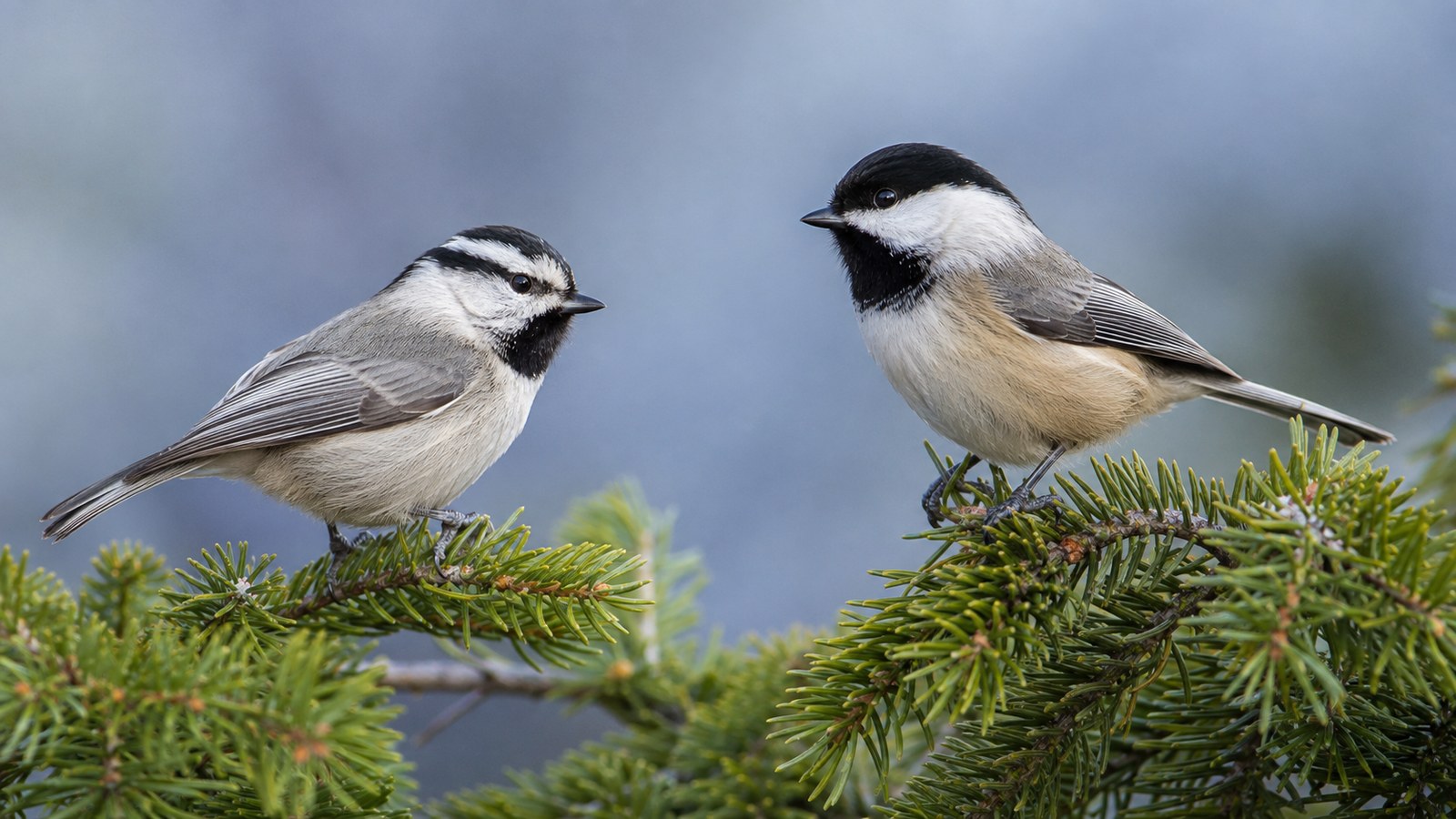
Why these two chickadees can appear together
Mountain and Black-capped Chickadees share the same compact shape, short bill, white cheeks, dark bib, gray back, pale underparts, and active feeding style. Both may visit feeders, join mixed winter flocks, cling to twigs, and hang below cones or branches. In parts of western Canada and the western United States, both can occur within the same wider region.
The head pattern usually makes the identification straightforward. The problem begins when the bird faces the observer, turns away, moves through shadow, or appears in a blurred photograph. A careful comparison should therefore use a few clues rather than depending on one brief flash of white above the eye.
Mountain and Black-capped Chickadee comparison
| Feature | Mountain Chickadee | Black-capped Chickadee |
|---|---|---|
| Eyebrow | White stripe above the eye | No white eyebrow |
| Cap | Black cap appears divided by the eyebrow | Solid black cap |
| Back | Usually cool gray | Gray, sometimes with a slight olive cast |
| Sides | Often pale gray or lightly buff | Often warmer buff, especially toward the rear flanks |
| Wings | Gray wings with pale edging that varies by region and wear | Often shows noticeable pale feather edging |
| Habitat | Western mountain conifers and higher slopes | Deciduous, mixed, streamside, valley, park, and neighbourhood woodland |
| Elevation | Commonly middle and higher mountain elevations | Often lower valleys and drainages in western overlap areas |
| Sound | Chickadee calls and whistled songs, often with a husky quality | Clear chickadee calls and familiar whistled song, with regional variation |
Find the eyebrow from more than one angle
The Mountain Chickadee’s white eyebrow, also called a supercilium, runs above the eye through the black cap. It’s the most dependable visible difference. A clean side view can make it look broad and bright. A direct front view may show only small pale marks near the forehead, while a rear view can hide the stripe almost completely.
Wait for the bird to turn. A chickadee often returns to the same feeder approach branch or cone. Studying that spot may produce a better side profile than following the bird around the whole yard. A short sequence of photographs can also reveal the stripe in one frame even when it disappears in the others.
When the eyebrow looks weak or missing
Light can change the eyebrow’s appearance. Deep shade may make white feathers look gray. Bright snow can reduce contrast. Motion blur can blend the eyebrow into the cap, and a twig may cross the exact part of the head that matters. Feather wear may also make the stripe look narrower or less tidy.
Don’t turn one unclear photograph into proof of Black-capped Chickadee. Check the full cap in several frames, then use forest type, elevation, location, flank colour, wings, and calls. The bird may remain unidentified when the head never becomes visible enough.
Use forest type and elevation as supporting clues
Mountain Chickadees are strongly associated with dry western mountain forests, especially pine, fir, spruce, and other evergreen stands. Black-capped Chickadees often use broad-leaved trees along streams, wooded valleys, mixed forests, parks, and residential areas. Cornell notes this conifer-versus-drainage difference as a good comparison where the species approach one another.
Habitat isn’t an invisible fence. Black-capped Chickadees can enter conifers, and Mountain Chickadees can descend to feeders or lower slopes outside the breeding season. The most convincing identification combines the white eyebrow with a habitat that makes sense.
Seasonal movement can change the local shortlist
Mountain Chickadees may move to lower elevations during cold weather or when mountain food changes. That can bring them into neighbourhoods where residents usually notice Black-capped Chickadees. A winter feeder below the usual mountain forest should therefore not be dismissed as too low for Mountain Chickadee.
Write down the date, elevation, nearby tree species, recent weather, and whether snow has covered higher ground. These details can explain why a bird appears outside the place where it’s most often expected.
Compare side colour carefully
Black-capped Chickadees often have warmer buff or tan along the sides. Mountain Chickadees can look cooler gray or only lightly buff. This difference is usually less dependable than the eyebrow because light, feather wear, season, and regional variation can change the impression.
Look toward the rear flanks rather than the middle of the white belly. Compare colour only when the birds are in similar light. A shaded Mountain Chickadee and a sunlit Black-capped Chickadee can appear more different than they really are.
Study the wings, but don’t expect one perfect pattern
Black-capped Chickadees often show pale edging on the folded wing, creating a brighter or more patterned look. Mountain Chickadees also have pale feather edges, and their appearance varies across the West. Cornell describes regional differences in Mountain Chickadee bill shape and flank tone, reminding bird watchers that one illustration can’t represent every population.
Wing edging works best as supporting evidence. A side photograph in even light is much better than a quick view of a bird turning among branches. Wear can reduce pale edges later in the feather cycle.
Bill shape varies within Mountain Chickadees
Mountain Chickadees aren’t identical across their entire range. Birds in different western regions can vary in bill length and shape. Some populations have shorter, blunter bills, while others have longer or more pointed bills. That variation makes bill shape a poor main test against Black-capped Chickadee.
Both species still have the small, pointed bill typical of a chickadee. Use it to separate them from nuthatches or other small birds, not as the first way to split this pair.
Listen for more than one call
Both species make chickadee calls, scolding notes, contact sounds, and whistled songs. Mountain Chickadees can sound husky, rough, or slightly more complex, while Black-capped Chickadees often give the familiar clear whistle and chick-a-dee call. The two can still sound similar, especially at a distance.
Record several phrases. Note pitch, pace, number of notes, repetition, and whether more than one species may be calling in the flock. Wind through conifers can remove fine sound details, so sound should support the eyebrow and habitat rather than replace them.
Watch mixed flocks closely
Mountain Chickadees may travel with nuthatches, kinglets, and other small forest birds. Black-capped Chickadees also lead or join mixed flocks. Where their ranges overlap, both chickadees can be present in the same general area, and a fast-moving flock may contain more than one species.
Don’t assume that every chickadee following the first bird is identical. Check each head. One bird may show a white eyebrow while the next has a solid black cap.
Feeder behaviour is similar
Both species may take sunflower seeds, suet, or small food pieces, then carry them to a branch to open or cache. Both can approach in quick turns and return repeatedly. Feeder behaviour confirms that the bird fits the chickadee pattern but rarely separates the species.
A feeder can still improve identification because it provides scale, predictable perches, and repeated views. Note which trees the bird uses before and after each visit. Mountain Chickadees may approach from nearby conifers, while Black-capped Chickadees may move through deciduous or mixed cover.
Don’t use exact size as the deciding clue
Both birds are tiny, round-headed, and active. Feather fluffing, posture, distance, lens angle, and branch thickness can change the apparent size. A Mountain Chickadee closer to the camera can look much larger than a Black-capped bird behind it.
Use size only with a direct side-by-side comparison or a known object at the same distance. The eyebrow, habitat, and location are much stronger clues.
A seven-clue field routine
- Record the exact location, elevation, and date.
- Check whether the habitat is mountain conifer, deciduous, mixed, or streamside woodland.
- Wait for a clean side view of the head.
- Look for a white eyebrow through the black cap.
- Compare flank warmth and folded-wing edging.
- Record several songs or calls.
- Leave the bird as Mountain/Black-capped Chickadee when the head remains hidden and the other clues conflict.
Continue with Pacific chickadees and sound
The Chestnut-backed vs Black-capped Chickadee guide uses the brown back, sides, wings, Pacific forest, and voice. The chickadee sound guide compares Mountain whistles with all five other North American chickadees in the cluster.
Frequently asked questions
What is the easiest way to tell a Mountain Chickadee from a Black-capped Chickadee?
Look for the Mountain Chickadee’s white eyebrow stripe through the black cap. Black-capped Chickadees have a solid black cap without a white eyebrow.
Do Mountain and Black-capped Chickadees live in the same places?
Their ranges overlap in parts of western North America. Mountain Chickadees favour mountain conifers, while Black-capped Chickadees are often more common in deciduous or mixed woodland, wooded valleys, and streamside trees.
Can a Mountain Chickadee’s eyebrow be hard to see?
Yes. Poor light, a front-facing view, motion blur, shadow, feather wear, or snow glare can make the eyebrow less obvious. Confirm it with habitat, location, several views, and sound.
Do Mountain and Black-capped Chickadees sound different?
Both make chickadee calls and whistled songs. Mountain Chickadees often sound huskier or more complex, but regional and individual variation means sound should support visible marks and habitat rather than replace them.