
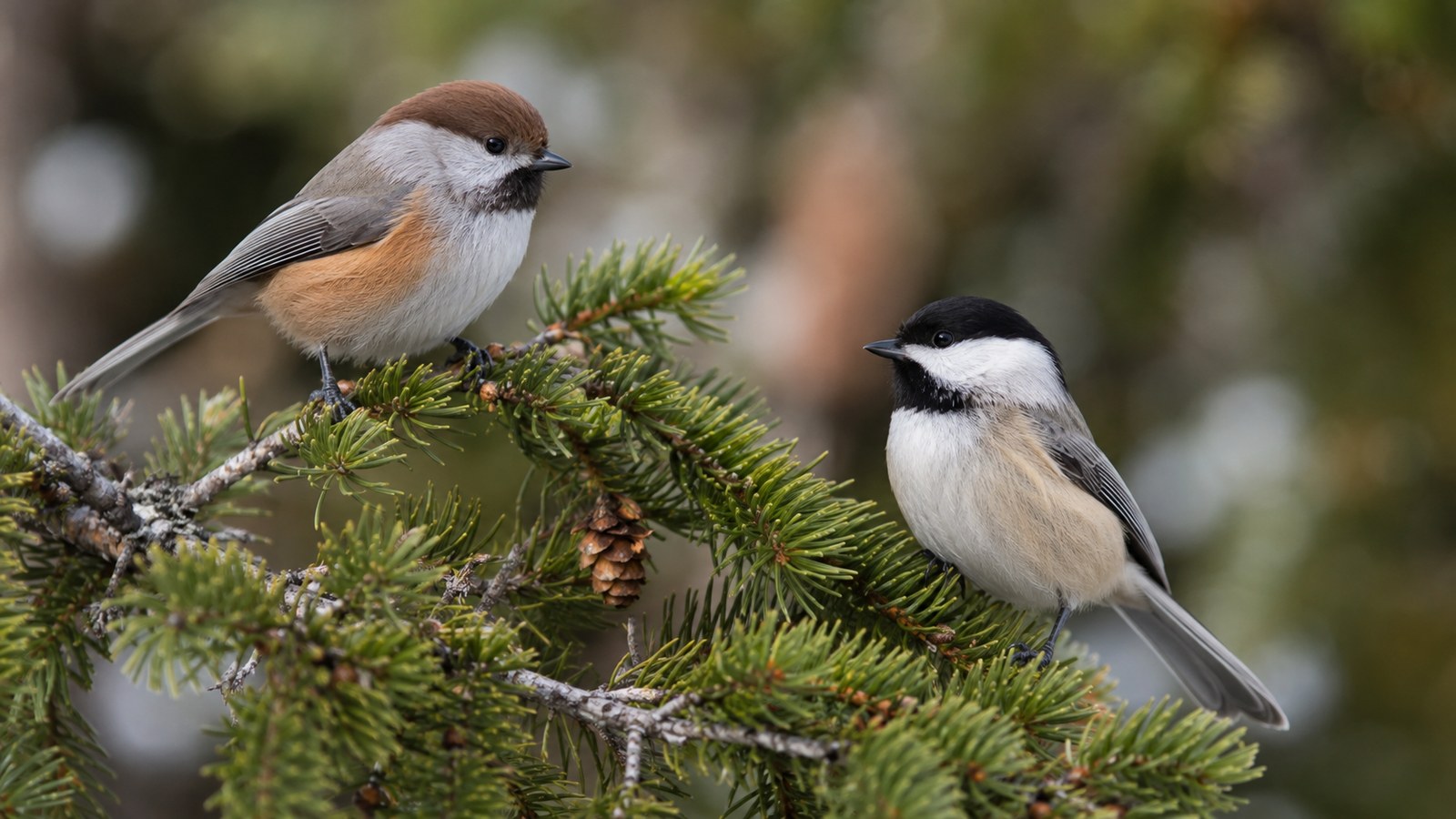
Why cap colour can create false confidence
Boreal Chickadee is often introduced as the brown-capped chickadee, while Black-capped Chickadee seems to explain itself. That sounds easy until a black cap turns chocolate brown in warm evening light, deep shade, reflected colour, or a photograph with unusual white balance.
A dependable identification checks the whole pattern. Boreal Chickadees have a gray collar behind the cap, less white on the face, a smaller and rougher-looking bib, warm sides, and a close connection to northern spruce and fir. Black-capped Chickadees usually look cleaner and more strongly black-and-white across the head.
Boreal and Black-capped Chickadee comparison
| Feature | Boreal Chickadee | Black-capped Chickadee |
|---|---|---|
| Cap | Warm brown | Black |
| Nape | Gray collar behind the brown cap | Black cap continues across the nape |
| Cheek | Smaller, less extensive white patch | Broad, bright white cheek |
| Bib | Small, uneven, or untidy-looking | Larger and more sharply defined |
| Sides | Deep warm buff, cinnamon, or rusty wash | Paler buff, often strongest toward the rear flanks |
| Wings | Usually plainer gray | Often more visible pale feather edging |
| Habitat | Northern spruce, fir, and boreal evergreen forest | Deciduous, mixed, shrubby, park, neighbourhood, and open woodland |
| Call | Slower, huskier, and buzzier | Clearer familiar chick-a-dee call and whistled song |
Check the nape after the cap
The gray collar behind a Boreal Chickadee’s brown cap is one of the best supporting clues. It creates a softer head pattern than the Black-capped Chickadee’s solid dark cap and nape. A side or slightly rear-facing view may show the collar especially well.
When the cap looks brown but the nape remains fully black, lighting may be changing a Black-capped Chickadee. Wait for another angle before deciding. The nape can be more dependable than the forehead when light comes from one side.
Compare the size of the white cheek patch
Black-capped Chickadees have broad, clean white cheeks framed by the black cap and bib. Boreal Chickadees have smaller white cheek patches, with more brown and gray surrounding them. The result is a less crisp black-and-white face.
Posture matters. A fluffed bird can enlarge the cheek, while a bird stretching forward can narrow it. Compare several positions and use the cheek with the nape and bib.
Look at the bib shape
A Black-capped Chickadee usually has a larger, more solid black throat bib with a fairly clean boundary against the pale breast. A Boreal Chickadee’s bib is smaller and may look ragged, broken, or less extensive. Cornell describes Boreal as lacking the full black throat of Black-capped Chickadee.
One front-facing photograph can distort bib size because feathers spread or compress. A relaxed side view gives a better sense of how far the dark throat reaches.
Warm sides help confirm Boreal Chickadee
Boreal Chickadees often show rich buff, cinnamon, or rusty colour along the sides. Black-capped Chickadees can also have buff flanks, but the colour is usually paler. On Boreal, the warm wash often contributes to an overall softer brown appearance.
Warm light can exaggerate both species. Compare the sides with the white belly and gray back, and avoid judging colour from a heavily edited photograph. Habitat and head pattern should agree.
Wing pattern helps too
Black-capped Chickadees often have visible pale edging on the wing feathers, creating a brighter folded wing. Boreal Chickadees usually look plainer gray in the wings. This difference may disappear in worn plumage, poor light, or a blurred image.
Photograph the bird from the side when possible. A front view hides the folded wing, and a strongly backlit bird may remove the pale edges from view.
Boreal habitat is a major clue
Boreal Chickadees are northern evergreen specialists. Look in spruce and fir forest, including dense stands with a mixture of young and mature trees. Cornell notes that spruce is especially important. The birds may remain quiet and partly hidden within thick cover.
Black-capped Chickadees use a much wider habitat range. They can occur in deciduous and mixed woodland, shrubby edges, parks, stream corridors, farms, and residential neighbourhoods. A brown-capped-looking bird in an open city park deserves extra caution unless other Boreal features are clear.
Range narrows the possibilities
Boreal Chickadees occur across much of northern Canada and Alaska, extending locally into parts of the northern United States. Black-capped Chickadees are widespread across Canada and the northern United States and are often much more familiar around towns and feeders.
Being inside Boreal range doesn’t make every chickadee Boreal. Both species can occur in the same broader region. The local forest type and complete head pattern remain important.
Boreal Chickadees can be quieter and harder to find
Boreal Chickadees are often less conspicuous than Black-capped Chickadees. They may stay within dense spruce, move in small groups, and call less continuously. A bird watcher may hear only a few rough notes before the flock disappears deeper into the trees.
Slow observation helps. Pause near a forest edge or opening and listen after the first movement passes. Robin and I often find that small forest birds reappear once we stop trying to follow every branch.
Listen for the slower, buzzier call
The Boreal Chickadee’s chick-a-dee call usually sounds slower, huskier, and buzzier than the Black-capped Chickadee’s clearer call. The rough quality can help when the bird remains hidden in spruce.
Distance, wind, traffic, and alarm level can change the sound. A Black-capped Chickadee may give harsh scolding notes, while a Boreal call may lose its buzz at a distance. Record several calls and compare them with the visible pattern and habitat.
The songs sound different too
Across much of its range, Black-capped Chickadee gives a clear whistled song. Boreal Chickadees don’t have the same familiar sweet whistle and are often found by calls instead. Hearing a clean Black-capped song can support that identification even when the cap colour looks warm.
Black-capped songs vary regionally, especially in parts of the West. The presence of a whistle helps, but the complete local sound pattern should be considered.
Don’t confuse Boreal with Chestnut-backed Chickadee
In parts of northwestern North America, Chestnut-backed Chickadee may enter the shortlist. It has a blackish head and rich chestnut back, while Boreal has a brown cap, gray collar, and gray-brown back. Chestnut-backed usually shows much stronger reddish-brown across the back itself.
The common backyard chickadee overview places all six main species in one table and explains how head and back pattern shorten the list.
Photography and colour balance
Automatic camera settings can warm or cool a photograph. A shaded Black-capped Chickadee photographed against autumn leaves may receive a brown cast. A Boreal Chickadee photographed on snow may look grayer and less warm than it did through binoculars.
Keep the original image when possible. Compare several frames taken as the bird changes position. Neutral objects such as snow, bark, or gray sky can help reveal whether the whole photograph has a colour cast.
A seven-clue field routine
- Record the exact location, date, and forest type.
- Decide whether the cap is truly brown or may be affected by light.
- Check for a gray collar behind the cap.
- Compare the white cheek patch and bib size.
- Look for rich buff sides and plain gray wings.
- Record several calls and listen for a slower buzzy quality.
- Leave the bird as Boreal/Black-capped Chickadee when the view and sound remain incomplete.
Continue with Pacific chickadees and sound
The Chestnut-backed vs Black-capped Chickadee guide separates a brown-backed Pacific bird from a gray-backed Black-capped. The chickadee sound guide compares Boreal raspiness with whistles, scratchy calls, gargles, habitat, and range.
Frequently asked questions
What is the easiest way to tell a Boreal Chickadee from a Black-capped Chickadee?
A Boreal Chickadee has a brown cap, gray nape collar, smaller white cheek patch, small dark bib, and warm buff sides. A Black-capped Chickadee has a black cap, broader white cheeks, and a larger sharply defined bib.
Can a Black-capped Chickadee look brown-headed?
Yes. Warm sunlight, deep shade, reflections, camera white balance, or faded photographs can make a black cap look brown. Confirm the identification with the nape, cheek, bib, sides, wings, habitat, and call.
Where should I look for a Boreal Chickadee?
Look in northern spruce and fir forest, especially dense boreal habitat with young and mature evergreens. Black-capped Chickadees use a wider range of deciduous, mixed, shrubby, park, and residential habitats.
Do Boreal and Black-capped Chickadees sound different?
Boreal Chickadees usually give a slower, huskier, buzzier chickadee call. Black-capped Chickadees generally sound clearer, but wind, distance, alarm level, and overlapping calls can make sound uncertain.