
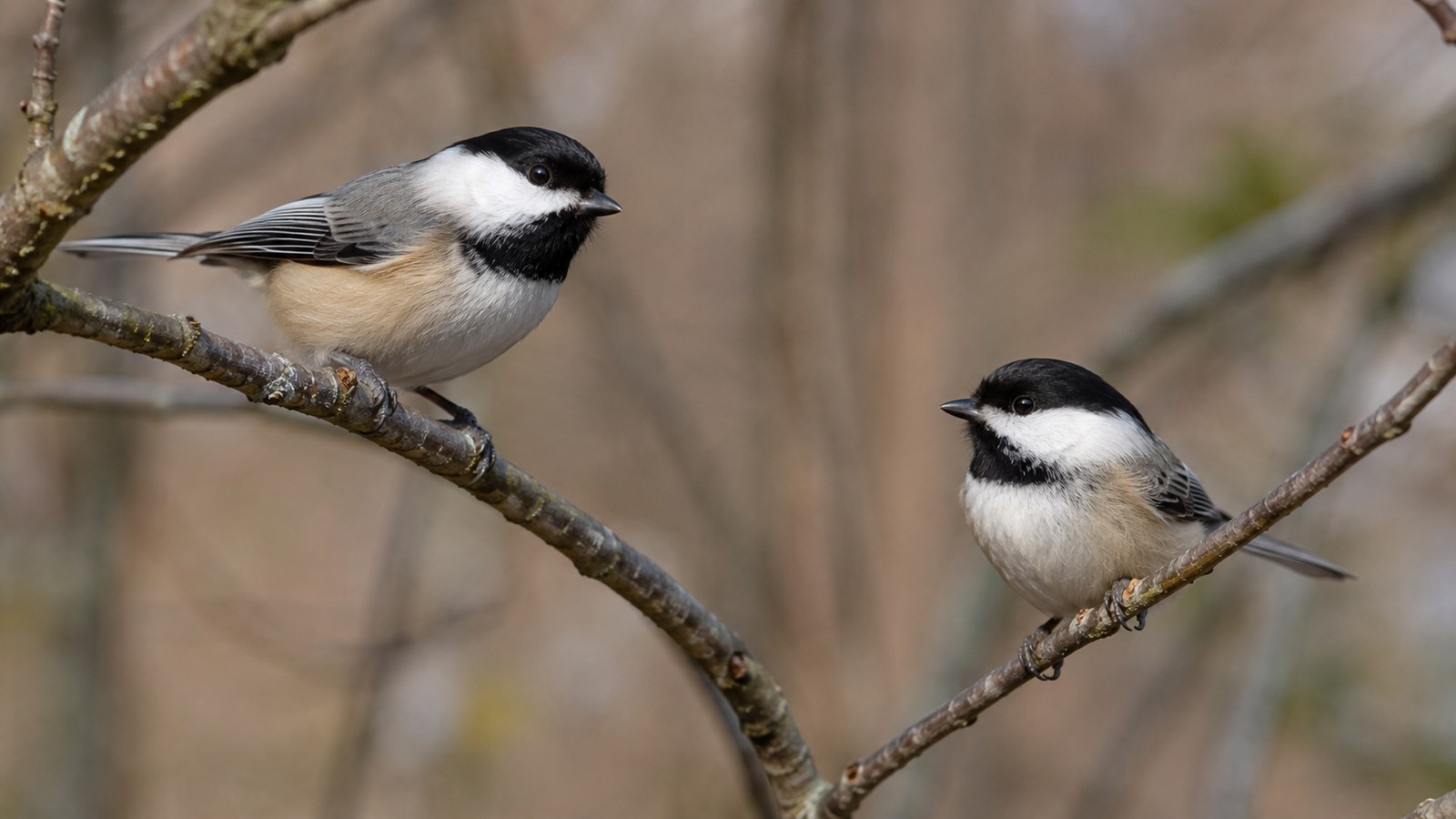
Why these chickadees are difficult to separate
Both species are tiny, round-headed birds with short bills, long tails, black caps, black throat patches, white cheeks, gray backs, and pale underparts. Both visit feeders, travel in winter flocks, hang from twigs, carry seeds away, and give versions of the familiar chick-a-dee call.
Their resemblance is so close that a single front-facing photograph may not be enough. The strongest method begins with geography and sound. Plumage details become works best when the bird is photographed clearly from the side.
Black-capped and Carolina Chickadee comparison
| Feature | Black-capped Chickadee | Carolina Chickadee |
|---|---|---|
| Main range | Much of Canada, Alaska, and the northern United States, with some western populations | Southeastern and south-central United States |
| Typical song | Often a clear two- or three-note whistle with a noticeable pitch drop | Often a longer four-note whistle, though many variations occur |
| Folded wing | Usually more visible white edging on wing feathers | Usually plainer gray with less white edging |
| Sides | Often warmer and more buff-coloured | Often grayer or less strongly buff |
| Call pace | Chick-a-dee call often sounds a little slower | Comparable call often sounds faster |
| Overall pattern | Can look slightly brighter-winged and more warmly coloured | Can look slightly neater, grayer, and plainer-winged |
| Contact area | Occurs on the cooler or northern side of the meeting zone | Occurs on the warmer or southern side of the meeting zone |
First confirm that it’s one of these two species
Both have solid black caps without the white eyebrow of a Mountain Chickadee. Neither has the brown cap of a Boreal Chickadee or the chestnut back of a Chestnut-backed Chickadee. Their throat bibs aren’t as extensive as the large black bib of a Mexican Chickadee.
A White-breasted Nuthatch can share the same feeder, but it has a longer bill, shorter tail, white throat, and no black bib. It also moves along trunks and heavy branches in a more nuthatch-like way, often travelling headfirst downward.
Range is the best first clue
Black-capped Chickadees are widespread across much of Canada and extend through the northern United States. Carolina Chickadees replace them across much of the southeastern and south-central United States. For most sightings, one species is clearly more expected than the other.
Don’t use a remembered border as the only proof. Check a current regional range source, especially near the meeting zone. Local elevation, climate, and habitat can matter, and the boundary has shifted over time.
Listen for the song
Across much of its range, a Black-capped Chickadee sings a clear two- or three-note whistle. Many people remember it as a clear first note followed by a lower phrase. Carolina Chickadees often sing a four-note whistle with an alternating high and low shape.
That difference helps, not absolute. Cornell notes that Black-capped Chickadees in the Pacific Northwest may use three or four notes on a similar pitch. Carolina Chickadees have a large song repertoire, with many patterns beyond the best-known four-note song. Record several songs rather than trusting one phrase.
Compare the chick-a-dee calls carefully
Both species produce chick-a-dee calls with variable numbers of dee notes. Carolina Chickadee calls often sound more rapid than Black-capped calls, but pace can change with excitement, alarm, flock activity, and distance.
Calls help when the same bird repeats them clearly. A brief call in wind, traffic, or a mixed flock is less dependable. Record the complete phrase and compare it with local recordings rather than counting one uncertain note.
Study the white edging in the wings
A Black-capped Chickadee usually shows broader and brighter pale edging on the wing feathers. This can create a more patterned folded wing, especially along the coverts and secondaries. A Carolina Chickadee usually has a plainer gray wing with less obvious pale edging.
Use a side view in even light. The difference can disappear when the wing is shadowed, the bird is facing the camera, feathers are worn, or the photograph is blurred. White edging is supporting evidence, not a guaranteed field mark in every view.
Compare flank colour
Black-capped Chickadees often show warmer buff or tan along the sides. Carolina Chickadees are often grayer and less warmly coloured. The difference may be most visible near the rear flanks rather than across the centre of the belly.
Warm evening light can make either bird look buff. Overexposed photographs can remove the colour completely. Check the flank clue only after considering location and sound.
Don’t depend on small size differences
Black-capped Chickadees may average a little larger, but both species are tiny and active. A bird close to the camera looks larger than one deeper in the branches, and fluffed feathers can change the body outline.
Size starts to matter only with a direct comparison, a known feeder dimension, or a carefully scaled photograph. For an ordinary sighting, range, song, and wing pattern are stronger clues.
Head pattern usually doesn’t solve the pair
Both birds have black caps, white cheeks, and black bibs. Small differences in bib shape, cheek shape, or cap size can change with posture and feather position. A bird turning its head may look much more strongly marked than it did a second earlier.
Use the head mainly to confirm that the bird belongs to this difficult pair. Then move to the wing, side colour, sound, and map.
Habitat can support the answer
Black-capped Chickadees use deciduous and mixed forests, woodland edges, shrubby areas, parks, and residential neighbourhoods across their broad northern range. Carolina Chickadees use deciduous and mixed woods, swamps, riparian areas, parks, and neighbourhoods across the Southeast.
The habitats overlap broadly in character, so habitat alone rarely identifies the species. It matters more when combined with latitude, elevation, and local range knowledge.
The contact and hybrid zone
Black-capped and Carolina Chickadees meet along a narrow band across part of the eastern and central United States. They can hybridize there. Some birds may show intermediate wing pattern, mixed songs, or combinations that don’t match a clean field-guide example.
The contact zone isn’t a fixed line painted across the landscape. Research has documented changes in the distribution boundary. A bird near the zone should be judged with extra caution, and even experienced observers may leave it unidentified to species.
When a song doesn’t match the plumage
A chickadee may learn or use song features associated with nearby birds. Hybrids and birds living near the contact zone can complicate the expected match between appearance and sound. One mixed clue shouldn’t be ignored just because another clue seems stronger.
Record exactly what conflicts. For example: “plainer Carolina-like wing, but two-note Black-capped-like whistle.” A clear note of the conflict can be more valuable than choosing whichever feature was easiest to see.
Photograph the bird from the side
The most reliable photograph shows the folded wing, back, flank, and head in the same frame. A front view may show the cap and bib but hide the main plumage difference. A rear view can show wing edging but lose the throat and side colour.
Use a fast shutter speed when possible because chickadees rarely remain still. A short burst may capture one clean side profile without repeatedly disturbing or following the bird.
Record the feeder and flock context
Note whether the bird arrived alone, with another chickadee, or in a mixed flock. Record the food, nearby tree type, time, date, and whether the bird carried seeds away. These details may not separate the two species directly, but they preserve the setting and help evaluate future sightings.
At home, the same chickadee may return to a favourite staging branch. Studying that branch with binoculars or a camera can produce a better wing view than trying to follow the bird through the whole yard.
A seven-clue comparison routine
- Mark the exact location on a map.
- Check whether the site is north, south, or within the contact region.
- Record several complete songs or calls.
- Photograph the folded wing from the side.
- Compare the amount of white edging.
- Note whether the sides look warm buff or mostly gray.
- Leave the identification combined when the evidence remains mixed.
When to use “Black-capped/Carolina Chickadee”
Use the combined identification when the bird is in or near the contact zone and you lack a clear song, side photograph, or dependable wing view. It’s also appropriate when sound points toward one species but plumage points toward the other.
This label records the observation honestly while preserving the possibility of a hybrid or an uncertain pure bird. It’s better than forcing a species name from one weak clue.
Continue with Pacific chickadees and sound
The Chestnut-backed vs Black-capped Chickadee guide compares back colour, sides, wings, Pacific habitat, regional variation, and voice. The chickadee sound guide places Black-capped and Carolina whistles beside Mountain, Chestnut-backed, Boreal, and Mexican voices.
Frequently asked questions
Which chickadee has whiter wings?
Black-capped Chickadees usually show more white edging in the folded wing. Carolina Chickadees generally look plainer gray, though light, wear, and photograph quality can hide the difference.
Is every four-note chickadee song from a Carolina Chickadee?
No. Carolina Chickadees often sing four-note whistles, but they’ve many other songs, and Black-capped Chickadees show regional song variation. Check range and plumage as well.
Can these chickadees be separated by their black bib?
Bib shape can vary with posture and feather position. It’s not as dependable as range, song, and white wing edging.
Which species is common in Canada?
Black-capped Chickadee is widespread across much of Canada. Carolina Chickadee is mainly a southeastern and south-central United States species.
Sources and further reading
- Cornell Lab: Black-capped Chickadee identification
- Cornell Lab: Black-capped Chickadee similar species
- Cornell Lab: Black-capped Chickadee sounds
- Cornell Lab: Carolina Chickadee identification
- Cornell Lab: Carolina Chickadee similar species
- Cornell Lab: Carolina Chickadee sounds
- Cornell Bird Academy: chickadee hybrid-zone research