
A fast backyard color guide
| Color impression | Likely birds to compare | Best next clue |
|---|---|---|
| Red | Northern Cardinal, House Finch, Purple Finch | Bill, red placement, crest, and streaking |
| Yellow | American Goldfinch, Yellow Warbler, Common Yellowthroat | Bill, wing pattern, habitat, and season |
| Black | American Crow, Common Raven, male Red-winged Blackbird | Size, bill, tail, shoulder marks, and voice |
| Brown | Sparrows, wrens, Brown Thrasher, female finches | Face pattern, breast marks, bill, and behavior |
| Blue | Blue Jay, bluebird where locally present | Crest, body shape, breast color, and habitat |
| Gray | Gray Catbird, Northern Mockingbird, Tufted Titmouse | Head, wing flashes, crest, and sound |
| Orange chest | American Robin, Eastern Towhee, some thrushes | Back color, breast boundary, ground behavior |
| Red head | Several woodpeckers, male House Finch | Where the red sits and how the bird feeds |
Red birds in the backyard
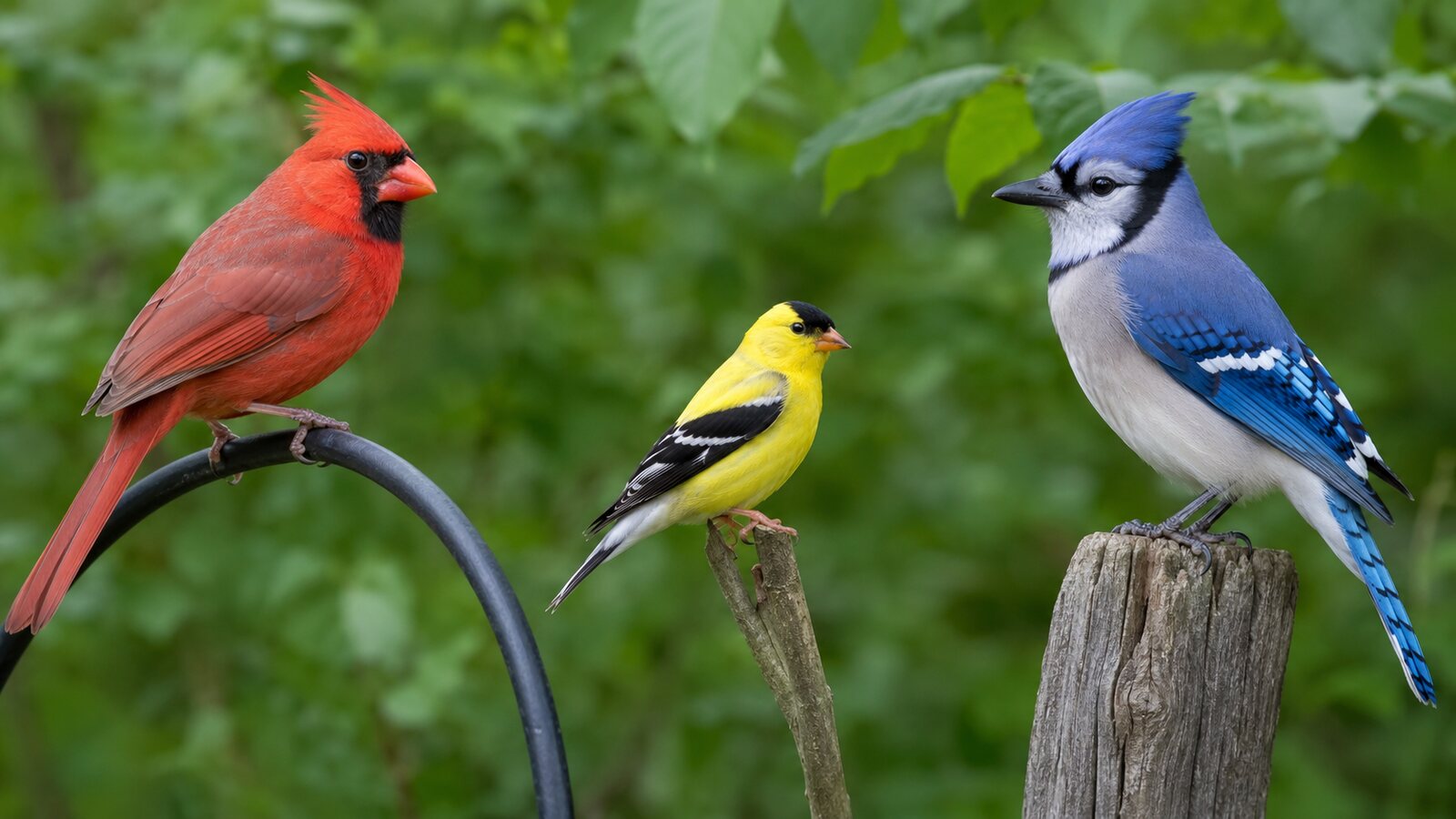
A male Northern Cardinal is bright red with a crest, thick orange-red bill, and black face. Females are warm tan with red in the wings, tail, and crest. Cardinals often feed on or near the ground and visit sunflower feeders.
Male House Finches usually show red on the forehead, throat, and upper chest, with brown streaks continuing down the belly. A male Purple Finch tends to look more broadly washed in raspberry red. Compare them in the House Finch vs Purple Finch guide.
A bird with only a red crown or shoulder is not a red bird overall. Check woodpeckers and the male Red-winged Blackbird before deciding.
Small yellow birds
An American Goldfinch is one of the most likely yellow birds at a seed feeder. Breeding males are bright yellow with black wings and a black forehead. Females and winter birds are much duller, but the notched tail, dark wings, and rolling flight still help.
A Yellow Warbler has a thin insect-eating bill and usually searches shrubs and leafy trees rather than seed feeders. Male Common Yellowthroats have a black mask and stay low in dense vegetation. Habitat and bill shape can separate these birds even when all look yellow.
In open fields, an Eastern Meadowlark or Western Meadowlark may show a bright yellow breast with a black V, but neither is a small backyard feeder bird.
Black birds and large dark birds
An American Crow is large, all black, and usually gives clear caws. A Common Raven is larger and heavier-billed, with shaggy throat feathers, a wedge-shaped tail, and deep croaks. The crow vs raven comparison shows the practical differences.
Male Red-winged Blackbirds are smaller and often reveal red-and-yellow shoulder patches. Females are brown and heavily streaked, which surprises many observers. Shiny or iridescent black birds may change color as the viewing angle moves.
Small brown birds and sparrow-like birds
“Small brown bird” describes many species. Start with bill shape and breast pattern. A thick cone-shaped bill suggests a sparrow or finch. A thin bill suggests a wren, warbler, or another insect eater.
A Song Sparrow has a streaked breast and rounded tail and often stays near low brush. A female House Finch is also streaked but usually has a shorter tail and may visit feeders in a flock. The Song Sparrow vs House Sparrow page prevents another common mix-up.
A House Wren is tiny, plain-faced, and quick, with a thin bill and barred tail. A Carolina Wren is larger and warmer brown with a bold white eyebrow. See the House Wren vs Carolina Wren comparison.
A Brown Thrasher is much larger, with a long tail, yellow eye, curved bill, and heavily streaked pale underparts.
Blue and gray backyard birds
A Blue Jay is a large crested bird with blue, white, and black patterning. It visits peanuts and sunflower seeds, carries food away, and makes a wide range of loud calls.
A Gray Catbird is dark slate gray with a black cap and rusty feathers beneath the tail. A Northern Mockingbird is paler and flashes white wing patches. A Tufted Titmouse is much smaller, crested, and often comes to feeders.
Compare the two gray mimics with the rusty Brown Thrasher in the thrasher, catbird, and mockingbird guide.
Birds with orange or rusty chests
An American Robin is robin-sized, with a gray-brown back, orange breast, yellow bill, and upright ground-feeding posture. It often runs and pauses on lawns.
An Eastern Towhee has rusty sides rather than a fully orange chest. Males are black above with a white belly; females are brown above. They scratch noisily in leaves near dense cover.
Warm evening light can make a pale or brown breast look orange. Check the boundary of the color, the back, the bill, and the bird's movement.
Birds with red heads
Ask exactly where the red appears. A Red-headed Woodpecker has an entirely red adult head, a bold black-and-white body, and large white wing patches. A Red-bellied Woodpecker has red on the crown and nape but a pale face and barred back. The Red-bellied vs Red-headed Woodpecker comparison shows the full pattern.
Male Downy and Hairy Woodpeckers have only a small red patch at the back of the head. Use the Downy vs Hairy Woodpecker comparison for bill size, body size, tail marks, and voice.
Use backyard behavior as a field mark
A nuthatch that creeps headfirst down bark, a goldfinch clinging to a nyjer feeder, a robin running on the lawn, and a woodpecker bracing against a trunk reveal more than color alone.
- At sunflower feeders: cardinals, finches, chickadees, nuthatches, and jays are good candidates.
- At suet: woodpeckers, nuthatches, chickadees, and some wrens may visit.
- On lawns: robins, starlings, grackles, doves, and some sparrows forage on the ground.
- Hanging upside down: chickadees, nuthatches, and goldfinches often feed acrobatically.
- Scratching leaves: towhees, sparrows, thrashers, and wrens may reveal themselves by movement and sound.
Use the feeder as context, not proof. The guides to birds that eat sunflower seeds and birds that eat suet can narrow the possibilities.
Light, age, sex, and season change color
Shade can turn bright plumage dull, while low sunlight makes brown feathers glow red. Iridescent feathers may appear colorful from one angle and black from another. Wet feathers, worn feathers, molt, and camera settings also affect appearance.
Males and females may differ, and juveniles often look duller or more streaked than adults. The guide to why the same bird can look different explains these changes.
A six-clue identification note
Before the bird leaves, record six things: rough size, main colors, bill shape, tail shape, where it fed, and any sound. Add location, date, and a photograph or recording if possible. Then use the complete bird identification routine to compare the clues.
Frequently asked questions
Is color enough to identify a bird?
Usually not. Size, shape, bill, behavior, sound, region, and season should support the color clue.
What is a small red bird at a feeder?
Male House and Purple Finches are common possibilities. Check red placement, streaking, head shape, bill, region, and season.
What is a small yellow bird at a feeder?
An American Goldfinch is a strong possibility. Confirm it with the dark wings, finch bill, notched tail, and feeder behavior.
Why does the color look different in a photo?
Light, exposure, feather angle, age, wear, and wet plumage can all change the apparent color.